What this calculator does
The Parkland formula estimates how much crystalloid an adult burn patient needs in the first 24 hours after a thermal injury. This tool turns weight and burn size into a total volume plus the two hourly infusion rates a nurse or clinician actually charts. It is an educational aid, not a prescription: resuscitation is always titrated to the patient.
How to use it
Enter body weight in kilograms and the burn size as a percentage of total body surface area (TBSA), counting only partial-thickness (second degree) and full-thickness burns — superficial erythema is excluded. Then choose the resuscitation factor: \(4\,\text{mL}\) for classic Parkland, or \(2\)-\(3\,\text{mL}\) if your protocol follows the modified Brooke or the American Burn Association permissive approach.
The formula explained
With \(F\) = factor in mL per kg per %TBSA, \(W\) = weight in kg and TBSA in percent:
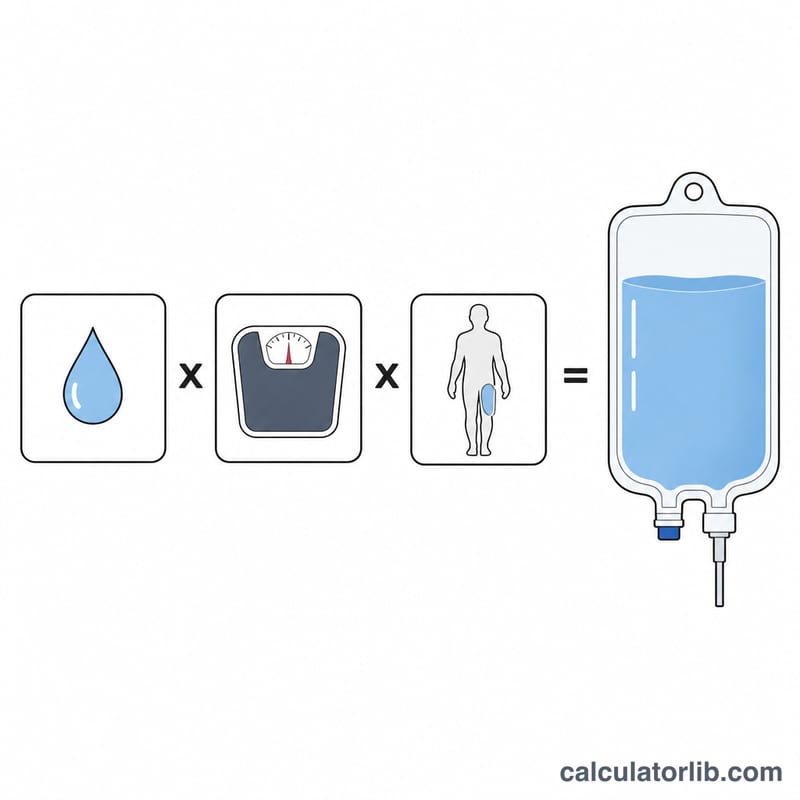
$$V_{24} = F \times W \times \text{TBSA}\,(\%)$$Half of \(V_{24}\) is infused over the first 8 hours measured from the time of the burn, not from arrival, so any delay compresses the remaining volume into fewer hours. The second half runs over the following 16 hours:
$$R_{0-8} = \frac{V_{24} }{16}, \qquad R_{8-24} = \frac{V_{24} }{32}$$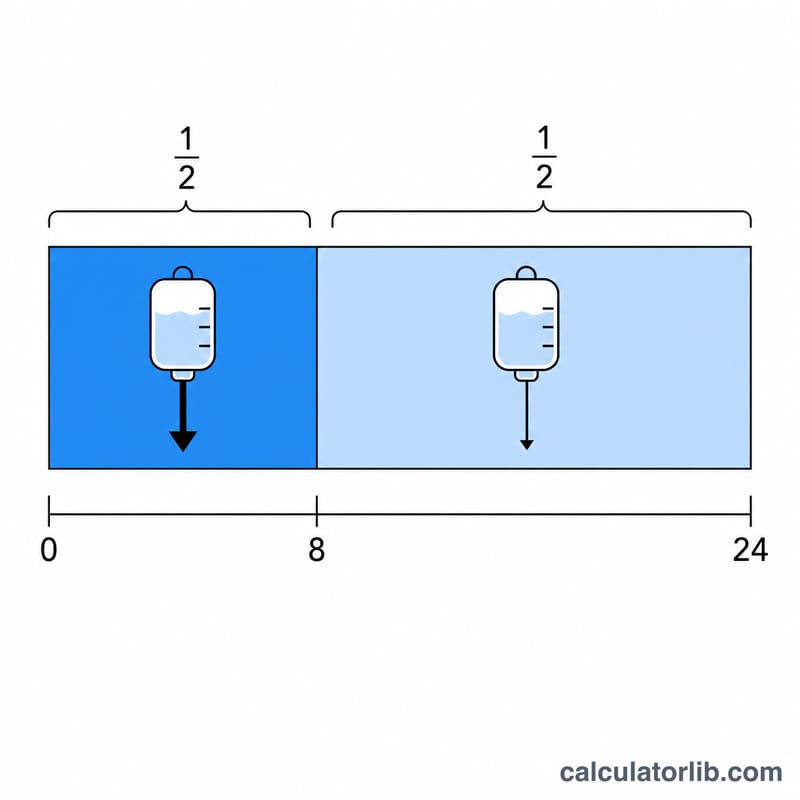
Worked example
A 70 kg adult with 30% TBSA burns, classic Parkland factor:
$$V_{24} = 4 \times 70 \times 30 = 8400\,\text{mL}$$First 8 hours: \(8400 / 2 = 4200\,\text{mL}\), i.e. \(4200 / 8 = 525\,\text{mL/h}\). Next 16 hours: \(4200\,\text{mL}\) at \(4200 / 16 = 262.5\,\text{mL/h}\).
TBSA Reference Table: Rule of Nines and Resuscitation Thresholds
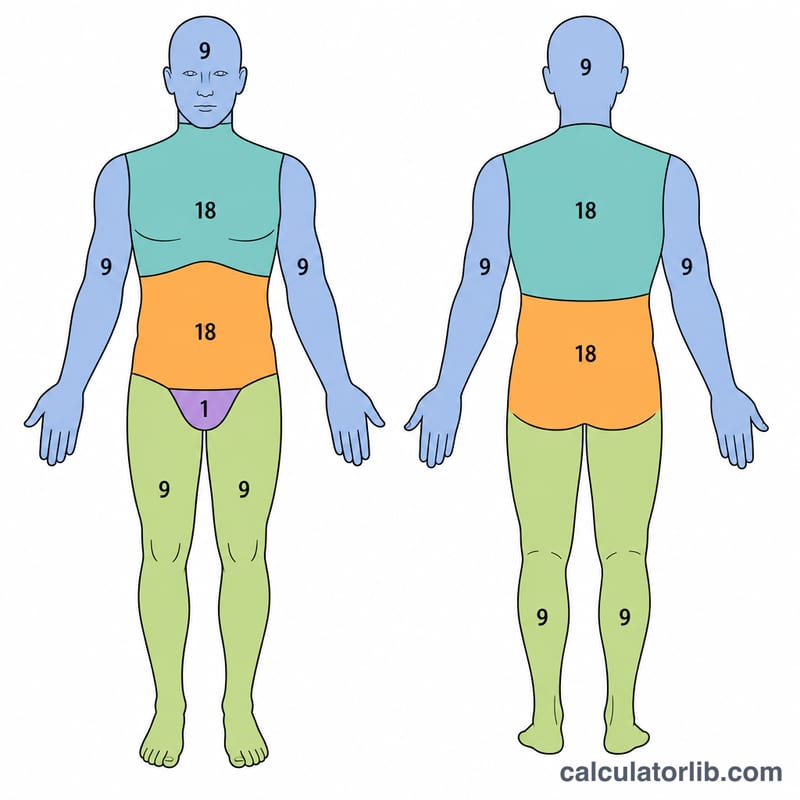
Total body surface area (TBSA) is the single input that most affects the calculated volume, and it is the one most often estimated wrongly — usually too high. Count only partial-thickness and full-thickness burn.
Rule of Nines
| Body region | Adult (%) | Infant / young child (%) |
|---|---|---|
| Head and neck | 9 | 18 |
| Each arm (whole) | 9 | 9 |
| Anterior trunk (chest + abdomen) | 18 | 18 |
| Posterior trunk (back + buttocks) | 18 | 18 |
| Each leg (whole) | 18 | 13.5 |
| Perineum / genitalia | 1 | 1 |
| Total | 100 | 100 |
The paediatric variant exists because an infant's head is proportionally much larger and the legs smaller. A widely taught approximation for ages between infancy and adulthood: from the infant figures, subtract about 1% from the head and add about 0.5% to each leg for every year of age, converging on the adult values around age 10.
Palmar surface rule
For scattered or patchy burns, the patient's own palm including the fingers is approximately 1% of their TBSA (the palm alone, excluding fingers, is often quoted as about 0.5%). Use the patient's hand, not the clinician's. This method is well suited to small or irregular burns but accumulates error over large areas.
Most accurate method
The Lund–Browder chart is regarded as the most accurate manual method because it assigns age-specific percentages to each body segment, correcting the head-to-leg proportion continuously rather than in two fixed variants. It is the preferred tool for children and for any burn where the calculated volume will drive resuscitation. Digital three-dimensional mapping tools are increasingly used in burn centres for the same reason.
Thresholds for formal fluid resuscitation
The following reflect American Burn Association (ABA) guidance, widely adopted in North America; other countries use similar but not identical cut-offs, so check your national or local burn protocol.
| Population | TBSA at which formal IV resuscitation is generally indicated |
|---|---|
| Adults | ≥ 20% TBSA (partial- and full-thickness) |
| Children | ≥ 10–15% TBSA |
| Below these thresholds | Oral rehydration plus maintenance fluid is often sufficient in an otherwise well patient |
Burn-centre referral criteria (ABA)
- Partial-thickness burns greater than 10% TBSA.
- Any full-thickness burn.
- Burns involving the face, hands, feet, genitalia, perineum, or major joints.
- Electrical burns, including lightning injury.
- Chemical burns.
- Inhalation injury.
- Burns in patients with pre-existing illness that could complicate management or prolong recovery.
- Burns with concomitant trauma, where the burn poses the greater immediate risk (otherwise stabilise trauma first).
- Burned children in hospitals without qualified paediatric capability.
- Patients needing special social, emotional or long-term rehabilitative support, including suspected abuse or neglect.
FAQ
Which fluid is used? Warmed lactated Ringer solution is the standard isotonic crystalloid; colloid is usually withheld in the first hours.
Is the result a fixed target? No. It is a starting point. Titrate to urine output — about 0.5 mL/kg/h in adults and 1 mL/kg/h in children — and reduce the rate if output exceeds target to avoid over-resuscitation (fluid creep, compartment syndrome, pulmonary oedema).
Does it work for children? Children need the same Parkland volume plus separate maintenance fluid containing dextrose, and lower TBSA thresholds trigger resuscitation. Use a paediatric burn protocol.