What Is the Aviation Fuel Burn Calculator?
The Aviation Fuel Burn Calculator helps pilots and flight planners estimate how much fuel an aircraft will consume over a given leg. It combines the engine fuel flow rate with the cruise altitude and flight duration to produce a realistic fuel burn figure, then reports the distance covered and the resulting fuel efficiency. These numbers support fuel loading, reserve planning, and range checks before departure.
The Formula Explained
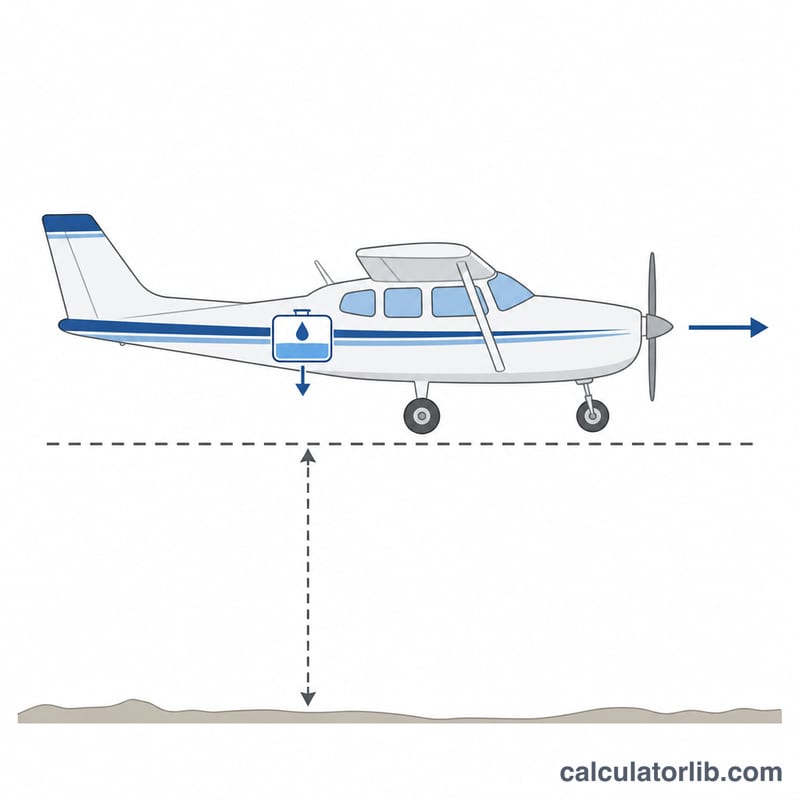
Piston and turbine engines are typically leaned at altitude, so the effective fuel flow drops slightly as you climb. This calculator models that with a simple 1% reduction per 1000 feet applied to the base fuel flow:
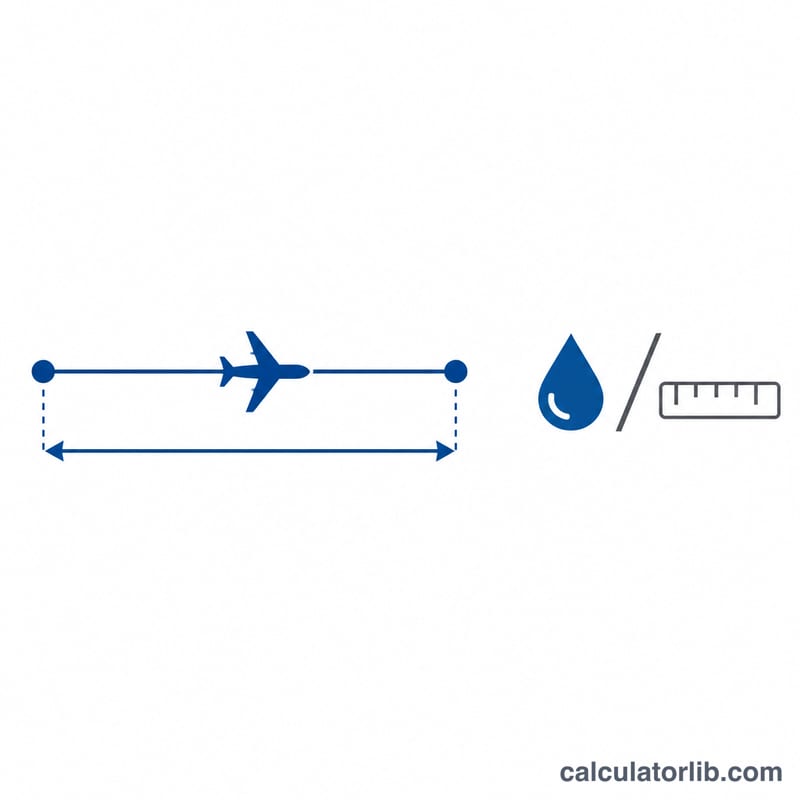
$$\text{Fuel Burn} = \text{FF} \times \left(1 - 0.01 \times \frac{\text{Alt}}{1000}\right) \times t$$Here \(\text{FF}\) = base fuel flow in gallons per hour, \(\text{Alt}\) = cruise altitude in feet, and \(t\) = flight duration in hours. Distance is \(V \times t\) using true airspeed \(V\), and fuel efficiency is distance divided by fuel burn.
How to Use It
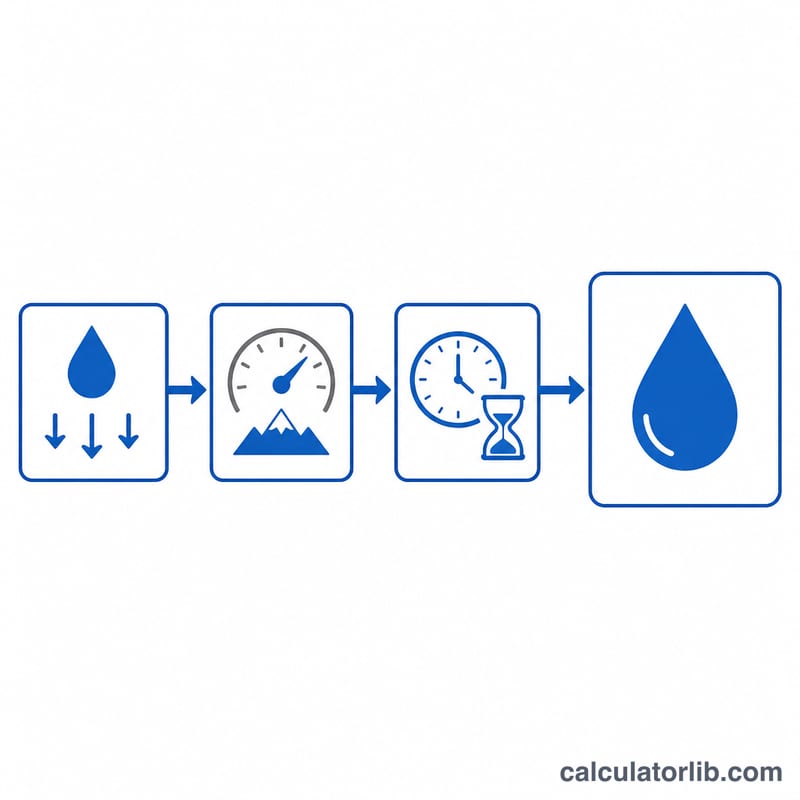
Enter your planned fuel flow, true airspeed, cruise altitude, and expected flight time. The calculator returns total gallons burned, the altitude-adjusted fuel flow, the distance flown, and the nautical miles per gallon. Always add regulatory and personal reserves on top of the computed burn.
Worked Example
Suppose an aircraft burns \(12\) gph, cruises at \(120\) knots and \(8000\) feet, for \(3\) hours. The altitude factor is \(1 - 0.01 \times 8 = 0.92\), so:
$$\text{Fuel Burn} = 12 \times 0.92 \times 3 = 33.12\,\text{gal}$$Distance is \(120 \times 3 = 360\) nm, giving efficiency of \(\frac{360}{33.12} \approx 10.87\) nm/gal.
Typical Fuel Flow and Cruise Speeds by Aircraft Type
The table below gives typical, approximate cruise fuel flow and true airspeed (TAS) for common general-aviation aircraft. Use them as starting values for the calculator's Fuel Flow and Speed fields. Real numbers change with power setting (for example 65% vs 75% power), mixture leaning, altitude, weight, temperature and the aircraft's model year and engine. The Pilot's Operating Handbook (POH) or Aircraft Flight Manual (AFM) for your specific aircraft is the authority. Always plan with its cruise performance tables, not with these figures.
| Aircraft | Engine / fuel | Typical cruise fuel flow (US gal/hr) | Typical cruise TAS (knots) |
|---|---|---|---|
| Cessna 152 | Single piston, avgas | ~6 | ~95 |
| Cessna 172 | Single piston, avgas | ~8–9 | ~120 |
| Piper PA-28 Archer | Single piston, avgas | ~9–10 | ~125 |
| Cirrus SR22 | Single piston, avgas | ~15–17 | ~175 |
| Beechcraft Bonanza A36 | Single piston, avgas | ~14–15 | ~165 |
| Piper Seneca | Twin piston, avgas | ~20–24 (both engines combined) | ~180 |
| Beechcraft King Air C90 | Twin turboprop, Jet A | ~70–80 (both engines combined) | ~230 |
For twins, enter the total fuel flow of all engines combined. Turbine aircraft manuals often give fuel flow in pounds per hour instead of gallons. Convert it to gallons with the fuel density shown in the next section before you enter it.
Fuel Volume, Weight and Unit Conversions
The calculator works in US gallons, knots and feet. Weight-and-balance calculations need pounds or kilograms, and many countries fuel aircraft in litres, so these conversions are often needed. Fuel density changes with temperature: fuel gets lighter when warm and heavier when cold. The densities below are standard planning approximations. They are not exact values.
| Quantity | Conversion |
|---|---|
| Avgas 100LL weight | ≈ 6.0 lb per US gal |
| Jet A weight | ≈ 6.7 lb per US gal |
| US gallon to litres | 1 US gal = 3.785 L |
| Avgas mass per litre | 1 L ≈ 0.72 kg |
| Jet A mass per litre | 1 L ≈ 0.80 kg |
| Nautical mile | 1 nm = 1.151 statute mi = 1.852 km |
| Fuel efficiency | 1 nm/gal ≈ 0.489 km/L |
The efficiency factor comes from \(1.852 \text{ km} \div 3.785 \text{ L} \approx 0.489\). For example, 10 nm/gal ≈ 4.89 km/L.
Example: converting a 33.12-gallon trip burn
Take a fuel flow of 12 gph, a cruise altitude of 8,000 ft and a duration of 3 hours. The calculator's altitude adjustment gives:
$$12 \times \left(1 - 0.01 \times \frac{8000}{1000}\right) \times 3 = 12 \times 0.92 \times 3 = 33.12 \text{ gal}$$Trip burn: 33.12 US gallons. Converted:
- Weight as avgas: \(33.12 \times 6.0 = 198.72\) lb (about 90 kg)
- Weight if it were Jet A: \(33.12 \times 6.7 \approx 221.9\) lb
- Volume: \(33.12 \times 3.785 \approx 125.36\) L
- Avgas mass from litres: \(125.36 \times 0.72 \approx 90.3\) kg
The kilogram figures from the two routes differ slightly (about 90.1 vs 90.3 kg). That is normal, because 6.0 lb/gal and 0.72 kg/L are both rounded approximations.
Planning Fuel Reserves on Top of Trip Burn
The calculator estimates trip fuel, meaning the fuel burned in cruise for the duration you enter. Legal and safe fuel planning adds reserves and allowances on top of that number. The rules below come from specific regulators. Check the rules that apply where you fly and to your type of operation.
United States (FAA, 14 CFR Part 91, airplanes)
- VFR by day: enough fuel to reach the first point of intended landing, plus 30 minutes at normal cruising speed (14 CFR 91.151).
- VFR at night: the same, plus 45 minutes at normal cruising speed (14 CFR 91.151).
- IFR: enough fuel to fly to the destination, then to the alternate airport (when one is required), plus 45 minutes at normal cruising speed (14 CFR 91.167).
ICAO / EASA practice
ICAO-based rules, including EASA in Europe, split fuel into separate parts. One is contingency fuel, often 5% of trip fuel and subject to a stated minimum. Another is final reserve fuel, typically 30 minutes for turbine aircraft (flown at holding speed at 1,500 ft above the aerodrome) and usually 45 minutes for piston aircraft. Exact requirements depend on the operation type and the operator's approved fuel policy.
Turning reserve minutes into gallons
Multiply the reserve time in hours by the altitude-adjusted fuel flow. In the example of 12 gph at 8,000 ft, the adjusted flow is \(12 \times 0.92 = 11.04\) gph.
$$\text{Reserve} = \frac{45}{60} \text{ hr} \times 11.04 \text{ gph} = 0.75 \times 11.04 \approx 8.3 \text{ gal}$$- 30-minute day VFR reserve: \(0.5 \times 11.04 = 5.52\) gal
- 5% contingency on a 33.12 gal trip: \(0.05 \times 33.12 \approx 1.66\) gal
Practical recommendations
- Add taxi and run-up fuel, often around 1 gallon for a light single. Use the figure your POH gives.
- Add a climb allowance. Fuel flow during climb is well above cruise flow. Many POHs publish "fuel, time and distance to climb" tables for this.
- Plan for headwinds and diversions. Work out duration from groundspeed, not TAS, and allow for weather, ATC re-routes or holding.
- Set a personal minimum above the legal minimum. Many pilots choose to land with at least one hour of fuel remaining.
- Check actual fuel on board visually or with a dipstick before flight, and compare actual burn with your plan during the flight.
This is general planning information, not operational or regulatory advice. Your aircraft's POH/AFM, your operator's fuel policy and your national aviation authority's regulations are the authority.
FAQ
Why does altitude reduce fuel flow? Leaner mixtures and thinner air at altitude generally lower fuel consumption, modeled here as a 1% drop per 1000 feet.
Does this include reserves? No. The result is trip burn only, add required reserves separately.
What units are used? Fuel flow in gph, speed in knots, altitude in feet, time in hours, and burn in gallons.