What this calculator does
The Upholstery Fabric Yardage Calculator estimates how many yards of fabric you need to reupholster a chair, sofa, ottoman, or bench. Upholstery fabric is sold by the linear yard at a fixed bolt width, so knowing your total surface area is only half the answer — you also have to account for the width of the goods and for waste from cutting, seam allowances, and pattern matching.
The formula explained
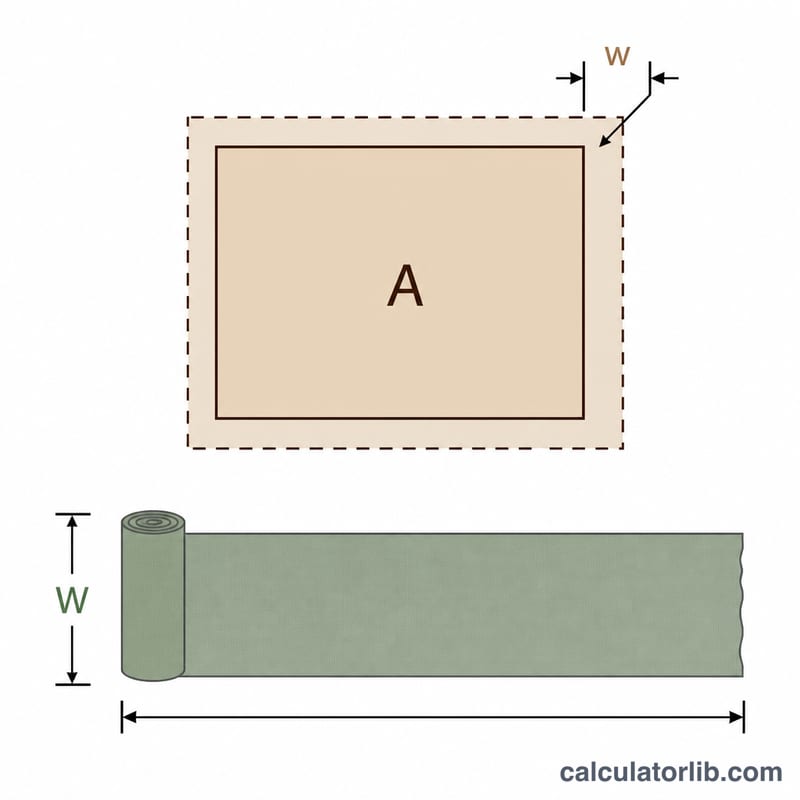
The estimate combines three numbers: the area you must cover \(A\) (in square feet), the fabric width \(W\) (in inches), and a waste fraction \(w\).
$$\text{Yardage} = \frac{A \times (1 + w)}{W \times 36 / 144}$$
Here \(A\) = surface area in square feet, \(W\) = usable fabric width in inches, and \(w\) = waste allowance as a decimal (15% = 0.15). The denominator \(\frac{ {W \times 36}}{144}\) is the square footage of one linear yard, because a yard is \(36\) inches long and \(144\) square inches make one square foot.
How to use it
Measure every panel of the piece — seat, inside and outside back, arms, cushions, and skirt — and add the areas together for \(A\). Enter your bolt width (commonly \(54\) inches for home decor fabric, sometimes \(45\)). Pick a waste allowance: \(15\%\) for plain fabric, and more for large repeats or stripes that must line up.
Worked example
Suppose you must cover \(40\) sq ft with \(54\)-inch fabric and a \(15\%\) waste allowance. One yard covers \(\frac{ {54 \times 36}}{144} = 13.5\) sq ft, and the padded area is \(40 \times 1.15 = 46\) sq ft:
$$\text{Yardage} = \frac{46}{13.5} = 3.41\,\text{yd}$$
Round up to \(3.5\) or \(4\) yards when buying.
Standard Fabric Widths & Yardage per Yard
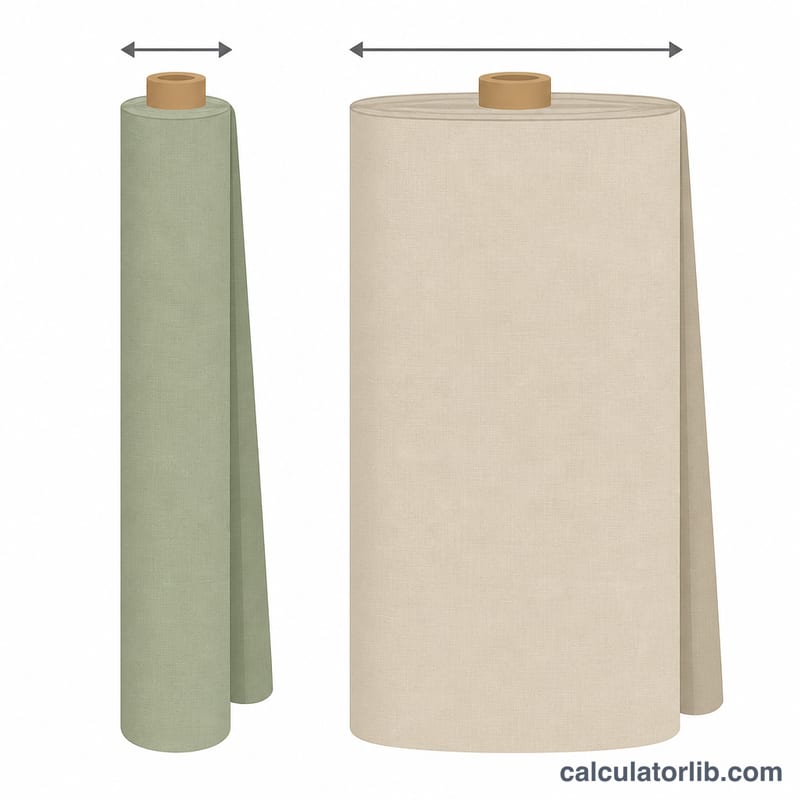
Upholstery and decorator fabrics are sold by the linear yard (36 inches long) off bolts of a fixed width. The area one linear yard covers depends only on that width. These figures use US customary units (inches and yards), and 54 in is the most common decorator/upholstery bolt width in the United States. Converting the bolt width \(W\) (in inches) to the square footage of one linear yard uses:
$$\text{Sq ft per yard} = \frac{W \times 36}{144}$$
| Bolt width | Typical use | Calculation | Sq ft per linear yard |
|---|---|---|---|
| 45 in | Quilting / lighter-weight goods | \((45 \times 36)/144\) | 11.25 sq ft |
| 54 in | Standard upholstery / decorator | \((54 \times 36)/144\) | 13.5 sq ft |
| 60 in | Wide decorator / drapery | \((60 \times 36)/144\) | 15 sq ft |
A wider bolt covers more area per yard, so for the same surface area you buy fewer yards from a 60 in bolt than a 45 in bolt. Always check the actual usable width on the bolt end, since selvages and printed borders can slightly reduce the width you can cut into.
Yardage Across Common Projects
These estimates assume a 54 in bolt (13.5 sq ft per linear yard) and apply the estimator formula:
$$\text{Yardage} = \frac{A \times (1 + w)}{W \times 36 / 144}$$
where \(A\) is surface area in square feet, \(W\) is fabric width in inches, and \(w\) is the waste allowance as a fraction. The surface areas below are rough, typical values — a real piece should be measured. "Raw yards" is the exact result; "purchase yards" is rounded up to the next half yard, which is how most fabric stores cut.
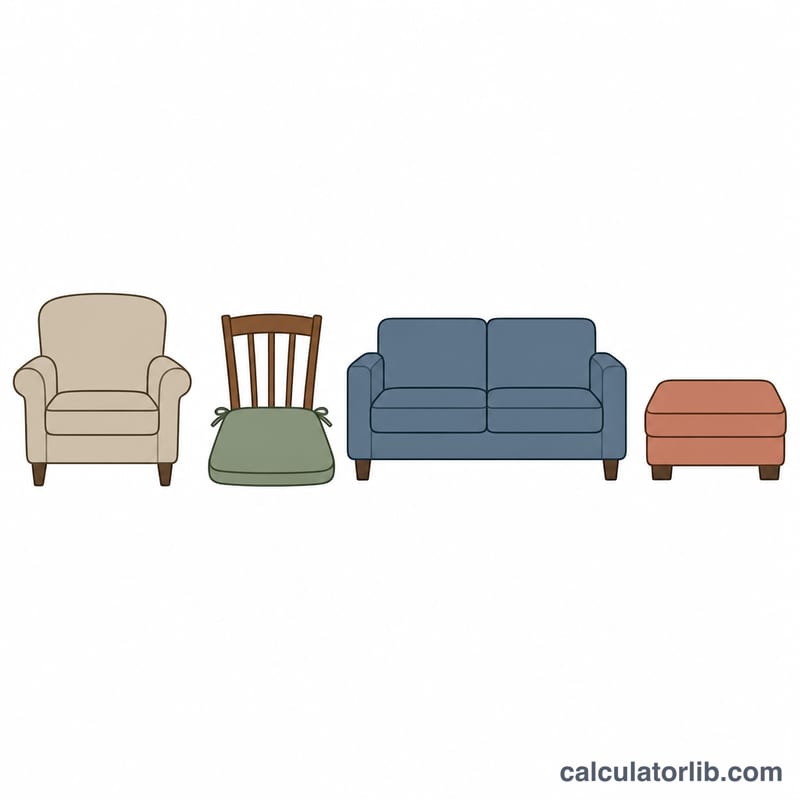
| Piece | Approx. area | Raw yards @ 15% | Purchase @ 15% | Raw yards @ 25% | Purchase @ 25% |
|---|---|---|---|---|---|
| Dining chair seat | ~10 sq ft | 0.85 yd | 1 yd | 0.93 yd | 1 yd |
| Armchair | ~25 sq ft | 2.13 yd | 2.5 yd | 2.31 yd | 2.5 yd |
| Sofa | ~50 sq ft | 4.26 yd | 4.5 yd | 4.63 yd | 5 yd |
Notice how the higher 25% waste allowance rarely changes the small pieces (they still round to 1 yard) but adds a meaningful amount on a sofa — moving it from 4.5 to 5 yards. For fabrics that need pattern matching, plan closer to the 25% column.
How Much Fabric to Buy
The calculator gives an estimate; the amount you actually order should build in some margin for cutting, matching, and mistakes. Practical guidance:
- Round up, never down. Fabric is cut in whole or half-yard increments, so round the raw result up to at least the next half yard. Rounding down leaves you short mid-project, and a second cut may not match.
- Add extra for pattern repeats and stripes. A plain fabric can use the lower (around 15%) waste allowance, but large-repeat prints, plaids, and stripes must be aligned across seams and cushions. Add 25% or more, and for very large repeats add roughly one extra repeat length per major panel.
- Buy it all from a single bolt / dye lot. Fabric dyed in different lots can vary subtly in color. Order the full quantity at once and ask for a single continuous cut from one bolt so adjacent panels match.
- Order a little surplus for repairs. An extra half-yard to a yard set aside lets you patch a worn cushion or arm years later without hunting for a discontinued fabric.
- Confirm the usable width. Base your estimate on the width you can actually cut into, not the nominal bolt label, and re-run the numbers if you switch to a wider or narrower fabric.
This is general estimating guidance, not a guarantee for a specific job. When possible, confirm quantities with your upholsterer or a fabric professional before ordering, especially for expensive or hard-to-reorder textiles.
FAQ
Why add a waste allowance? Cutting around curves, matching patterns, and seam allowances all consume extra fabric; \(15\%\) is a safe minimum for plain goods.
What fabric width should I use? Check the bolt label. Decorator fabric is usually \(54\) inches wide, while some fabrics run \(45\) inches.
Should I round up? Yes. Fabric is sold in whole or half yards, and buying from a single bolt avoids dye-lot mismatches, so always round the estimate up.