
What Is the Pleated Skirt Fabric Calculator?
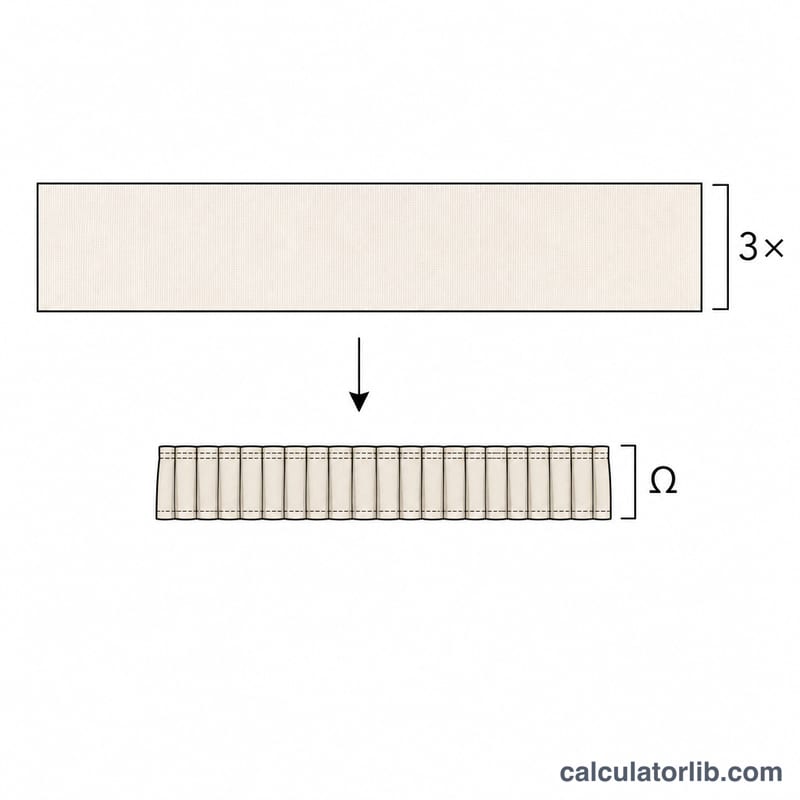
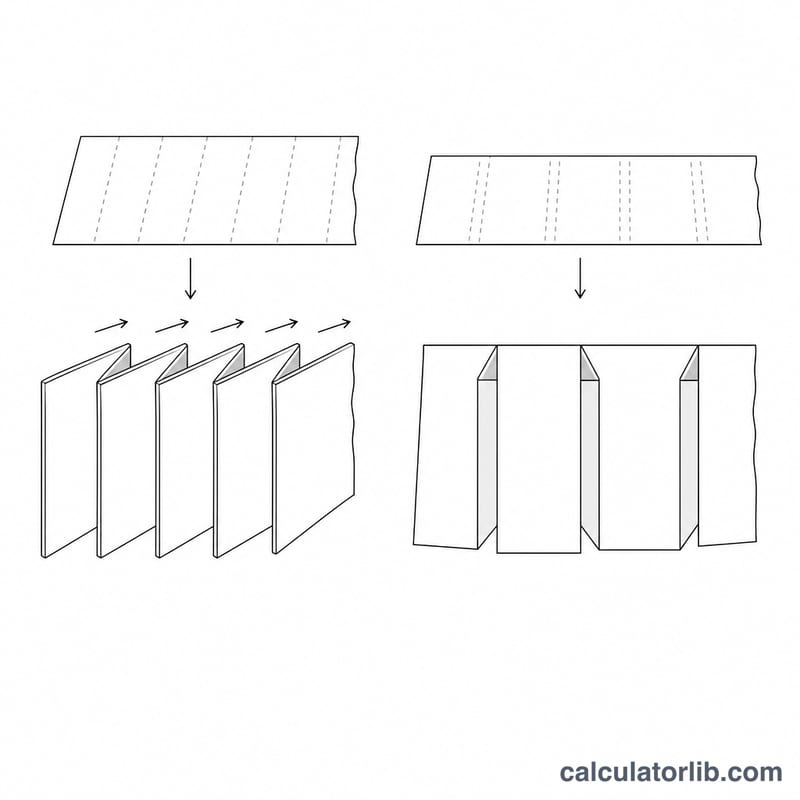
This tool helps sewists and dressmakers quickly estimate how much fabric width they need for a pleated skirt and how many pleats will fit around the waist. Pleats add fullness, so the fabric must be several times longer than the actual waist measurement. This calculator uses a standard 3x fullness multiplier for both knife and box pleats and adds your seam allowance.
How to Use It
Enter your finished waist circumference in centimeters, the width you want each pleat to show on the finished garment, choose knife or box pleat, and set a seam allowance for the closure and side seams. The calculator returns the total fabric length you need to cut and the approximate number of pleats.
The Formula Explained
Fabric length is calculated as $$\text{Waist} \times 3 + \text{Seam Allowance}$$. The factor of 3 reflects the classic rule that pleated fabric needs three times the finished waist to create crisp, full folds. The pleat count is simply $$\text{Waist} \div \text{Pleat Width}$$, telling you how many evenly spaced pleats will go around the body.
Worked Example
Suppose your waist is 70 cm, you want 3 cm pleats, with a 3 cm seam allowance. Fabric length = $$70 \times 3 + 3 = \textbf{213}\text{ cm}.$$ Pleat count = $$70 \div 3 \approx \textbf{23.33}\text{ pleats}.$$ You would round to a whole number of pleats and adjust pleat width slightly to fit evenly.
FAQ
Why 3x fullness? A 3x multiplier produces full, well-defined pleats. Lighter, less dramatic pleating can use 2x, while extra-full looks use more.
Is this for fabric length or width? It gives the horizontal span of fabric (along the grain at the waistline). Add your desired skirt length plus hem separately for the vertical dimension.
Should I round the pleat count? Yes. Round to a whole number and slightly tweak the pleat width so the pleats divide evenly around the waist.