What this calculator does
The Meat Smoking Time Calculator estimates how long to keep meat in the smoker based on its weight, the cut, and your smoker temperature. Low-and-slow barbecue depends heavily on time, and this tool turns three simple inputs into an estimated total cook time in both hours and minutes so you can plan when to light the fire.
The formula
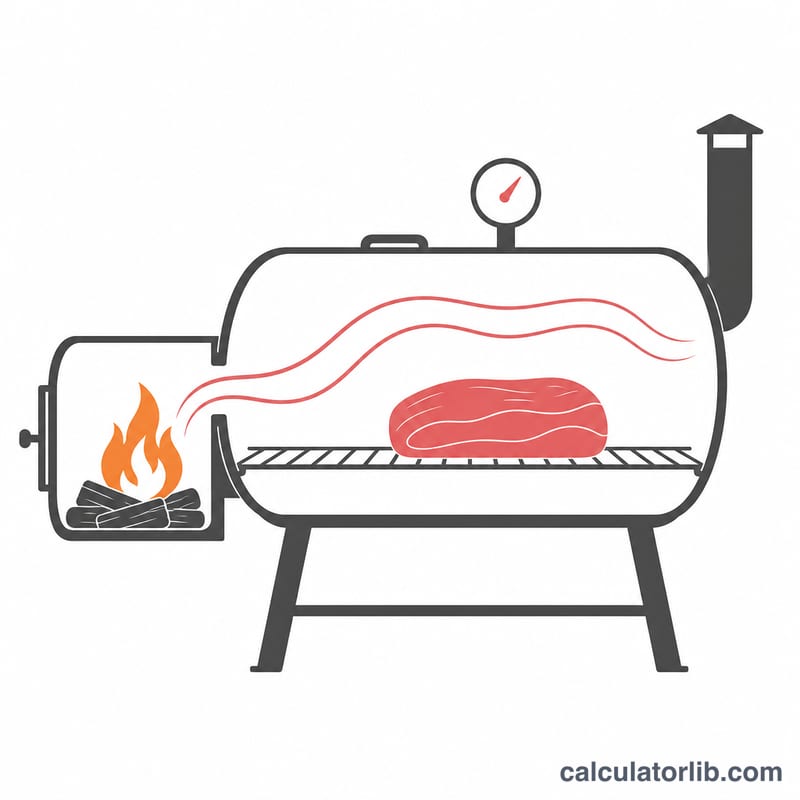
Each cut has a rough per-pound cooking rate at a reference temperature of 225 °F. The estimate scales that rate by weight and adjusts inversely for temperature:
$$\text{Minutes} = W \times R \times \frac{225}{T}$$
where \(W\) = weight in pounds, \(R\) = per-pound rate in min/lb for the chosen cut (for example \(R = 90\) for brisket), and \(T\) = smoker temperature in \(\text{deg F}\). A hotter smoker means a smaller \(\tfrac{225}{T}\) factor and a shorter cook. Hours are simply \(\text{Hours} = \tfrac{\text{Minutes}}{60}\).
How to use it
Enter the trimmed weight of the meat, pick the cut from the list, and set your target smoker temperature. The default of 225 °F is the classic barbecue sweet spot. Read the estimated hours, then build in a buffer and a resting period.
Worked example
A 12 lb brisket (\(R = 90\)) smoked at 225 °F:
$$\text{Minutes} = 12 \times 90 \times \frac{225}{225} = 1080$$
That is \(\tfrac{1080}{60} = 18\) hours of smoking time.
Per-Pound Smoking Rates by Cut
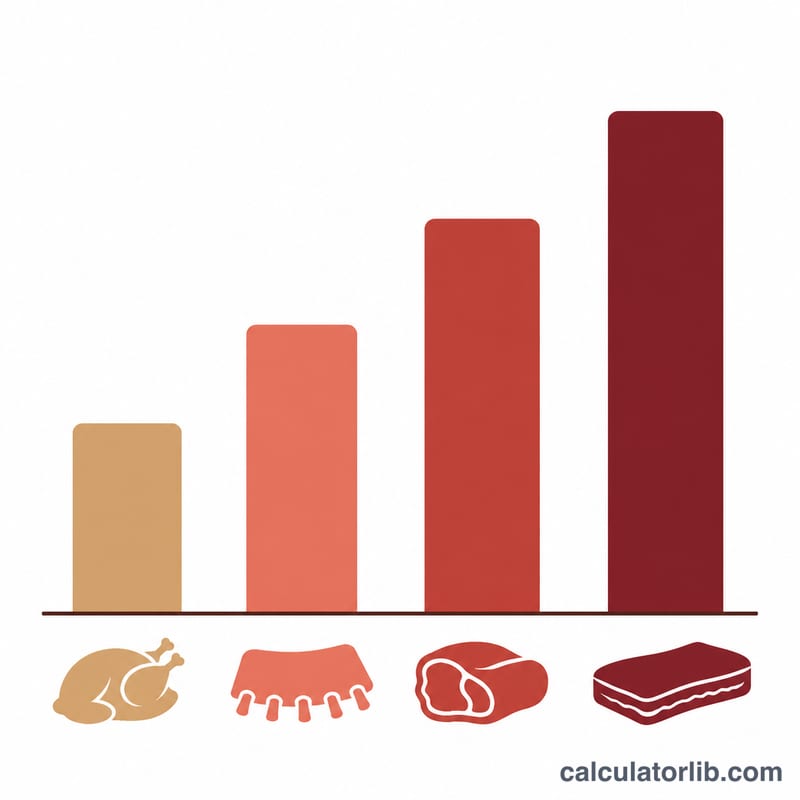
The calculator gives each cut a base rate \(R\) in minutes per pound at a smoker temperature of 225 °F. It multiplies that rate by the meat's weight, then scales the result for your actual smoker temperature. The rates below are planning averages from common low-and-slow barbecue practice. They are not exact cook times. The hours-per-pound column shows the range many pitmasters report at 225 °F, for comparison.
| Cut | Calculator rate R (min/lb at 225 °F) | Equivalent (h/lb at 225 °F) | Typical range reported (h/lb at 225 °F) |
|---|---|---|---|
| Beef brisket (whole packer) | 90 | 1.5 | about 1–1.5 |
| Pork shoulder / Boston butt | 80 | ≈1.33 | about 1.25–2 |
| Beef ribs (plate or chuck) | 75 | 1.25 | about 1–1.5 (often 8–10 h total) |
| Pork spare ribs / St. Louis cut | 45 | 0.75 | usually timed by rack: about 5–6 h |
| Pork baby back ribs | 40 | ≈0.67 | usually timed by rack: about 4–5 h |
| Poultry (whole chicken, turkey pieces) | 20 | ≈0.33 | about 0.33–0.5; often smoked hotter (275–325 °F) for crisper skin |
Ribs are timed by rack, not strictly by weight. A rack of ribs is thin, so it cooks through in about the same time whether it weighs 2.5 lb or 3.5 lb. Most cooks follow a per-rack schedule, such as the popular 3-2-1 method for spare ribs. They then check for doneness by the bend test or probe tenderness. Treat the calculator's rib result as a rough guide only. The same caution applies to poultry: check that the meat has reached a safe internal temperature rather than relying on the clock.
Target Internal Temperatures by Cut
This page uses two different kinds of temperature, and they do different jobs:
- Safety minimums are the lowest internal temperatures at which the meat is considered safe to eat. They come from the U.S. Department of Agriculture's Food Safety and Inspection Service (USDA FSIS) and FoodSafety.gov. These are U.S. guidelines. Other countries' food-safety agencies may publish slightly different figures, so check your local guidance.
- Texture (doneness) targets are much higher temperatures used in barbecue. At these temperatures collagen in tough cuts breaks down into gelatin, which makes the meat tender enough to slice or pull. They come from common barbecue practice, not from any food-safety standard.
| Meat | USDA safety minimum (U.S.) | Typical barbecue texture target |
|---|---|---|
| Poultry (whole chicken, turkey, ground poultry) | 165 °F | 165 °F in the breast; many cooks take thighs to about 175–185 °F for better texture |
| Beef brisket (whole cut) | 145 °F + 3-minute rest | about 195–205 °F, probe-tender |
| Pork shoulder / butt (whole cut) | 145 °F + 3-minute rest | about 195–205 °F for pulled pork |
| Pork or beef ribs | 145 °F + 3-minute rest | about 190–203 °F, or when they pass the bend test |
| Ground beef or pork (e.g., smoked meatloaf, sausage) | 160 °F | 160 °F (same as the safety minimum) |
The stall
Large cuts such as brisket and pork shoulder often stop rising in temperature for several hours. This usually happens somewhere around 150–170 °F internal. The cause is evaporative cooling: moisture evaporating from the meat's surface cools it about as fast as the smoker heats it. Wrapping the meat in butcher paper or foil (the "Texas crutch") cuts down evaporation and shortens the stall. The stall is normal and does not mean anything is wrong.
Sources: USDA FSIS, "Safe Minimum Internal Temperature Chart"; FoodSafety.gov, "Safe Minimum Internal Temperatures." The texture targets and stall range are general barbecue practice. Always check internal temperature with a calibrated instant-read or probe thermometer.
Smoking Time at Different Smoker Temperatures
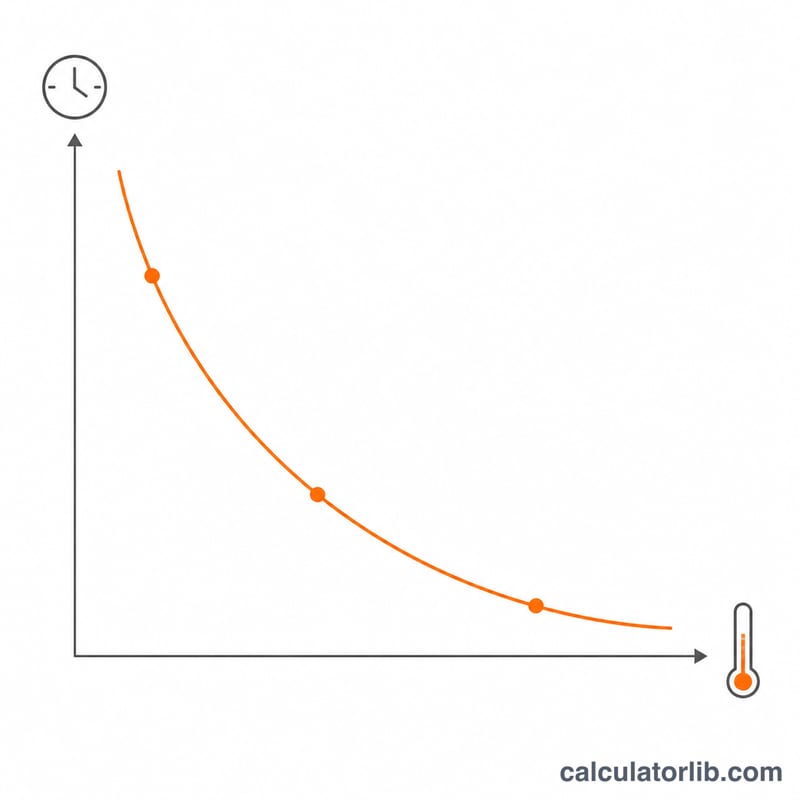
The calculator assumes that cooking time scales in inverse proportion to smoker temperature, using 225 °F as the reference point:
$$\text{Minutes} = W \times R \times \frac{225}{T}$$Here \(W\) is the weight in pounds, \(R\) is the cut's rate in min/lb, and \(T\) is the smoker temperature in °F. For example, a 12 lb brisket (\(R = 90\)) at 250 °F gives \(12 \times 90 \times \frac{225}{250} = 1080 \times 0.9 = 972\) minutes, which is 16.2 hours.
| Smoker temp | 12 lb brisket (R = 90): minutes | 12 lb brisket: hours | 8 lb pork shoulder (R = 80): minutes | 8 lb pork shoulder: hours |
|---|---|---|---|---|
| 225 °F | \(1080 \times 1 = 1080\) | 18.0 (18 h 0 min) | \(640 \times 1 = 640\) | 10.67 (10 h 40 min) |
| 250 °F | \(1080 \times 0.9 = 972\) | 16.2 (16 h 12 min) | \(640 \times 0.9 = 576\) | 9.6 (9 h 36 min) |
| 275 °F | \(1080 \times \frac{225}{275} \approx 883.6\) | 14.73 (≈14 h 44 min) | \(640 \times \frac{225}{275} \approx 523.6\) | 8.73 (≈8 h 44 min) |
| 300 °F | \(1080 \times 0.75 = 810\) | 13.5 (13 h 30 min) | \(640 \times 0.75 = 480\) | 8.0 (8 h 0 min) |
Real cooks vary. The inverse-temperature scaling is a simplification. Actual times can run several hours shorter or longer than the table. Common reasons are the length of the stall, whether and when you wrap (wrapping in foil usually shortens a cook more than butcher paper does), the meat's thickness and fat content, smoker temperature swings, weather, and how often the lid is opened. Use these numbers to plan a start time, and add a buffer of an hour or two. Large cuts can rest wrapped in a cooler for a long time if they finish early. Take the meat off based on internal temperature and tenderness, not on the clock.
FAQ
Is this exact? No. It is a planning estimate. Cook to internal temperature, not the clock, and expect stalls where the meat pauses for hours.
Does higher heat always finish faster? Generally yes in this model, but very high temperatures change texture and can dry out lean cuts, so stay within safe ranges for your recipe.
Should I add buffer time? Yes. Add 30–60 minutes of slack plus a rest of at least 30 minutes for large cuts like brisket and pork shoulder.