What This Calculator Does
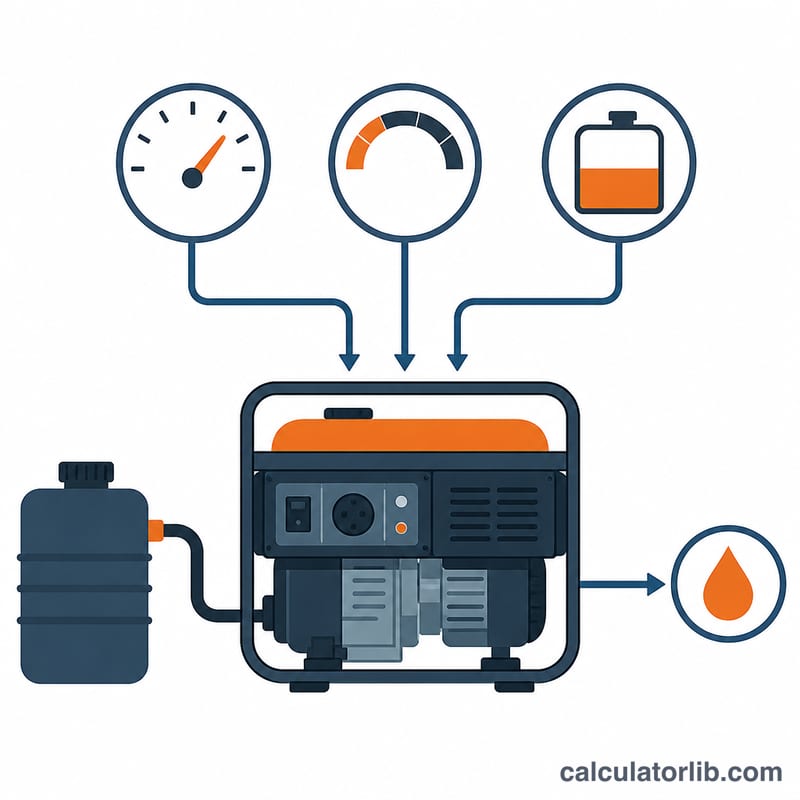
The Generator Fuel Consumption Calculator estimates how quickly a generator burns fuel and how long it can run on a single tank. It works from four practical inputs: the unit rated power, the load level as a percentage, the fuel use per kilowatt-hour, and the tank capacity. This helps you plan refueling intervals for backup power, job sites, RVs, and events.
The result is shown in liters per hour and in US gallons per hour (1 US gallon = 3.785411784 liters). To get the fuel-use figure for your own generator, take the fuel rate from its spec sheet at a given load and divide it by the kilowatts at that load; for example, 1.4 gallons per hour at 7.5 kW is \(1.4 \times 3.785 \div 7.5 \approx 0.71\) L/kWh.
The Formula Explained
The generator only produces its full rating when fully loaded. The actual power output is the rated power \(P\) scaled by the load fraction \(L/100\). Multiplying by the specific fuel use \(S\) (liters per kWh) gives the hourly burn rate:
$$\dot{F} = P \times \frac{L}{100} \times S$$Here \(P\) = rated power in kW, \(L\) = load level in percent, and \(S\) = fuel consumed per kWh. Dividing the tank capacity \(T\) by that rate gives the runtime:
$$t = \frac{T}{\dot{F}}$$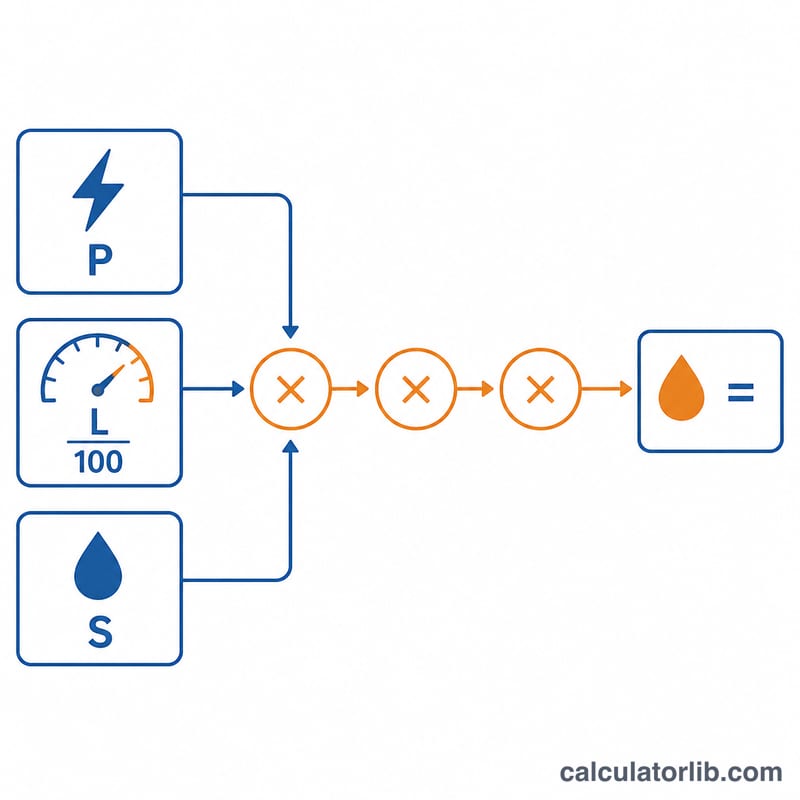
Worked Example
Take a \(20\,\text{kW}\) diesel generator running at \(75\%\) load, using \(0.3\) liters per kWh, with a \(50\)-liter tank. First find the power output:
$$P_{out} = 20 \times \frac{75}{100} = 15\,\text{kW}$$Then the fuel rate and runtime:
$$\dot{F} = 15 \times 0.3 = 4.5\,\text{L/h}, \quad t = \frac{50}{4.5} \approx 11.1\,\text{h}$$Typical Specific Fuel Consumption by Generator Type
The specific fuel consumption (SFC) is how much fuel the engine burns per unit of electrical energy produced, expressed in litres per kilowatt-hour (L/kWh). It is the value you enter in the sfc field. Efficiency varies with engine design, load level (units are usually most efficient near 75–100% of rated load) and age, so treat the figures below as broad engineering approximations, not exact constants.
| Fuel / engine type | Typical SFC | Notes |
|---|---|---|
| Diesel | ≈ 0.25–0.35 L/kWh | Most efficient at higher loads; lower end reached near rated output. |
| Gasoline (petrol) | ≈ 0.35–0.50 L/kWh | Generally higher consumption per kWh than diesel. |
| Propane / LPG (liquid) | ≈ 0.40–0.55 L/kWh | Value in liquid litres; not directly comparable to gaseous volume. |
| Natural gas | ≈ 0.28–0.34 m³/kWh | Measured as gas volume (m³ or cubic feet), not litres of liquid. |
These ranges are unit- and standard-neutral approximations; different regions and manufacturers report SFC under different load and reference conditions. Gaseous fuels (natural gas, and propane measured as vapour) are metered by gas volume rather than liquid litres, so their figures are not interchangeable with the liquid L/kWh value this calculator expects — convert to a consistent unit before entering it. Whenever possible, use the specific fuel consumption printed on your generator's manufacturer data sheet instead of a generic value, because it reflects your exact engine, alternator and rated conditions.
Fuel Rate and Runtime Across Load Levels
This comparison fixes the rated power at 20 kW, the specific fuel consumption at 0.3 L/kWh, and the tank at 50 L, then varies the load. The burn rate uses the tool's formula, and runtime is the tank divided by that burn rate:
$$\text{Fuel Rate} = P \times \frac{L}{100} \times S \qquad \text{Runtime} = \frac{\text{Tank}}{\text{Fuel Rate}}$$
Worked example at 100% load: \(\text{Fuel Rate} = 20 \times \frac{100}{100} \times 0.3 = 6.0\ \text{L/h}\), so \(\text{Runtime} = \frac{50}{6.0} \approx 8.33\ \text{h}\).
| Load | Power output (kW) | Burn rate (L/h) | Runtime (h) |
|---|---|---|---|
| 25% | 5 | 1.5 | 33.33 |
| 50% | 10 | 3.0 | 16.67 |
| 75% | 15 | 4.5 | 11.11 |
| 100% | 20 | 6.0 | 8.33 |
Note how burn rate scales linearly with load while runtime falls sharply: doubling the load from 50% to 100% doubles fuel use and roughly halves how long the tank lasts. Real burn rates can differ from these idealised figures because a fixed SFC ignores the efficiency changes that occur at very light loads.
Practical Refueling Recommendations
The runtime this calculator returns is a planning estimate, not a guarantee. Build in margin so the generator never coasts to an unplanned stop:
- Keep a fuel reserve. Plan to refuel while roughly 10–20% of the tank remains rather than running it dry — a dry tank can draw air or sediment into the fuel system, and diesel engines in particular may need bleeding/priming before they restart.
- Schedule refuel intervals shorter than the estimate. If the tool predicts 8.3 hours at full load, set a refuel or top-up point noticeably earlier (for example every 6–7 hours) so a busy period or a distraction doesn't cause an outage.
- Pad for real-world conditions. Cold weather, high altitude, a heavily aged engine, and sustained near-100% loading all tend to raise actual consumption above a nominal SFC figure. Add a safety margin to your estimated burn rate rather than assuming best-case efficiency.
- Re-check against reality. Compare actual fuel used over a known run against the prediction, and adjust the sfc value you enter so future estimates track your specific unit.
- Match load to efficiency. Generators are usually most efficient around 75% of rated load; running heavily under-loaded for long periods can waste fuel and, on diesels, cause wet-stacking.
Always follow your generator manufacturer's guidance and your local fuel-storage and ventilation regulations, which vary by country and jurisdiction.
Related tools
- Generator wattage: the generator size your appliances need, including starting watts.
- Generator fuel cost: what running the generator costs at your fuel price.
- Watts to amps: the current a load draws on a 120 V or 240 V circuit.
- Battery runtime: how long a battery bank runs the same load instead.
Frequently Asked Questions
What is a typical fuel use per kWh? Diesel gensets often fall near \(0.25\) to \(0.35\) liters per kWh; check your manufacturer data sheet for accuracy.
Why does load level matter so much? Fuel use scales with actual power delivered, so a lightly loaded generator burns far less fuel and runs longer per tank.
Is this exact? It is an estimate. Real burn rates vary with efficiency, temperature, fuel quality, and generator age, so treat results as planning figures.