
What This Calculator Does
The Boat Fuel Consumption Calculator estimates how much fuel your boat will burn on a trip, how long the trip takes, what it will cost, and how efficiently you are running. You enter the distance, your average cruising speed, and your engine fuel burn rate in gallons per hour (GPH), and the tool does the rest. It works for outboards, inboards, and diesel cruisers — just use the burn rate that matches your engine and throttle setting.
How To Use It
Enter the trip distance and choose the unit (nautical miles, statute miles, or kilometers). Distances are converted to nautical miles so they pair correctly with speed in knots. Enter your average speed in knots and your fuel burn rate in gallons per hour. Add a fuel price to see the estimated cost.
The Formula
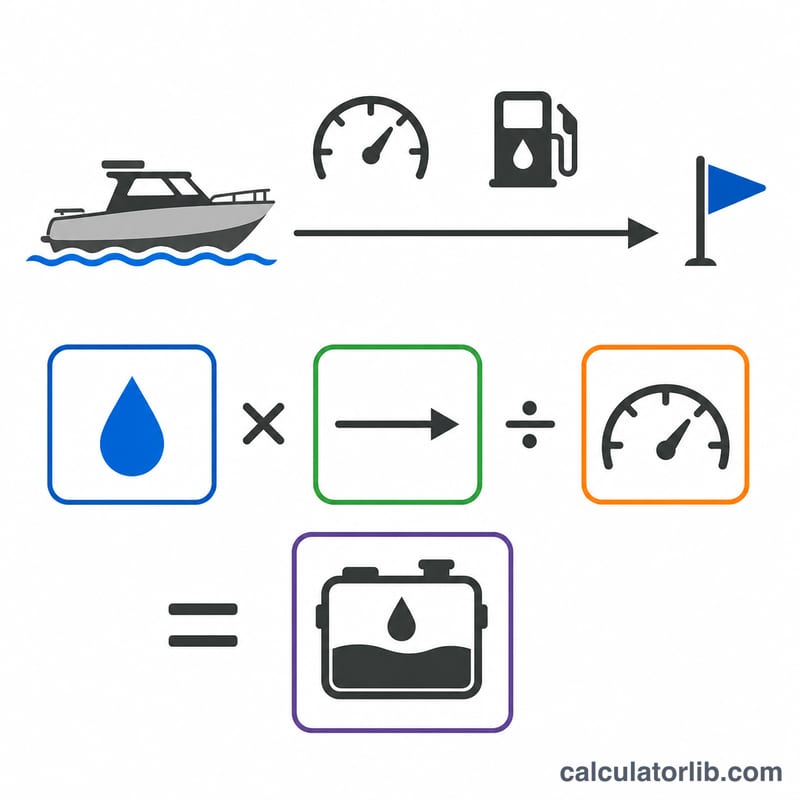
Trip time is distance divided by speed, and fuel used is the burn rate multiplied by that time:
$$F = \text{GPH} \times \frac{d}{v}$$where \(F\) = fuel in gallons, \(\text{GPH}\) = gallons per hour, \(d\) = distance in nautical miles, and \(v\) = speed in knots. The cost is \(C = F \times P\) with \(P\) the price per gallon.
Worked Example
A boat travels \(50\) nautical miles at \(20\) knots, burning \(15\) gallons per hour, with fuel at $4.50/gal:
$$t = \frac{50}{20} = 2.5\,\text{hours}$$$$F = 15 \times 2.5 = 37.5\,\text{gallons}$$$$C = 37.5 \times 4.50 = \$168.75$$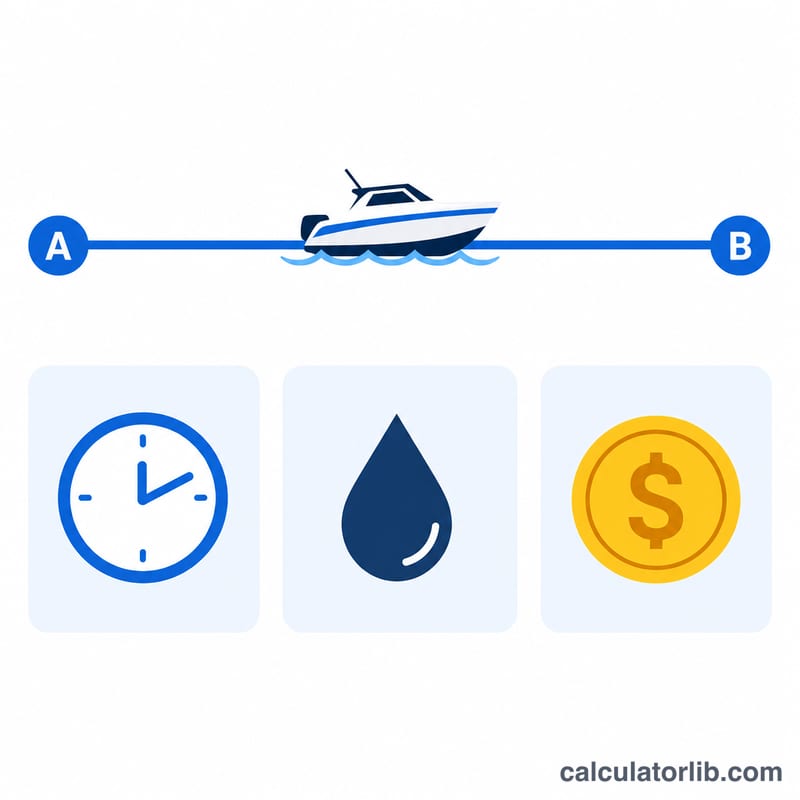
Typical Fuel Burn Rates by Boat Type
Fuel burn (gallons per hour, GPH) varies enormously with engine size, hull type and how hard you push the throttle. The figures below are rough averages at a typical cruising RPM — your actual numbers depend on load, sea state and hull cleanliness. Use them only as a starting estimate, then refine with your own measured burn.
| Boat type | Power | Approx. cruise speed | Typical GPH at cruise |
|---|---|---|---|
| Small single outboard skiff | ~115 hp | 22–25 kn | ~6 GPH |
| Mid-size single outboard center console | ~250 hp | 26–30 kn | 12–13 GPH |
| Inboard gas cabin cruiser | ~320 hp I/O | 20–24 kn | 16–20 GPH |
| Twin-engine sportfish (gas) | 2 × 350 hp | 28–32 kn | 40–55 GPH |
| Twin-engine sportfish (diesel) | 2 × 480 hp | 26–30 kn | 30–40 GPH |
| Displacement diesel trawler | ~120 hp | 7–9 kn | 2–4 GPH |
| Sailboat under auxiliary diesel | ~30 hp | 5–6 kn | 0.5–1 GPH |
As a quick sanity check, a well-loaded planing gas engine burns roughly 0.05 gallons per hour per horsepower at cruise (about 1 GPH for every 20 hp), so a 250 hp outboard run hard is in the 12–13 GPH range.
Fuel Use Across Common Trips
Total fuel depends on how long the engine runs, so for a fixed distance the single biggest lever is speed. Fuel for a trip is GPH × (distance ÷ speed). The table below shows the same boats over realistic outings — note how dropping off plane to a slower cruise can cut total burn dramatically.
| Trip | Distance | Speed | GPH | Trip time | Total fuel | Fuel / nm | Cost @ $4.50/gal |
|---|---|---|---|---|---|---|---|
| Coastal day run (fast) | 40 nm | 25 kn | 13 | 1.6 h | 20.8 gal | 0.52 gal | $93.60 |
| Same run, slowed down | 40 nm | 18 kn | 8 | 2.2 h | 17.8 gal | 0.44 gal | $80.00 |
| Sportfish offshore | 60 nm | 28 kn | 48 | 2.1 h | 102.9 gal | 1.71 gal | $462.86 |
| Trawler passage | 60 nm | 8 kn | 3 | 7.5 h | 22.5 gal | 0.38 gal | $101.25 |
| Skiff harbor hop | 12 nm | 22 kn | 6 | 0.55 h | 3.3 gal | 0.27 gal | $14.73 |
The first two rows are the same boat over the same 40 nm: easing from 25 to 18 knots adds about 36 minutes but saves roughly 3 gallons and over $13 — because the engine is off plane and far more efficient. Most planing hulls have a "sweet spot" just above planing speed where fuel per mile is lowest.
Planning Your Fuel Load
Estimating burn is only half the job — you also need to carry enough fuel to get home safely with margin to spare. A widely used boating guideline is the one-third rule: plan to use one-third of your fuel going out, one-third returning, and keep one-third in reserve. In other words, your usable trip fuel should be no more than about two-thirds of tank capacity.
- Estimate the round trip. Calculate fuel for the full out-and-back distance at your planned cruise speed and GPH, not just one leg.
- Apply the one-third reserve. Divide your estimated trip fuel by two-thirds (multiply by 1.5) to get the minimum tank load you should leave the dock with. A trip needing 60 gallons calls for at least 90 gallons aboard.
- Add margin for conditions. Head seas, current, wind and a dirty hull all raise GPH and slow you down — both increase fuel use. Add 10–20% on top of the calm-water estimate for any open-water passage.
- Round up, never down. Round tank capacity and fuel needs to the conservative side, and remember the bottom few gallons in a tank may not be reliably usable.
- Verify your real GPH. Fill up, run a known distance at cruise, and refill to measure actual gallons burned. Compare it with this calculator's estimate and adjust your assumed GPH so future plans are accurate.
Also account for fuel burned at idle, trolling, or running generators and accessories, which the simple distance-based estimate does not include. Always carry a means to monitor remaining fuel and know your true range before heading offshore.
This is general boating-safety information, not a substitute for proper voyage planning, local knowledge, or manufacturer fuel data for your specific vessel.
FAQ
Where do I find my GPH? Many engine manufacturers publish fuel-flow charts, or a fuel-flow meter reads it live. A rough rule for gas engines is GPH ≈ 0.5 × horsepower × 0.10 at cruise.
Should I add a reserve? Yes. Mariners commonly use the one-third rule: one-third of fuel out, one-third back, one-third in reserve. This calculator shows usage only, so plan extra capacity.
Why convert to nautical miles? Boat speed is given in knots (nautical miles per hour), so distance must be in nautical miles for the time calculation to be correct.