
What Is the Wheat Seeding Rate Calculator?
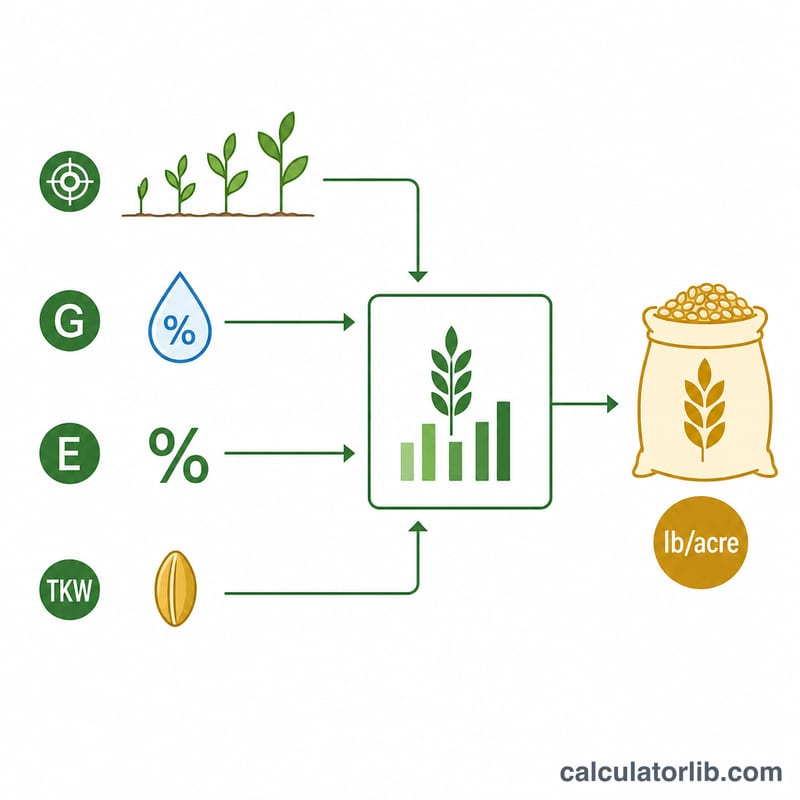
This tool converts a desired plant stand into a practical seeding rate in pounds per acre. It accounts for thousand kernel weight (TKW), germination, and field emergence so you can plant the right amount of seed to hit your target population.
How to Use It
Enter your target plants per square foot, the seed lot TKW in grams, the germination percentage from the seed tag, and your expected field emergence (survival). The calculator returns seeds needed per square foot, seeds per acre, and the recommended rate in pounds per acre.
The Formula
First adjust the target for expected losses, then scale to an acre and convert to weight:
$$\text{seeds/ft}^2 = \frac{\text{target}}{\frac{G}{100}\times\frac{E}{100}}$$ $$\text{lb/acre} = \text{seeds/ft}^2 \times 43{,}560 \times \frac{\text{TKW}/1000}{453.592}$$where target = desired plants per ft², \(G\) = germination %, \(E\) = emergence %, and TKW = thousand kernel weight in grams (453.592 g per pound).
Worked Example
Target 30 plants/ft², TKW 38 g, 95% germination, 85% emergence:
$$\text{seeds/ft}^2 = \frac{30}{0.95\times0.85} = 37.15$$ $$\text{seeds/acre} = 37.15\times43{,}560 = 1{,}618{,}266$$ $$\text{lb/acre} = 1{,}618{,}266\times\frac{0.038}{453.592} = 135.6$$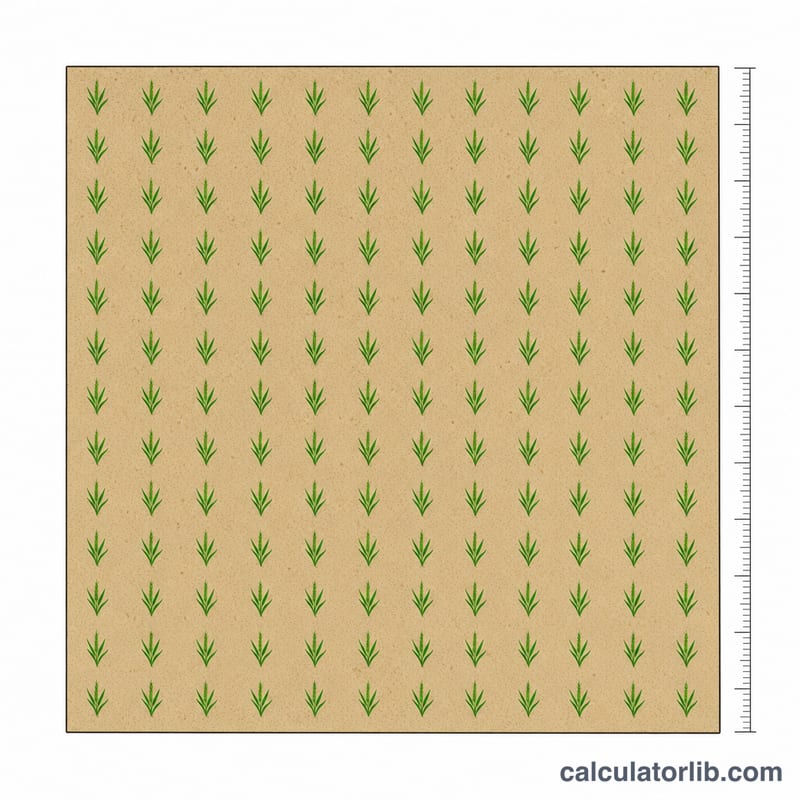
Typical Wheat TKW, Germination and Target Stand Values
Seeding rate in pounds per acre depends heavily on seed size (thousand kernel weight, or TKW), the live seed percentage from the seed tag, and how aggressive a plant stand you are targeting. The same target plant stand can require very different seed weights when the kernels are small versus large, which is why weighing your actual seed lot is far more accurate than assuming a fixed bushel rate.
Thousand Kernel Weight (TKW) by wheat type
| Wheat class / situation | Typical TKW (g) | Notes |
|---|---|---|
| Small-seeded winter wheat | 28–34 | Lighter lots, often hard red varieties |
| Typical winter wheat | 32–40 | Most common range |
| Large-seeded / spring wheat | 38–48 | Hard red spring, some durum lots |
| Overall practical range | 30–45 | Always confirm with your own seed lot |
Target plant stand
| Crop / planting window | Target plants per ft² | Approx. plants per acre |
|---|---|---|
| Winter wheat (timely) | 20–28 | ~870,000–1,220,000 |
| Winter wheat (late) | 28–35 | ~1,220,000–1,525,000 |
| Spring wheat | 25–35 | ~1,090,000–1,525,000 |
One acre is 43,560 ft², so a target of 25 plants/ft² equals 1 acre × 25 ≈ 1,089,000 plants per acre. The calculator above converts a per-ft² target into the equivalent seed weight automatically.
Germination and field emergence
| Value | Typical range | Source |
|---|---|---|
| Germination (lab) | 85–98% | Printed on seed tag |
| Field emergence (good seedbed) | 85–95% | Estimated from conditions |
| Field emergence (poor/dry/late) | 50–80% | Estimated from conditions |
Lab germination tells you the seed's potential under ideal conditions; field emergence accounts for real-world losses to crusting, moisture, depth, residue and pests. Multiply the two to estimate the share of planted seeds that actually become plants.
Practical Recommendations
- Round up when buying seed. Calculated rates rarely land on a whole bag or bushel. Always round the per-acre rate up so you do not run short in the field; a small surplus is cheaper than re-entering a field or finishing with a thin strip.
- Add a margin for tough conditions. The field-emergence percentage is where reality bites. For a dry, cloddy or rough seedbed, lower your emergence assumption (e.g. from 90% to 70%), which automatically raises the seeding rate. It is better to plan for lower emergence than to discover a thin stand at green-up.
- Increase the rate for late or no-till planting. Late-planted wheat tillers less, so a higher plant population compensates for fewer heads per plant. No-till and heavy residue also reduce emergence. Shift your target stand toward the high end (28–35 plants/ft²) in these situations.
- Calibrate the drill to the calculated rate. A calculated lb/acre figure is only useful if the drill actually delivers it. Run a calibration pass, weigh the seed metered over a known distance, and adjust the drill setting until the measured output matches your target rate.
- Convert to bags and acreage totals before ordering. Multiply your rate (lb/acre) by the field acreage, then divide by bag weight (often 50 lb) or by 60 lb/bushel to get the quantity to buy. For example, 120 lb/acre across a 40-acre field is 4,800 lb ≈ 96 bags of 50 lb or 80 bushels.
For a worked example: a target of 25 plants/ft², a TKW of 36 g, 95% germination and 85% field emergence gives a seeding rate of about 106 lb/acre. Across a 40-acre field that is roughly 4,240 lb, or about 85 bags of 50 lb seed.
This is general agronomic information, not field-specific advice. Local variety guides, extension recommendations, and your own calibration and conditions should always take precedence.
FAQ
What is TKW? Thousand kernel weight is the mass in grams of 1,000 seeds; bigger seeds need more pounds for the same plant count.
Why include emergence? Not every viable seed produces a plant — seedbed conditions, depth, and pests reduce stand, so emergence corrects for that loss.
Can I use bushels? Wheat is roughly 60 lb per bushel, so divide the lb/acre result by 60 for an approximate bushel rate.