What This Calculator Does
The Veterinary Drug Dosage Calculator determines the correct amount of medication to give an animal based on its body weight and the drug's recommended dosing rate. It also converts that dose into the actual liquid volume you draw up when using an injectable or oral suspension of a known concentration. This helps veterinary professionals and trained pet owners avoid both under-dosing and dangerous overdosing.
The Formula Explained
The core relationship is simple and linear. Multiply the animal's weight by the per-kilogram dosing rate to get the total dose in milligrams:
$$\text{Dose} = W \times R$$where \(W\) = body weight in kilograms and \(R\) = dosing rate in mg/kg. To find the volume of liquid drug to administer, divide the dose by the concentration \(C\) (in mg/mL):
$$\text{Volume} = \frac{\text{Dose}}{C}$$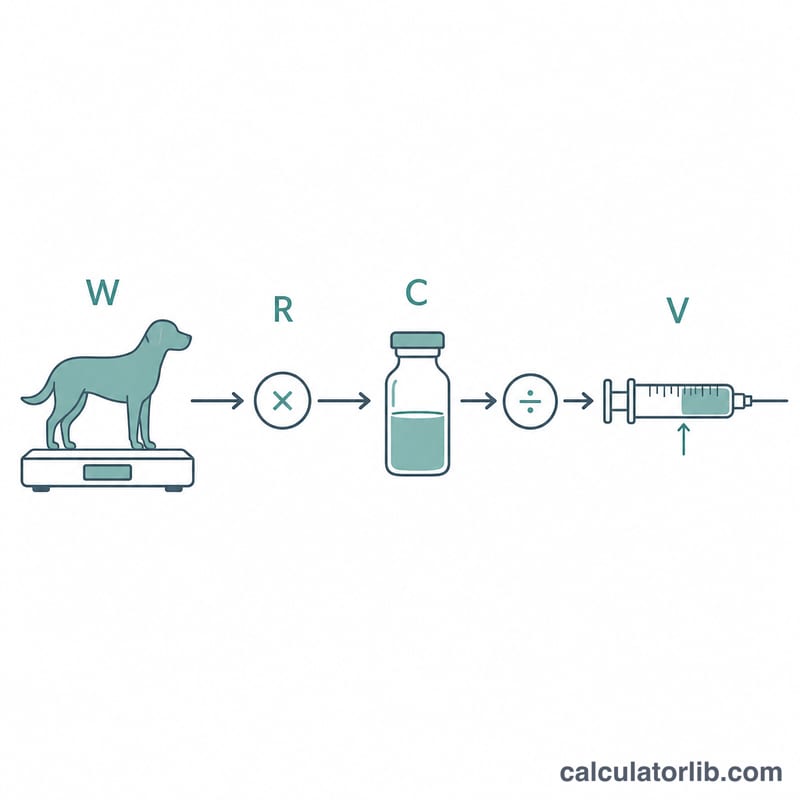
How To Use It
Enter the animal's current body weight in kilograms, the dosing rate from the drug label or your veterinarian, and the concentration printed on the product. The calculator instantly returns the total dose in milligrams and the volume in millilitres to draw into the syringe.
Worked Example
Consider a 10 kg dog prescribed a drug at 5 mg/kg, using a solution concentrated at 50 mg/mL. The total dose is:
$$\text{Dose} = 10 \times 5 = 50\,\text{mg}$$The volume to inject is then:
$$\text{Volume} = \frac{50}{50} = 1\,\text{mL}$$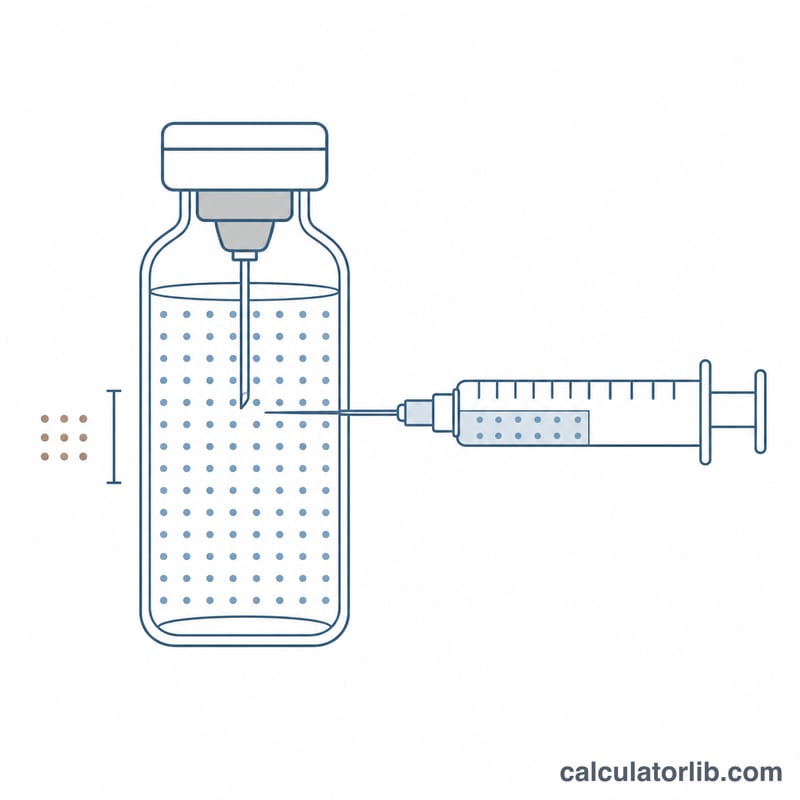
Common Veterinary Dosing Rates
The table below lists general, commonly cited mg/kg dosing rates used in small-animal veterinary practice. They are reference ranges only: the approved dose, formulation, and label for a given product vary by country and regulatory authority (for example US FDA/CVM, UK/EU EMA, or other national bodies), and by the individual animal's condition. Always confirm the exact dose against the current product label and your prescribing veterinarian before use.
| Drug | Species | Typical dosing rate (mg/kg) | Usual interval |
|---|---|---|---|
| Amoxicillin | Dog, Cat | 11–20 | every 8–12 h |
| Amoxicillin/clavulanate | Dog | 12.5–25 | every 12 h |
| Amoxicillin/clavulanate | Cat | 62.5 mg per cat (not per kg) | every 12 h |
| Cephalexin | Dog, Cat | 22–30 | every 8–12 h |
| Enrofloxacin | Dog | 5–20 | every 24 h |
| Enrofloxacin* | Cat | ≤ 5 | every 24 h |
| Furosemide | Dog, Cat | 2.5–5 (lower end for cats) | once or twice daily |
| Maropitant | Dog, Cat | 1 (injectable) | every 24 h |
| Maropitant | Dog | 2 (oral) | every 24 h |
*In cats, enrofloxacin is generally limited to 5 mg/kg per day because higher doses are associated with a risk of retinal toxicity and blindness.
This is general information, not professional or medical advice. Dosing decisions for a specific animal must be made by a licensed veterinarian; never dose based on this table alone.
Pounds-to-Kilograms Weight Conversion
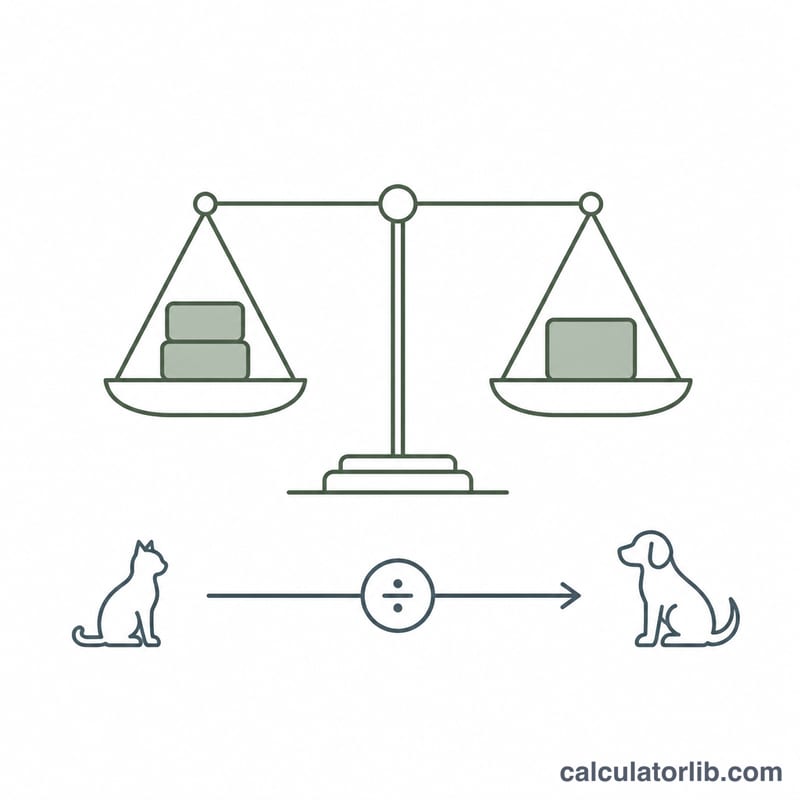
The dosage formula uses body weight in kilograms, but many owners weigh pets in pounds. Convert first, then enter the kilogram value. The exact relationship is:
$$\text{kg} = \frac{\text{lb}}{2.205}$$For example, a 20 lb dog is \( 20 \div 2.205 = 9.07 \) kg. Use the table below across a typical companion-animal weight range (values rounded to two decimals).
| Weight (lb) | Weight (kg) |
|---|---|
| 1 | 0.45 |
| 2 | 0.91 |
| 3 | 1.36 |
| 5 | 2.27 |
| 10 | 4.54 |
| 15 | 6.80 |
| 20 | 9.07 |
| 25 | 11.34 |
| 30 | 13.61 |
| 40 | 18.14 |
| 50 | 22.68 |
| 60 | 27.21 |
| 75 | 34.01 |
| 90 | 40.82 |
Note: 2.205 is a rounded factor; the precise value is 2.20462 lb per kg. For small animals the tiny difference is usually negligible, but always weigh the animal on a calibrated scale rather than estimating.
More Worked Examples
Each example follows the same two steps: first compute the total dose from weight and dosing rate, then divide by concentration to get the injection or oral volume.
$$\text{Dose} = W \times R \qquad V = \frac{\text{Dose}}{C}$$-
Cat dosed from a pounds-based weight (convert first). A cat weighs 9 lb, the dosing rate is 6 mg/kg, and the drug concentration is 50 mg/mL.
Convert the weight: \( 9 \div 2.205 = 4.08 \) kg.
Dose: \( 4.08\ \text{kg} \times 6\ \text{mg/kg} = 24.48\ \text{mg} \).
Volume: \( \dfrac{24.48\ \text{mg}}{50\ \text{mg/mL}} = 0.49\ \text{mL} \).
-
Oral suspension at a different concentration. A 25 kg dog is dosed at 10 mg/kg using a 100 mg/mL oral suspension.
Dose: \( 25\ \text{kg} \times 10\ \text{mg/kg} = 250\ \text{mg} \).
Volume: \( \dfrac{250\ \text{mg}}{100\ \text{mg/mL}} = \) 2.5 mL.
-
Small dog, fractional mL volume. A 3 kg dog is dosed at 5 mg/kg using a concentrated 100 mg/mL injectable.
Dose: \( 3\ \text{kg} \times 5\ \text{mg/kg} = 15\ \text{mg} \).
Volume: \( \dfrac{15\ \text{mg}}{100\ \text{mg/mL}} = \) 0.15 mL. Very small volumes like this are best measured with an appropriately sized syringe (for example a 0.5 mL or 1 mL syringe) for accuracy.
Round the final volume only to what your syringe can measure accurately, and confirm both the dosing rate and the exact product concentration on the label — concentrations differ between brands and formulations.
FAQ
Do I use kilograms or pounds? This tool uses kilograms. To convert, divide pounds by 2.205.
What is concentration? It is the amount of active drug per millilitre of liquid, printed on the vial or bottle, and it lets the tool convert milligrams into a measurable volume.
Is this a substitute for veterinary advice? No. Always confirm the dosing rate and final dose with a licensed veterinarian before administering any medication.