
What Is the Pet Medication Dosage Calculator?
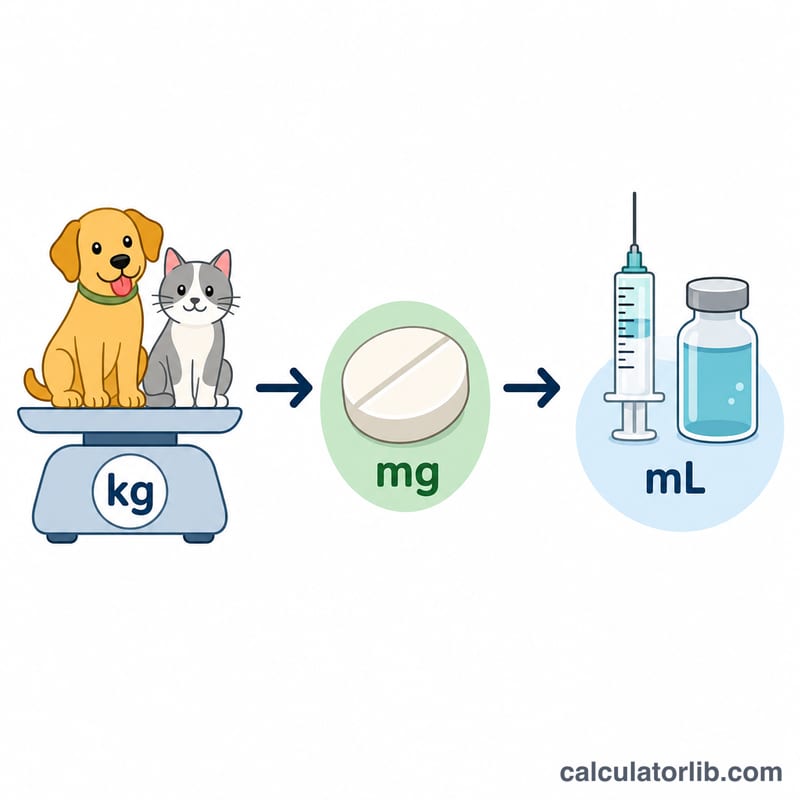
This calculator estimates how much medication to give a pet based on its body weight and the prescribed dose rate. It converts a per-kilogram dose into a total milligram (mg) amount, and — if the medication is a liquid — into a volume in milliliters (mL) using the product concentration. It works for dogs, cats, and other animals dosed by weight.
Important: This tool is for educational estimation only and does not replace veterinary advice. Always confirm doses, frequency, and suitability with your veterinarian before administering any medication. Some drugs are toxic to certain species (for example, several common human medications are dangerous to cats).
How to Use It
Enter your pet's weight and choose the unit (kg or lb). Enter the prescribed dose rate in mg per kg. If you are giving a liquid or injectable medication, enter the concentration in mg per mL to also get the volume to draw up. For tablets, you can ignore the volume output and compare the total mg to your tablet strength.
The Formula Explained
The total dose in milligrams is the dose rate multiplied by body weight in kilograms:
$$\text{Dose (mg)} = \text{dose rate (mg/kg)} \times \text{weight (kg)}$$
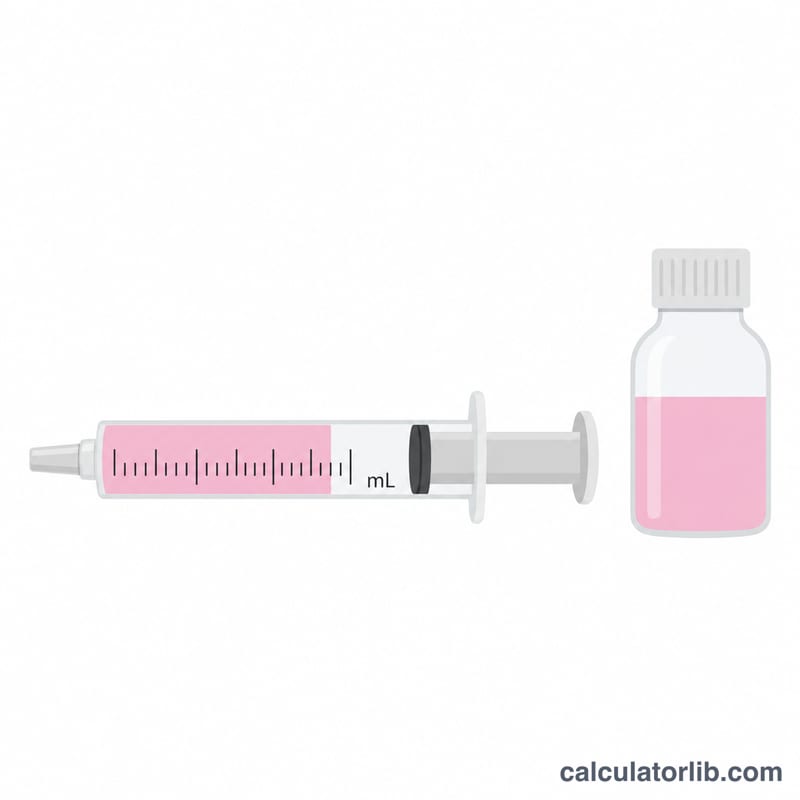
For liquids, the volume is the total dose divided by how concentrated the medication is:
$$\text{Volume (mL)} = \frac{\text{Dose (mg)}}{\text{concentration (mg/mL)}}$$
Worked Example
A 10 kg dog is prescribed 5 mg/kg of a medication that comes as a 50 mg/mL liquid. Total dose = \(5 \times 10 = 50\) mg. Volume = \(50 \div 50 = 1\) mL. So you would administer 50 mg, which equals 1 mL of the liquid.
FAQ
My pet's weight is in pounds — can I still use this? Yes. Select "lb" and the tool converts using \(1 \text{ lb} = 0.453592 \text{ kg}\) before calculating.
What if I only have tablets, not a liquid? Leave the concentration as is and just use the total mg figure, then divide by your tablet strength to find the number of tablets.
Is the result safe to use directly? Treat it as a sanity-check estimate. Dosing depends on the specific drug, formulation, the animal's species and health, and your vet's instructions. Always verify with a professional.