What is a compound ratio?
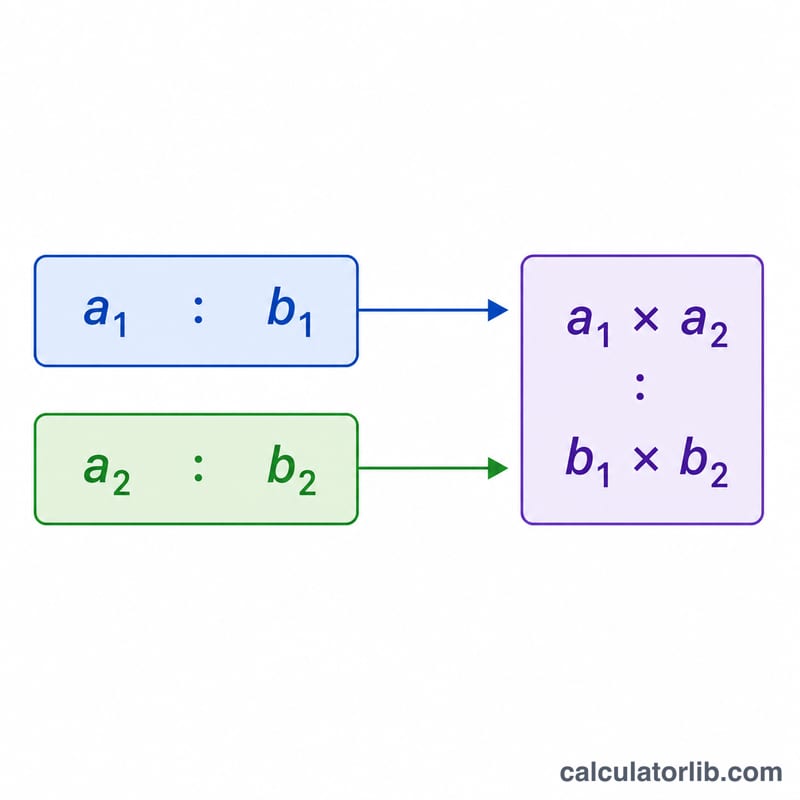
A compound ratio is the single ratio you get when you combine two or more ratios by multiplying their corresponding terms. If you have the ratios \(a{:}b\) and \(c{:}d\), their compound ratio is formed by multiplying the two first terms (antecedents) together and the two second terms (consequents) together. The general rule for any number of ratios is:
$$\text{Compound} = (a_1 \times a_2 \times \cdots) : (b_1 \times b_2 \times \cdots)$$
Here \(a_i\) are the antecedents (first terms) and \(b_i\) are the consequents (second terms) of each ratio you enter.
How to use this calculator
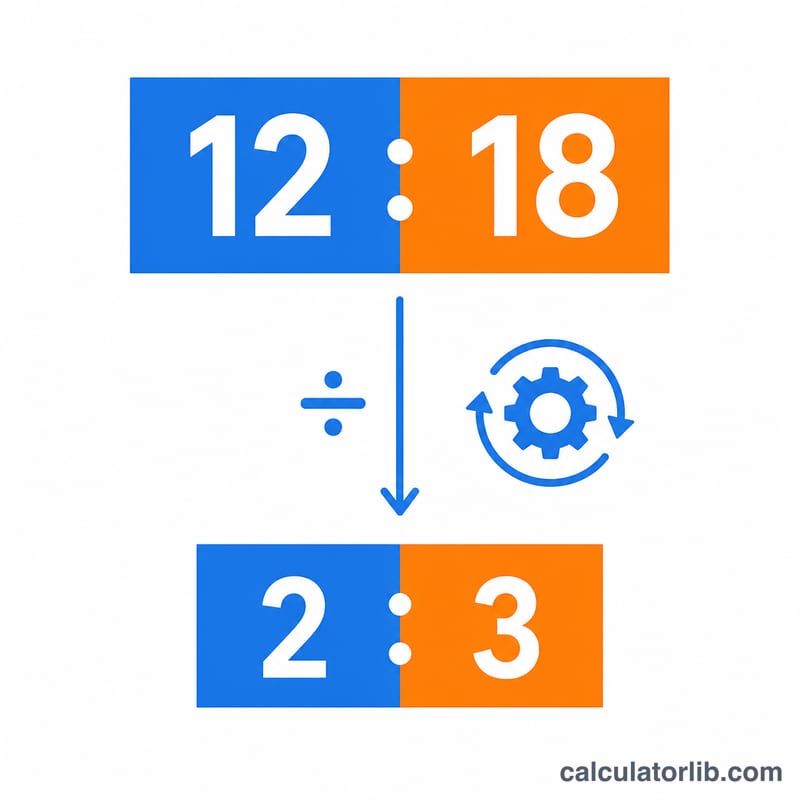
Enter the two terms for Ratio 1 and Ratio 2. If you only want to combine two ratios, leave Ratio 3 set to its default of 1 and 1, since multiplying by \(1{:}1\) does not change the result. The calculator multiplies the antecedents, multiplies the consequents, and then reduces the answer to its lowest terms by dividing both sides by their greatest common divisor (GCD).
The formula explained
Combining ratios is pure multiplication of matching positions. After multiplying, the raw compound ratio is simplified so it reads in the cleanest possible whole-number form:
$$(a \times c) : (b \times d) \;\longrightarrow\; \frac{a \times c}{g} : \frac{b \times d}{g}, \quad g = \gcd(a\times c,\; b\times d)$$
Worked example
Compound the ratios \(2{:}3\) and \(4{:}5\). Multiply the first terms and the second terms:
$$(2 \times 4) : (3 \times 5) = 8 : 15$$
Because \(\gcd(8,15)=1\), the ratio \(8{:}15\) is already in lowest terms, and its decimal value is \(\tfrac{8}{15} \approx 0.5333\).
More Worked Examples
Each example follows the same rule: multiply the antecedents (the left-hand terms) together, multiply the consequents (the right-hand terms) together, then reduce by the greatest common divisor (GCD). The compound formula is \(\text{Compound} = (a_1 \times a_2 \times \cdots) : (b_1 \times b_2 \times \cdots)\).
Example 1 — Combining three ratios (2:3, 4:5, 6:7)
- Multiply the antecedents: \(2 \times 4 \times 6 = 48\).
- Multiply the consequents: \(3 \times 5 \times 7 = 105\).
- Unreduced compound ratio: \(48 : 105\).
- Find the GCD: \(\gcd(48, 105) = 3\). Divide both terms by 3: \(48 \div 3 = 16\) and \(105 \div 3 = 35\).
- Simplified compound ratio: 16 : 35.
- Decimal value: \(16 \div 35 = 0.4571\) (rounded to four decimal places).
Example 2 — When the result reduces by a GCD greater than 1 (4:6 and 3:9)
- Multiply the antecedents: \(4 \times 3 = 12\).
- Multiply the consequents: \(6 \times 9 = 54\).
- Unreduced compound ratio: \(12 : 54\).
- Find the GCD: \(\gcd(12, 54) = 6\). Divide both terms by 6: \(12 \div 6 = 2\) and \(54 \div 6 = 9\).
- Simplified compound ratio: 2 : 9.
- Decimal value: \(2 \div 9 = 0.2222\) (rounded to four decimal places).
Example 3 — A non-whole input, showing rounding (2.5:3 and 4:7)
- Multiply the antecedents: \(2.5 \times 4 = 10\).
- Multiply the consequents: \(3 \times 7 = 21\).
- Compound ratio: \(10 : 21\). Since \(\gcd(10, 21) = 1\), it is already in lowest terms.
- Decimal value: \(10 \div 21 = 0.476190\ldots \approx 0.4762\) (rounded to four decimal places).
When an input is a fraction or decimal, the products can be non-whole. You can either keep the decimal ratio or scale both terms by the same factor to clear the decimals (for instance \(4.5 : 8\) becomes \(9 : 16\) after multiplying both sides by 2); the decimal value stays the same either way.
How to Combine Ratios by Hand
You can compound any set of ratios with a few multiplications and one reduction step. The worked numbers below use \(2 : 3\) and \(5 : 4\).
- Write each ratio as antecedent : consequent. Line up the terms so the left-hand values (antecedents) and right-hand values (consequents) are clear — here \(2 : 3\) and \(5 : 4\).
- Multiply all the antecedents together. \(2 \times 5 = 10\).
- Multiply all the consequents together. \(3 \times 4 = 12\). This gives the unreduced compound ratio \(10 : 12\).
- Find the GCD of the two products. \(\gcd(10, 12) = 2\).
- Divide both terms by the GCD to reach lowest terms: \(10 \div 2 = 5\) and \(12 \div 2 = 6\), giving \(5 : 6\).
- Optionally divide antecedent by consequent for the decimal value: \(5 \div 6 = 0.8333\) (rounded to four decimal places).
The same procedure extends to three or more ratios — just include every antecedent in the first product and every consequent in the second before reducing. If any input is a decimal, carry it through the multiplication as usual; you can scale both final terms by a common factor to clear any decimals without changing the ratio's value.
FAQ
Can I combine more than two ratios? Yes. This tool supports up to three ratios at once, and the same multiply-then-simplify rule extends to any count.
What if the terms are not whole numbers? The calculator rounds each entered term to the nearest whole number before multiplying, since ratios are compared in integer terms.
What does the decimal value mean? It is the antecedent divided by the consequent, giving you a quick sense of the ratio as a single number.