What this calculator does
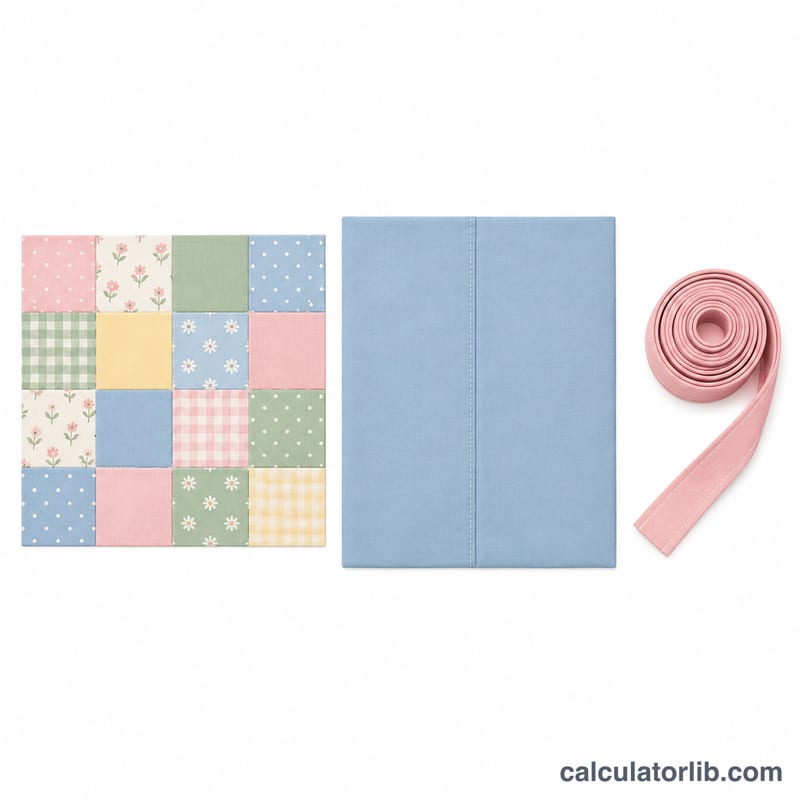
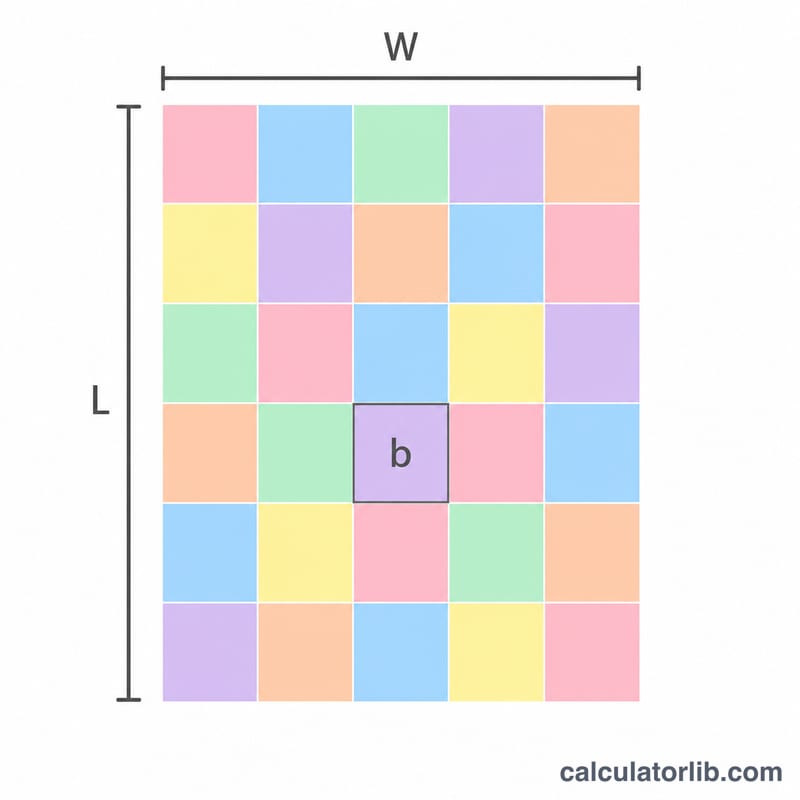
The Quilt Fabric Yardage Calculator estimates how much fabric to buy for a quilt top made from one fabric, plus backing and binding. Enter the finished quilt size, the finished block size, the pattern type, seam allowance and the usable width of your fabric (usually about 40 to 42 inches after trimming selvedges).
How to use it
Type the quilt width and length in inches, then the finished block size. Choose square patches, or half-square triangles where each cut square produces two triangles of that fabric. Add a percentage for cutting mistakes and shrinkage; 10% is a sensible default. The result shows the total in yards, rounded up to the nearest 1/8 yard, as fabric shops sell it.
The formulas explained
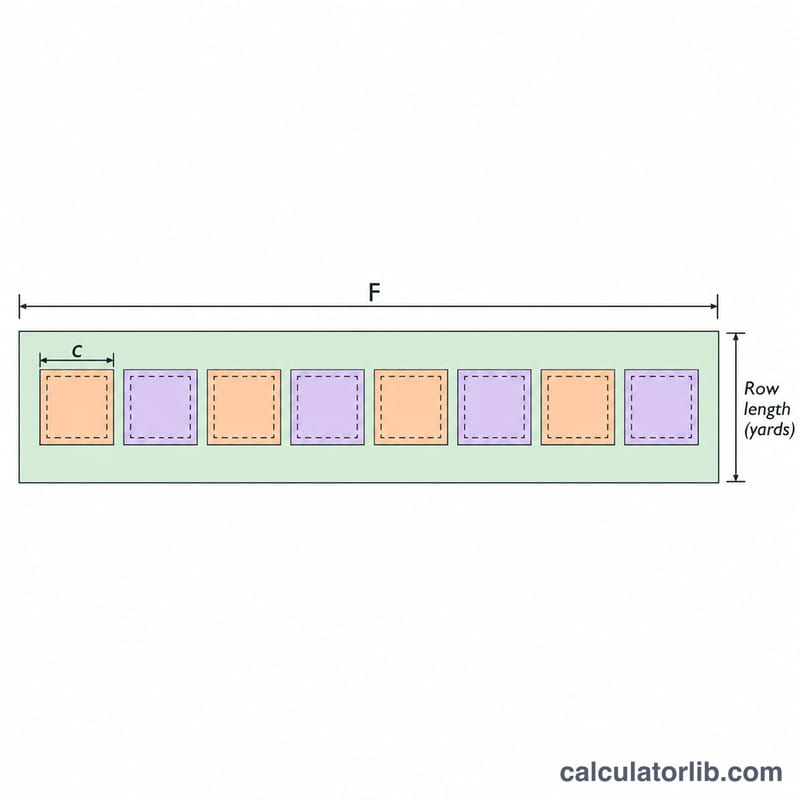
Each square is cut larger than the finished block to cover the seam allowance \(s\). For square patches the cut size is:
$$c = b + 2s$$For half-square triangles the cut square is \(c = b + 3.5s\), which gives the familiar 7/8 inch extra at a 1/4 inch seam. The number of squares that fit across the fabric is \(\lfloor W_f / c \rfloor\), where \(W_f\) is the usable fabric width. The strips needed are \(N_s = \lceil n / k \rceil\), where \(n\) is the number of squares and \(k\) the squares per strip. Then:
$$\text{Yards} = \frac{N_s \times c \times (1 + w)}{36}$$Backing is the quilt plus 4 inches on every side, pieced in whichever direction uses less fabric. Binding assumes strips cut across the fabric width to cover the perimeter plus 10 inches for joins and corners.
Worked example
A 60 \(\times\) 80 inch quilt with 10 inch blocks needs 6 \(\times\) 8 = 48 blocks. With a 1/4 inch seam:
$$c = 10 + 2(0.25) = 10.5\,\text{in}$$A 42 inch fabric yields 4 squares per strip, so 48 squares need 12 strips:
$$\text{Yards} = \frac{12 \times 10.5 \times 1.10}{36} = 3.85\,\text{yd} \to 3\tfrac{7}{8}\,\text{yd}$$Backing needs two 88 inch panels, 176 inches or 4.89 yd, rounded to 5 yd. Binding needs 7 strips of 2.5 inches, about 1/2 yd. The total is 9.375 yd.
Standard Quilt Sizes and Typical Backing Yardage
The sizes below are common US quilt sizes in inches. Actual sizes vary by pattern and maker, so treat them as starting points. Backing yardage assumes 42 inch usable fabric width and a 4 inch overhang on every side, so the backing is 8 inches larger than the quilt in each direction. Yardage is the shorter of the two ways of seaming the backing, rounded up to the next 1/8 yard, which matches the backing step of this calculator. The unrounded length is the number of fabric widths needed × the backing length ÷ 36.
| Size | Finished quilt (in) | Backing with overhang (in) | Backing at 42 in width (yd) | Backing at 108 in wide-back (yd) |
|---|---|---|---|---|
| Crib | 36 × 52 | 44 × 60 | 2 1/2 | 1 3/4 |
| Crib (large) | 45 × 60 | 53 × 68 | 3 | 2 |
| Throw (small) | 50 × 65 | 58 × 73 | 3 3/8 | 2 1/8 |
| Throw (large) | 60 × 72 | 68 × 80 | 3 7/8 | 2 1/4 |
| Twin | 70 × 90 | 78 × 98 | 5 1/2 | 2 3/4 |
| Full | 85 × 90 | 93 × 98 | 7 3/4 | 2 3/4 |
| Queen | 90 × 108 | 98 × 116 | 8 1/4 | 3 1/4 |
| King | 108 × 108 | 116 × 116 | 9 3/4 | Not wide enough (116 in needed) |
Wide-back fabric: Backing fabric about 108 inches wide can cover most sizes with one length and no seam. The yardage is just the backing length ÷ 36, rounded up. A king quilt with a 4 inch overhang needs 116 inches in both directions, which is more than 108 inches, so it still needs a seam. Check the usable width of the bolt you buy, because it is often a little under the printed width.
Cut Sizes by Finished Block Size
The table uses a 1/4 inch seam allowance. A square patch is cut at the finished size plus 1/2 inch (\(c = b + 0.5\)). A half-square triangle made by cutting a square once on the diagonal is cut at the finished size plus 7/8 inch (\(c = b + 0.875\)). The last two columns show how many pieces fit across one 42 inch strip, \(\lfloor 42 / c \rfloor\).
| Finished block (in) | Cut square (in) | Squares per 42 in strip | Cut HST square (in) | HST squares per 42 in strip |
|---|---|---|---|---|
| 2 | 2 1/2 | 16 | 2 7/8 | 14 |
| 3 | 3 1/2 | 12 | 3 7/8 | 10 |
| 4 | 4 1/2 | 9 | 4 7/8 | 8 |
| 5 | 5 1/2 | 7 | 5 7/8 | 7 |
| 6 | 6 1/2 | 6 | 6 7/8 | 6 |
| 8 | 8 1/2 | 4 | 8 7/8 | 4 |
| 10 | 10 1/2 | 4 | 10 7/8 | 3 |
| 12 | 12 1/2 | 3 | 12 7/8 | 3 |
Each HST square cut on the diagonal gives two triangles. Pairing triangles from two fabrics gives finished half-square triangle units. Many quilters also cut squares slightly oversized and trim them down, which uses a little more fabric than this table.
Practical Buying Tips
- Prewash and allow for shrinkage. Cotton can shrink a few percent. If you prewash, buy a little extra, because trimmed and straightened fabric is shorter and narrower than it was on the bolt. Wash all fabrics from the same project the same way.
- Buy extra for directional prints and matching. Stripes, one-way prints and motifs you need to match use more fabric. Increase the Extra % field to cover this.
- Round up to the next 1/8 yard. Cutting is never perfectly efficient, and shops sell fabric in fractions of a yard. The calculator rounds the top, backing and binding each up to 1/8 yard.
- Check usable width. The printed width (often 44–45 inches) includes the selvedges. After trimming them, usable width is often 40–42 inches. Enter your real usable width in the Fabric Width field.
- Consider wide backing fabric. A 108 inch wide-back often avoids a seam and can save time and sometimes fabric on larger quilts. Make sure the quilt plus overhang fits within its width.
- Buy binding fabric with the rest. Fabric from a different dye lot can differ slightly in color, so buy the binding at the same time as the top and backing.
- Add extra for sashing, borders and cornerstones. The estimate is based on blocks and the overall quilt size, so extra pieces such as sashing, borders and cornerstones need their own yardage added on top.
- Keep a small reserve. A mistake in cutting or a later repair is easier to fix if you have some leftover fabric.
The sizes, cut dimensions and widths in this article use US inches and yards. If you work in metric or with different seam allowances, adjust the values before relying on the results.
FAQ
Does this include sashing or borders? No. Add them separately by treating them as extra strips, or enlarge the quilt size to include them.
Why round up to 1/8 yard? Shops cut in 1/8 yard steps, and rounding down could leave you short.
Should I prewash? If you plan to, raise the extra percentage to 10 to 15% to allow for shrinkage.