
What this calculator does
Ending a car lease early can be expensive, because the lessor expects to recover the payments you agreed to make plus the car's projected residual value. This calculator estimates the total cost of terminating a lease before its scheduled end date by combining the remaining balance, contractual fees and the current market value of the vehicle. Amounts are in your own currency; always check your lease contract, since termination formulas differ between lessors.
How to use it
Enter your monthly payment, months remaining, the residual value from your lease contract, and the implied lease rate (the money factor multiplied by 2,400 gives an approximate APR; use 0 to ignore discounting). Add the early termination fee, disposition fee, any excess wear or mileage charges, and the current wholesale or market value of the car.
The formula explained
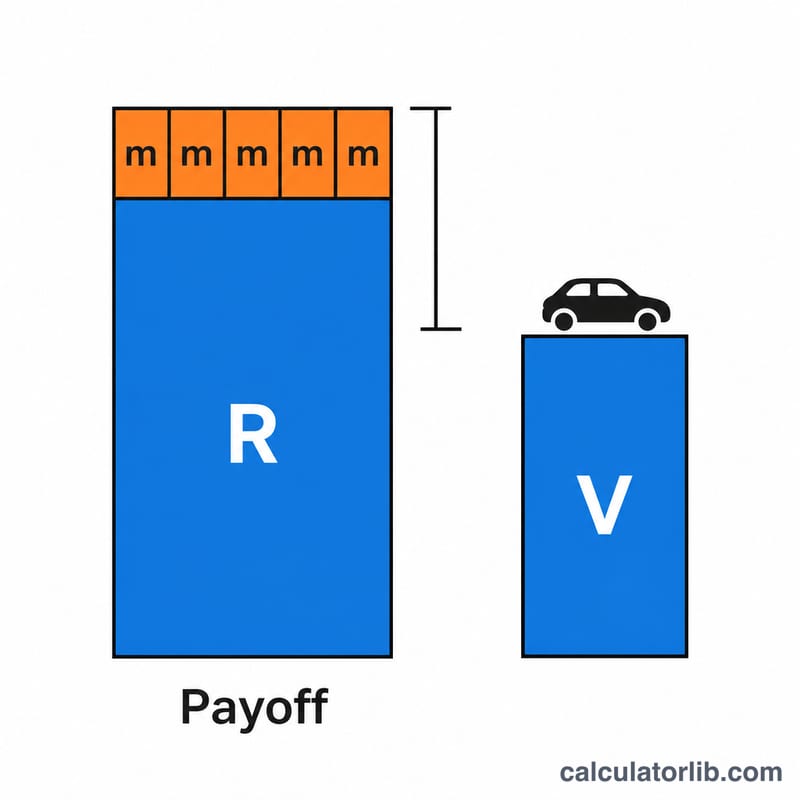
The adjusted lease balance is the present value of the remaining payments plus the discounted residual value:
$$B = P\frac{1-(1+r)^{-n}}{r} + \frac{R}{(1+r)^{n}}$$Here \(P\) = monthly payment, \(r\) = APR divided by 1,200, \(n\) = months remaining and \(R\) = residual value. The net cost is then:
$$\text{Net cost} = B + F_{e} + F_{d} + C_{x} - V$$where \(F_{e}\) = early termination fee, \(F_{d}\) = disposition fee, \(C_{x}\) = excess charges and \(V\) = vehicle market value.
Worked example
Suppose the payment is 400, 12 months remain, the residual is 15,000, the rate is 0%, the early fee is 500, the disposition fee is 395, and the car is worth 16,000.
$$B = 400 \times 12 + 15000 = 19800$$$$\text{Net cost} = 19800 + 500 + 395 - 16000 = 4695$$Finishing the lease would cost 4,800 in payments plus 395 in return charges, or 5,195, so terminating early saves about 500 in this case because the car is worth more than its residual.
Early Termination Cost Under Different Scenarios
All rows use the same lease: payment $400, 12 months remaining, residual value $15,000, early termination fee $500, disposition fee $395 and no excess charges. Total fees are therefore $895. Net cost = B + fees − market value. At 0% APR, \(B = 400\times 12 + 15{,}000 = 19{,}800\). At 6% APR (\(r = 0.005\)), \(B \approx 18{,}776.15\).
| APR | Market value | Adjusted balance B | Total fees | Net cost |
|---|---|---|---|---|
| 0% | $13,000 | $19,800.00 | $895 | $7,695.00 |
| 0% | $15,000 | $19,800.00 | $895 | $5,695.00 |
| 0% | $17,000 | $19,800.00 | $895 | $3,695.00 |
| 0% | $21,000 | $19,800.00 | $895 | −$305.00 (credit) |
| 6% | $13,000 | $18,776.15 | $895 | $6,671.15 |
| 6% | $15,000 | $18,776.15 | $895 | $4,671.15 |
| 6% | $17,000 | $18,776.15 | $895 | $2,671.15 |
| 6% | $20,000 | $18,776.15 | $895 | −$328.85 (credit) |
Takeaways: each $2,000 of extra market value lowers the net cost by exactly $2,000, while a higher APR lowers the discounted balance (about $1,024 here) because future amounts are discounted more heavily. The negative cases are hypothetical: they require the car to be worth well above the residual value, which is uncommon, and your lessor may not pay out the surplus.
FAQ
Is a lease buyout or sale cheaper than termination?
If your car is worth more than the payoff, selling or trading it in (where your lessor allows it) can return positive equity instead of a bill.
Why can the result be negative?
A negative net cost means the vehicle value exceeds what you owe, so you would have equity rather than a cost.
Is this exact?
No. Lessors use their own payoff formulas and may add taxes or other charges, so request an official payoff quote before deciding.