What is a brickwork mortar calculator?
This calculator estimates the volume of mortar needed to lay a brick wall, either from the wall face area or from a known number of bricks. It also converts the wet mortar volume into dry materials, cement and sand, so you can order the right quantities.
How to use it
Choose whether to calculate from wall area or from brick count. Enter the brick dimensions in millimetres (a standard UK brick is 215 × 65 × 102.5 mm), the mortar joint thickness (usually 10 mm), a wastage allowance (5–15 percent is typical) and the cement-to-sand ratio. Subtract door and window openings from the area before entering it.
The formula explained
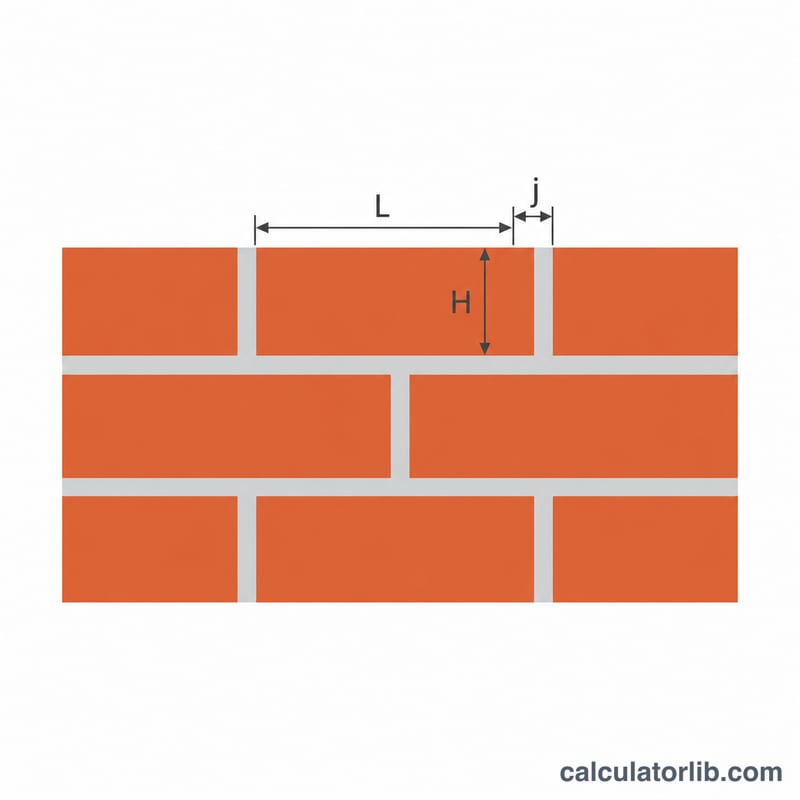
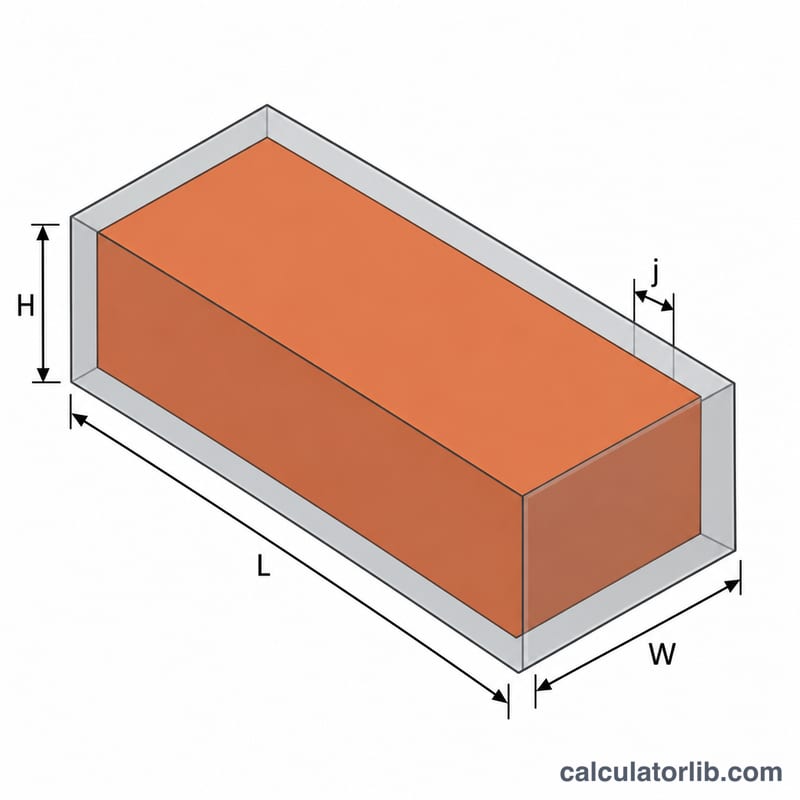
Each brick occupies a cell of size \((L+j)\times(H+j)\times W\), where \(L\), \(H\), \(W\) are the brick length, height and width and \(j\) is the joint thickness. The mortar in that cell is the cell volume minus the brick volume:
$$v = (L+j)(H+j)W - LHW$$
The number of bricks is \(N = A / ((L+j)(H+j))\) for a wall of face area \(A\). Total mortar is \(N\times v\), increased by the wastage percentage. Dry materials are taken as 1.33 times the wet volume, then split by the mix ratio, using cement at 1440 kg/m³ and sand at 1600 kg/m³.
Worked example
For \(A = 10\,\text{m}^2\) with a 215 × 65 × 102.5 mm brick and 10 mm joints:
$$N = \frac{10}{0.225 \times 0.075} = 592.6$$
$$v = 0.225 \times 0.075 \times 0.1025 - 0.215 \times 0.065 \times 0.1025 = 0.00029725\,\text{m}^3$$
$$V = 592.6 \times 0.00029725 = 0.176\,\text{m}^3$$
Adding 10 percent wastage gives about 0.194 m³ of wet mortar.
Typical Mortar Mixes by Application
In the UK, mortar strength is described by the designations M12, M6, M4 and M2 (the number is the minimum 28-day compressive strength in N/mm²). The Roman-numeral labels (i)–(iv) come from the older BS 5628 guidance, while BS EN 998-2 covers the mortar product specification. The ratios below are approximate cement:sand mixes by volume, using a plasticiser instead of lime. Always follow the specifier's or the manufacturer's recommendation, because requirements depend on the brick, exposure and design. These designations are UK-specific. Other countries use different classes and mix names.
| Designation | Cement : sand (by volume) | Typical use | Relative strength |
|---|---|---|---|
| M12 / (i) | 1 : 3 | Below DPC, retaining walls, heavily exposed or heavily loaded work | Highest (12 N/mm²) |
| M6 / (ii) | 1 : 4 | General external walls above DPC, most loadbearing masonry | High (6 N/mm²) |
| M4 / (iii) | 1 : 5 to 1 : 6 | Internal walls and sheltered external work, lower-strength bricks | Medium (4 N/mm²) |
| M2 / (iv) | about 1 : 7 to 1 : 8 | Internal non-loadbearing work only; not for exposed conditions | Lowest (2 N/mm²) |
The calculator's “Sand ratio N” field is the N in a 1 : N mix. Use 3 for M12, 4 for M6 and 5 or 6 for M4.
Mortar Quantities for Common Wall Sizes and Joint Thicknesses
Assumptions: standard brick 215 × 65 × 102.5 mm (single-skin wall, 102.5 mm thick), 10% wastage, 1:4 cement:sand mix, dry factor 1.33, cement 1440 kg/m³ and sand 1600 kg/m³.
Per brick, the joint mortar volume is \(v = (L+j)(H+j)W - LHW\). For a 10 mm joint: \(v = 0.225 \times 0.075 \times 0.1025 - 0.215 \times 0.065 \times 0.1025 = 0.00029725\ \text{m}^3\). With \(N = 1/0.016875 = 59.26\) bricks per m², wet mortar is about 0.01762 m³ per m² before wastage. For a 12 mm joint, \(v = 0.00035916\ \text{m}^3\) and \(N = 57.21\) bricks per m², giving about 0.02055 m³ per m².
| Wall area | Joint | Bricks (approx.) | Wet mortar incl. 10% waste (m³) | Cement (kg) | 25 kg bags (rounded up) | Sand (kg) |
|---|---|---|---|---|---|---|
| 5 m² | 10 mm | 296 | 0.097 | 37.1 | 2 | 164.9 |
| 10 m² | 10 mm | 593 | 0.194 | 74.2 | 3 | 329.9 |
| 20 m² | 10 mm | 1185 | 0.388 | 148.4 | 6 | 659.8 |
| 5 m² | 12 mm | 286 | 0.113 | 43.3 | 2 | 192.4 |
| 10 m² | 12 mm | 572 | 0.226 | 86.6 | 4 | 384.8 |
| 20 m² | 12 mm | 1144 | 0.452 | 173.2 | 7 | 769.6 |
Worked check for 10 m² at a 10 mm joint: wet volume \(= 592.6 \times 0.00029725 \times 1.10 = 0.1938\ \text{m}^3\). Dry volume \(= 1.33 \times 0.1938 = 0.2577\ \text{m}^3\). Cement volume \(= 0.2577/(1+4) = 0.05154\ \text{m}^3\), which is \(0.05154 \times 1440 = 74.2\) kg. Sand volume \(= 0.2577 - 0.05154 = 0.2062\ \text{m}^3\), which is \(0.2062 \times 1600 = 329.9\) kg.
A 2 mm increase in joint thickness (10 mm to 12 mm) raises mortar demand by roughly 17%, while using about 3.5% fewer bricks.
Practical Ordering Tips
- Round cement up to whole 25 kg bags. For example, 74.2 kg needs 3 bags. Buying one extra bag is cheap insurance for a larger job.
- Order sand by the tonne or in bulk bags. The sand figures are in kg, so divide by 1000 for tonnes (329.9 kg is about 0.33 t). Small jobs are usually cheaper with one bulk bag than with many small bags. Damp sand weighs more and bulks up, so allow a margin.
- Mix in small batches. Mortar begins to stiffen after about 1.5–2 hours, depending on temperature and mix. Only mix what you can lay in that time and do not re-wet mortar that has started to set.
- Increase wastage when conditions are poor. Use 15–20% instead of 10% for rough, irregular or handmade bricks with deep frogs, for exposed or windy sites where mortar dries or is dropped, and for inexperienced bricklayers.
- Check the joint thickness actually used. Joints are often thicker than planned, and this noticeably increases quantities (see the 10 mm vs 12 mm rows above).
- Sense-check against rules of thumb carefully. Some suppliers quote roughly 30–40 kg of cement per 1000 bricks for a 1:4 mix. Here the 10 mm joint, 10% wastage result for 10 m² works out to about 125 kg per 1000 bricks (74.2 kg for about 593 bricks), so that rule of thumb is not consistent with this calculation. It is likely based on different assumptions such as thinner joints, no wastage or smaller bricks. Use the calculated result, and ask your supplier which assumptions their figure is based on.
This is general information to help with estimating. Always confirm the mortar class, mix and quantities with your designer, the product data sheet or a qualified builder for structural or exposed work.
FAQ
Does this include frogs or perpend voids?
No. It assumes solid bricks and fully filled joints, so the wastage allowance covers any difference.
What about double-skin walls?
Set the width to the total wall thickness only if bricks are laid as a single solid unit; otherwise multiply the area by the number of leaves.
Why add wastage?
Mortar is lost through droppings, over-mixing and uneven joints, so ordering exactly the theoretical amount usually runs short.