What is an insulin days supply?
Pharmacies must report on each insulin claim how many days the dispensed quantity will last. An incorrect days supply can cause rejected claims, early refill denials or overpayment. This calculator estimates it from the insulin strength, container size, daily dose, injection count, priming waste and the in-use discard limit. Always follow your payer rules and the product labeling; this tool is a billing aid, not medical advice.
How to use it
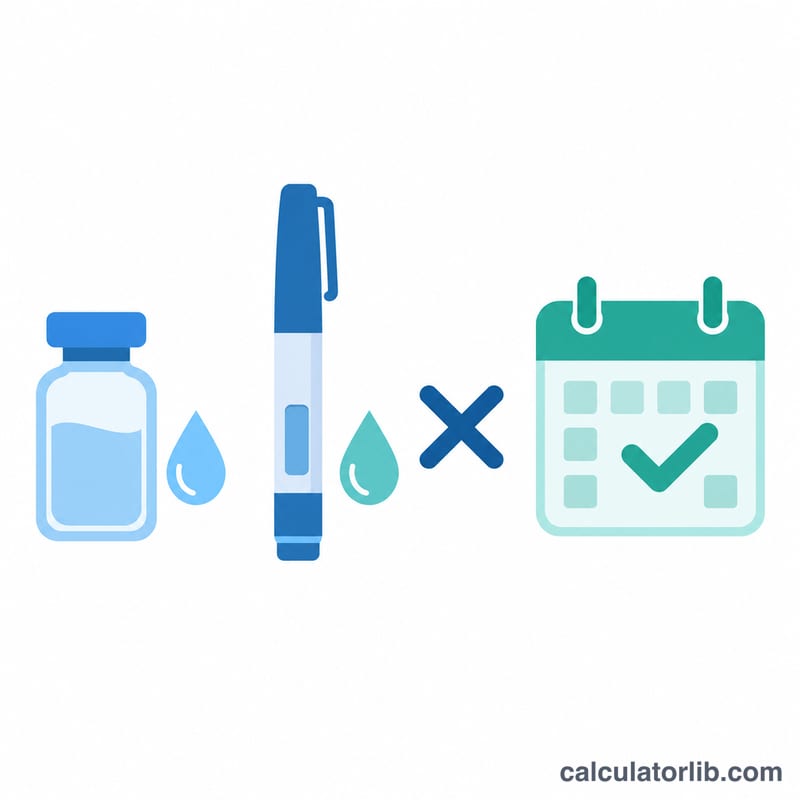
Enter the concentration (U-100 is 100 units/mL), the volume of one vial or pen, and how many containers are dispensed. Add the total daily dose, the number of injections per day and the units primed before each injection. Finally enter the number of days an opened container may be used (commonly 28 days; use 0 for no limit).
The formula explained
Daily usage is the dose plus priming waste:
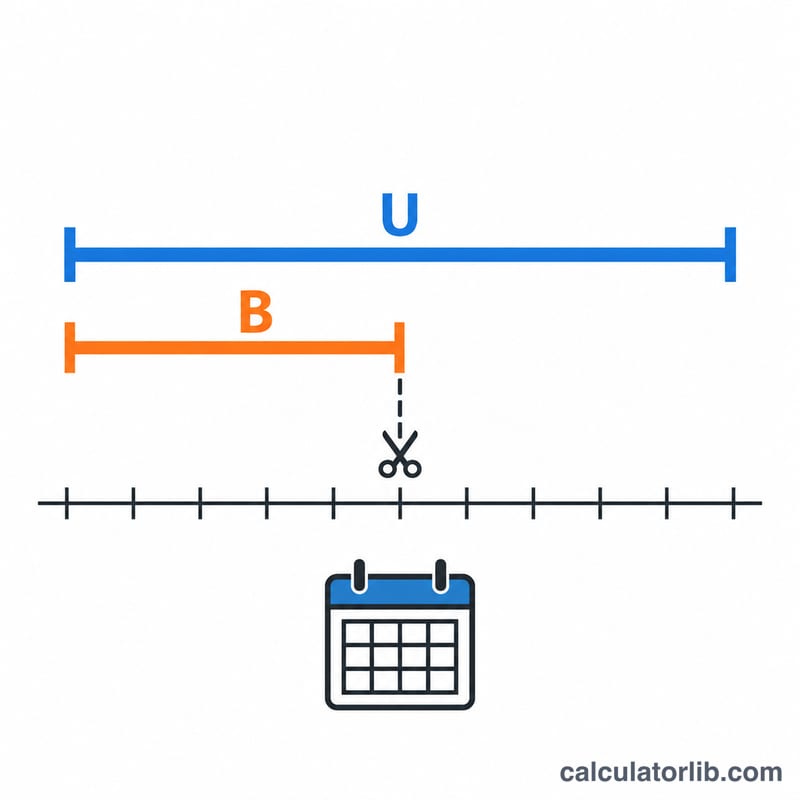
$$U_{day} = D + P \times N$$where \(D\) = daily dose, \(P\) = priming units, \(N\) = injections per day. Days per container are limited by the discard limit \(B\):
$$\text{Days} = \left\lfloor C \times \min\left(\frac{c \times V}{U_{day}}, B\right) \right\rfloor$$Here \(c\) = units/mL, \(V\) = mL per container and \(C\) = number of containers.
Worked example
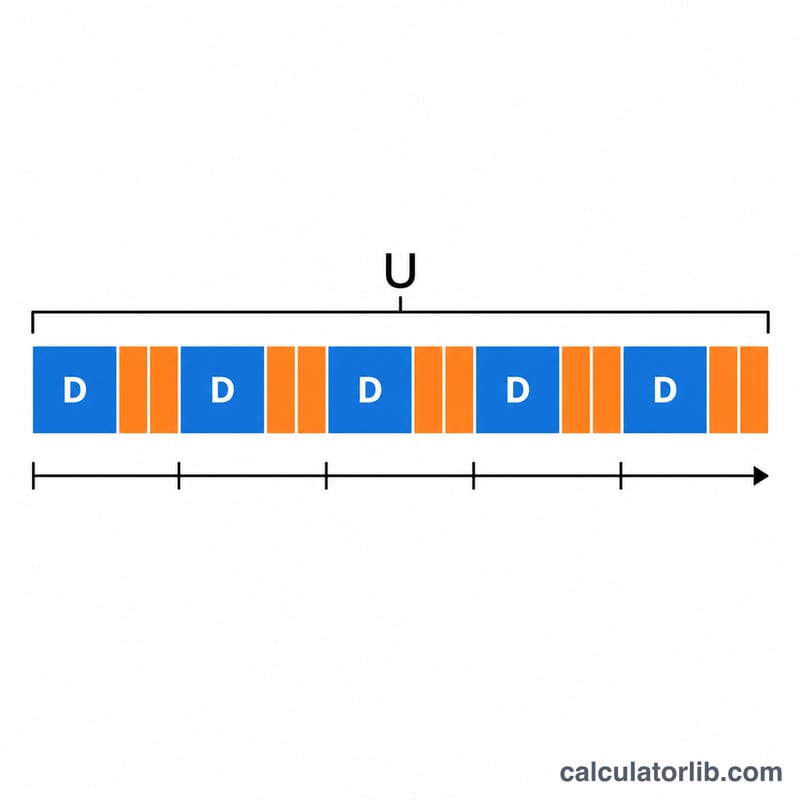
One 10 mL vial of U-100 insulin holds 1,000 units. A patient takes 30 units a day in 2 injections and primes 2 units each time:
$$U_{day} = 30 + 2 \times 2 = 34$$$$\frac{1000}{34} = 29.4 \text{ days} > 28 \Rightarrow \text{Days} = 28$$The 28-day discard limit applies, so the claim is 28 days and 48 units are discarded.
Typical In-Use Discard Limits by Insulin Product
Once a vial or pen is opened (in use), it must be discarded after a set number of days, even if insulin remains. The table lists commonly cited in-use periods at room temperature from US product labeling. Use it as the In-use limit (days) input.
| Insulin product | Type | In-use discard limit (days) |
|---|---|---|
| Insulin glargine U-100 (Lantus, Basaglar) | Vial / pen | 28 |
| Insulin lispro (Humalog) | Vial / pen | 28 |
| Insulin aspart (Novolog) | Vial / pen | 28 |
| Insulin detemir (Levemir) | Vial / pen | 42 |
| Insulin degludec (Tresiba) | Vial / pen | 56 |
| Insulin glargine U-300 (Toujeo) | Pen | 56 |
| Humulin R and Humulin N | Vial | 31 |
Important: The current product labeling and payer or pharmacy-billing rules override this table. Limits can differ by product version, country and storage conditions. An unopened, refrigerated container follows the expiration date printed on the label, not the in-use limit.
Common Concentrations and Package Sizes
| Concentration | Units per mL |
|---|---|
| U-100 | 100 |
| U-200 | 200 |
| U-300 | 300 |
| U-500 | 500 |
Total units per container = concentration × volume, i.e. \(U = \text{units/mL} \times \text{mL}\).
| Container | Calculation | Total units |
|---|---|---|
| 10 mL U-100 vial | \(100 \times 10\) | 1,000 |
| 3 mL U-100 pen | \(100 \times 3\) | 300 |
| Box of 5 U-100 3 mL pens | \(5 \times 300\) | 1,500 |
| 3 mL U-200 pen | \(200 \times 3\) | 600 |
| 1.5 mL U-300 pen | \(300 \times 1.5\) | 450 |
| 3 mL U-500 pen | \(500 \times 3\) | 1,500 |
Package contents vary by product and manufacturer, so always check the label for the concentration, volume per container and number of containers per box.
Scenario Comparison: Unit-Limited vs Discard-Limited
The calculator applies \(\text{Days} = \lfloor N \cdot \min(U/D,\, B) \rfloor\), where \(U\) is the units per container, \(D\) is the daily dose plus priming (priming units × injections per day), \(N\) is the number of containers and \(B\) is the in-use limit. Each container is capped by its own discard limit, then the result is multiplied by the number of containers and rounded down.
| Container | Daily dose (units) | Injections/day | Priming (units) | Usable units per day \(D\) | Days by units \(U/D\) | Discard limit (days) | Final days supply |
|---|---|---|---|---|---|---|---|
| 1 × 10 mL U-100 vial (1,000 units) | 30 | 1 | 0 | 30 | 33.3 | 28 | 28 (discard-limited) |
| 1 × 10 mL U-100 vial (1,000 units) | 80 | 2 | 2 | \(80 + 2 \times 2 = 84\) | \(1000/84 = 11.9\) | 28 | 11 (unit-limited) |
| Box of 5 × 3 mL U-100 pens (300 units each) | 40 | 1 | 2 | \(40 + 2 \times 1 = 42\) | \(300/42 = 7.14\) per pen | 28 per pen | \(5 \times 7.14 = 35.7\) → 35 (unit-limited) |
| Box of 5 × 3 mL U-100 pens (300 units each) | 40 | 1 | 0 | 40 | \(300/40 = 7.5\) per pen | 28 per pen | \(5 \times 7.5 = 37.5\) → 37 (unit-limited) |
| 1 × 3 mL U-100 pen (300 units) | 10 | 1 | 0 | 10 | 30 | 28 | 28 (discard-limited) |
Reading the table
- Discard-limited: When \(U/D\) exceeds \(B\), the container expires before it is empty, so the days supply equals the discard limit (times the number of containers).
- Unit-limited: When \(U/D\) is below \(B\), the insulin runs out first, so the days supply is set by the units available.
- Effect of priming waste: In the two pen-box rows, only the priming differs. Two priming units per injection reduce the supply from 37 to 35 days.
- Rounding: The result is always rounded down, since a partial day cannot be billed as a full day.
These examples assume a 28-day in-use limit; replace it with the limit on the product's current labeling. Priming waste for pens and any dead-space loss for vials depend on the device, so confirm the figures with the product instructions. This is general information, not professional or billing advice.
FAQ
Should priming be included?
Yes. Priming units are drawn from the container, so they shorten how long it lasts.
Why is the result rounded down?
Claims use whole days, and rounding down avoids overstating the supply.
Do pens and vials differ?
The math is the same. For a pack of pens, enter the volume of one pen and the number of pens; each pen is subject to its own discard limit.