What Is a Days' Supply Calculator?
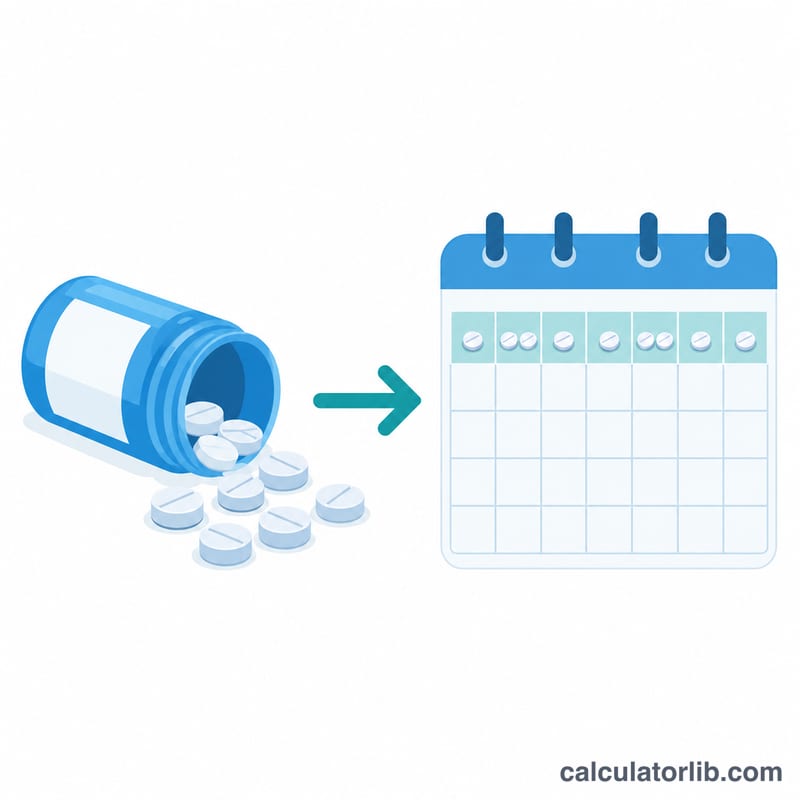
A Days' Supply Calculator estimates how many days a dispensed quantity of medication will last a patient, based on the prescribed dosing regimen. Pharmacies, prescribers, and insurers rely on this number for billing, refill timing, and medication adherence checks.
The Formula
The calculation divides the total quantity dispensed by the amount used each day. With \(Q\) = total quantity dispensed, \(D\) = dose per administration, and \(N\) = number of doses per day:
$$\text{Days Supply} = \frac{Q}{D \times N}$$The denominator \(D \times N\) is the daily usage, so the supply is the total quantity divided by how much is taken each day.
How to Use It
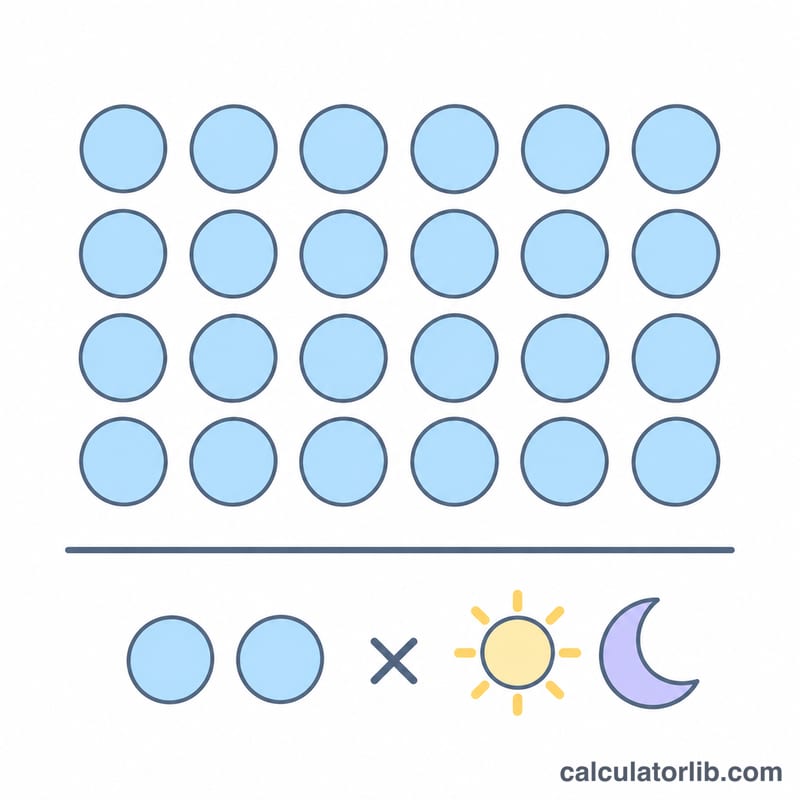
Enter the total quantity dispensed (tablets, capsules, or mL), the dose amount taken each time, and how many times per day the medication is taken. The calculator returns the number of days the prescription will cover. Keep the units consistent between the total quantity and the dose amount.
Worked Example
A prescription dispenses 90 tablets, with instructions to take 1 tablet three times daily. The daily usage is \(1 \times 3 = 3\) tablets:
$$\text{Days Supply} = \frac{90}{1 \times 3} = 30 \text{ days}$$The 90-tablet supply therefore lasts 30 days before a refill is needed.
More Worked Examples
Every example uses the same formula. First multiply the dose amount by the doses per day to get the daily usage. Then divide the total quantity by that daily usage. Days' supply is a count of whole days, so any fraction left over is rounded down.
$$\text{Days Supply} = \frac{Q}{D \times N}$$Here \(Q\) is the total quantity dispensed, \(D\) is the amount taken per dose and \(N\) is the number of doses per day. \(Q\) and \(D\) must use the same unit, such as tablets, mL or puffs.
Example 1: Liquid medication (oral solution)
- Total quantity: \(Q = 300\) mL
- Dose: \(D = 10\) mL, taken \(N = 2\) times per day
- Daily usage: \(10 \times 2 = 20\) mL per day
- Days' supply: \(\frac{300}{20} = 15\)
The bottle lasts 15 days. The division comes out exact, so nothing is rounded.
Example 2: Once-daily tablet
- Total quantity: \(Q = 30\) tablets
- Dose: \(D = 1\) tablet, taken \(N = 1\) time per day
- Daily usage: \(1 \times 1 = 1\) tablet per day
- Days' supply: \(\frac{30}{1} = 30\)
The fill lasts 30 days.
Example 3: Half-tablet dose
- Total quantity: \(Q = 60\) tablets
- Dose: \(D = 0.5\) tablet, taken \(N = 2\) times per day
- Daily usage: \(0.5 \times 2 = 1\) tablet per day
- Days' supply: \(\frac{60}{1} = 60\)
The 60 tablets last 60 days. Splitting tablets makes the same quantity last twice as long as a whole-tablet twice-daily dose (\(\frac{60}{1 \times 2} = 30\) days).
Example 4: When rounding down applies
- Total quantity: \(Q = 45\) tablets
- Dose: \(D = 1\) tablet, taken \(N = 2\) times per day
- Daily usage: \(1 \times 2 = 2\) tablets per day
- Days' supply: \(\frac{45}{2} = 22.5\), which rounds down to 22 days
After 22 full days, \(45 - 22 \times 2 = 1\) tablet is left. That is not enough for another full day of dosing, so it is not counted.
Interpreting Your Days' Supply
Days' supply is the number of days the current fill will last if the medication is taken exactly as written on the prescription. The day it runs out is roughly when a refill is due. Many pharmacies let you request a refill a few days early so there is no gap in treatment.
Common fill lengths
In the United States, many insurance plans and pharmacy benefit managers set limits on how much can be dispensed at once:
- 30-day supply: a common standard fill at retail pharmacies.
- 90-day supply: often allowed for long-term (maintenance) medications, usually through mail-order or extended retail programs.
These limits depend on the plan, the drug and local regulations. Other countries and health systems use different dispensing periods, so check the rules that apply where you are.
How the number is used
- Billing: pharmacies report days' supply on insurance claims. Plans use it to apply fill limits and decide when the next refill can be covered.
- Adherence checks: refill timing is compared with days' supply. Measures such as the proportion of days covered help pharmacists and clinicians see whether a medication is being refilled on schedule.
- Early-refill rules: a refill requested well before the previous supply should have run out may be rejected by the insurer or flagged for review.
Limitations
- The result is rounded down to whole days. A partial day's quantity is not counted.
- It assumes every dose is taken exactly as prescribed. It does not account for missed doses, extra or as-needed doses, dose changes, spills or wasted medication.
- For liquids, inhalers, insulin and similar products, the result is only as accurate as the total quantity and dose you enter in the same unit.
This is general information, not medical or pharmaceutical advice. This calculator does not recommend doses. For questions about how much to take, how often or when to refill, ask your prescriber or pharmacist.
FAQ
Should I round the result? Days' supply is usually rounded down to a whole number, since a partial day still requires a full dose on hand.
Does this work for liquids? Yes. Use the same units for both quantity and dose, for example 300 mL total with a 10 mL dose.
What if the dose varies? Use the average daily amount as the denominator to get an approximate supply.