What the Electricity Cost Calculator UK does
This calculator estimates how much your electricity will cost over a billing period. It takes the number of units you use, measured in kilowatt-hours (kWh), multiplies them by your unit rate in pence, and then adds the daily standing charge your supplier applies. The result is shown in pounds so you can quickly sanity-check a bill or compare tariffs before you switch.
How to use it
Enter the electricity you have used in kWh, which you can read from your smart meter or your latest bill. Add your unit rate in pence per kWh, the daily standing charge in pence, and the number of days in the billing period. Press calculate to see the energy cost, the standing charge cost, and the combined total side by side.
The formula explained
UK tariffs are quoted in pence, so the calculator divides by 100 to convert to pounds. With \(\text{kWh}\) = units used, \(\text{rate}\) = pence per kWh, \(\text{standing}\) = pence per day and \(\text{days}\) = length of the period, the total is:
$$\text{Total} = \text{kWh} \times \frac{\text{rate}}{100} + \frac{\text{standing} \times \text{days}}{100}$$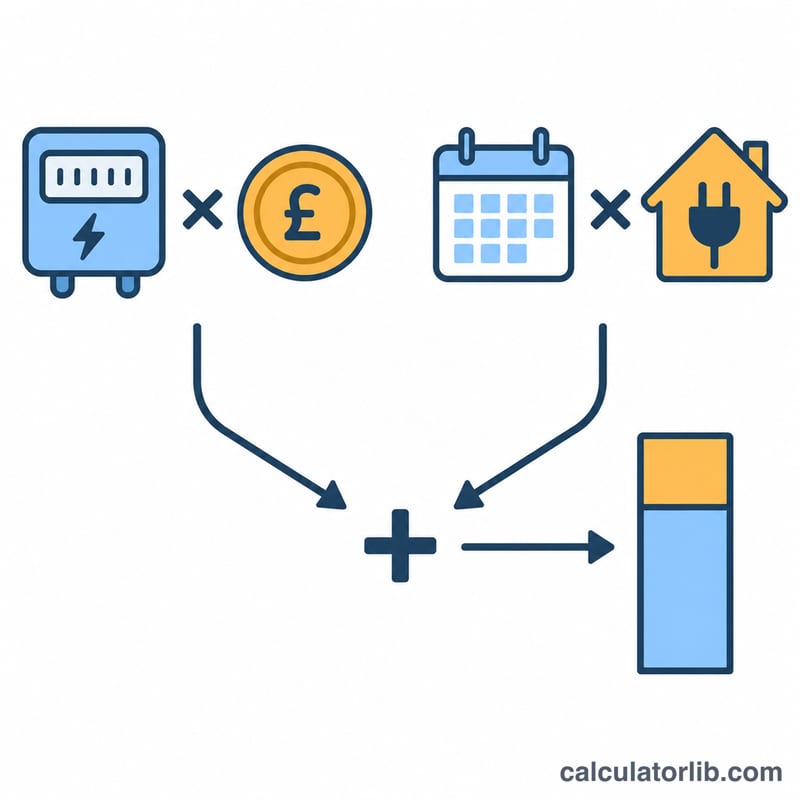
Worked example
Suppose you use 300 kWh at a unit rate of 24.5p, with a 60p daily standing charge over 30 days. The energy and standing components are:
$$\text{Energy} = 300 \times \frac{24.5}{100} = 73.50$$ $$\text{Standing} = \frac{60 \times 30}{100} = 18.00$$ $$\text{Total} = 73.50 + 18.00 = 91.50$$So the estimated bill is £91.50 for the period.
Typical UK Household Electricity Usage
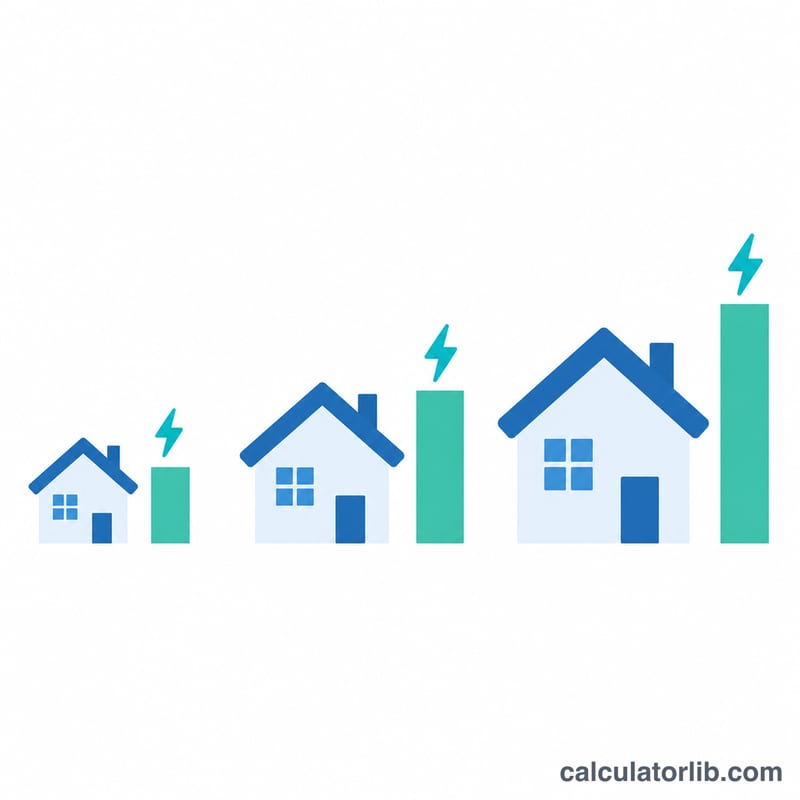
If you don't know your own usage, start with the industry benchmarks. Ofgem, the UK's energy regulator for Great Britain, publishes Typical Domestic Consumption Values (TDCVs). Suppliers and price comparison sites use them to show example annual costs. For electricity on a standard single-rate meter, the values are shown below. The monthly figures are the annual value divided by 12 and rounded.
| Usage level (Ofgem TDCV) | Annual electricity use | Approximate monthly use |
|---|---|---|
| Low | about 1,800 kWh/yr | about 150 kWh/month |
| Medium | about 2,700 kWh/yr | about 225 kWh/month |
| High | about 4,100 kWh/yr | about 342 kWh/month |
To get a monthly figure, divide the annual value by 12. For the high band: \(4{,}100 \div 12 \approx 341.7\) kWh, which rounds to about 342 kWh.
These figures are averages, not targets, and they only apply to UK homes. Your own use can be well above or below them depending on:
- Home size: larger homes usually have more lighting, appliances and space to heat.
- Number of occupants: more people means more cooking, washing, showering and device charging.
- Electric heating: homes heated by storage heaters, panel heaters or heat pumps can use several times the high TDCV.
- Economy 7 and other multi-rate meters: Ofgem publishes separate TDCVs for these meters, and the single-rate figures above do not apply to them directly.
For the most accurate estimate, use the kWh figure from your bill, your smart meter display or two meter readings taken a set number of days apart.
Estimated Costs for Different Usage Levels
The table below uses the calculator's formula with an illustrative unit rate of 24.5p/kWh and a standing charge of 60p/day. These are example numbers, not current tariff or price-cap figures. Replace them with the rates on your own bill. Each row covers a 30-day month and uses the approximate monthly Ofgem TDCV usage from the section above.
$$\text{Total (£)} = \frac{\text{kWh} \times 24.5 + 60 \times 30}{100}$$
| Scenario | Usage (kWh) | Energy cost (£) | Standing charge cost (£) | Total (£) |
|---|---|---|---|---|
| Zero usage | 0 | £0.00 | £18.00 | £18.00 |
| Low (Ofgem TDCV) | 150 | £36.75 | £18.00 | £54.75 |
| Medium (Ofgem TDCV) | 225 | £55.13 | £18.00 | £73.13 |
| High (Ofgem TDCV) | 342 | £83.79 | £18.00 | £101.79 |
Here is the low row worked through: \(150 \times 24.5 = 3{,}675\)p for energy, plus \(60 \times 30 = 1{,}800\)p for the standing charge. That makes 5,475p, and \(5{,}475 \div 100 = £54.75\). The medium row's exact values are £55.125 and £73.125, rounded to the nearest penny.
The standing charge stays the same whatever your usage. It is a fixed daily fee for being connected to the supply, so you pay £18.00 over 30 days even if you use no electricity at all. Because of this, low-usage homes pay a much higher effective price per kWh. In the low row that works out to \(5{,}475 \div 150 = 36.5\)p/kWh. In the high row it is only about 29.8p/kWh.
VAT: UK domestic electricity is charged VAT at the reduced rate of 5%. Unit rates and standing charges for household tariffs are normally quoted including VAT, and this example assumes they are. If your rates are quoted excluding VAT, as is common on business tariffs, multiply the total by 1.05.
FAQ
Why is the rate in pence? UK suppliers quote unit rates and standing charges in pence, so the calculator converts them to pounds by dividing by 100.
What is a standing charge? It is a fixed daily fee you pay regardless of how much electricity you use. Set it to 0 if your tariff has none.
Does the total include VAT? Domestic electricity carries 5% VAT. If your quoted rate already includes VAT, the total will too; otherwise add 5% yourself.