What this calculator does
This tool estimates how much an electrical appliance costs to run each month based on its power rating in watts, how many hours you use it per day, and the price you pay for electricity per kilowatt-hour (kWh). It works for any device — a fridge, air conditioner, space heater, gaming PC, light bulb or pool pump — and any currency, since you simply enter your own local rate.
How to use it
Enter the device wattage (often printed on a label or in the manual), the average number of hours you run it each day, your electricity rate per kWh from your utility bill, and the number of days in the month (30 by default). The calculator returns the estimated daily, monthly and yearly cost, plus the energy consumed per month in kWh.
The formula explained
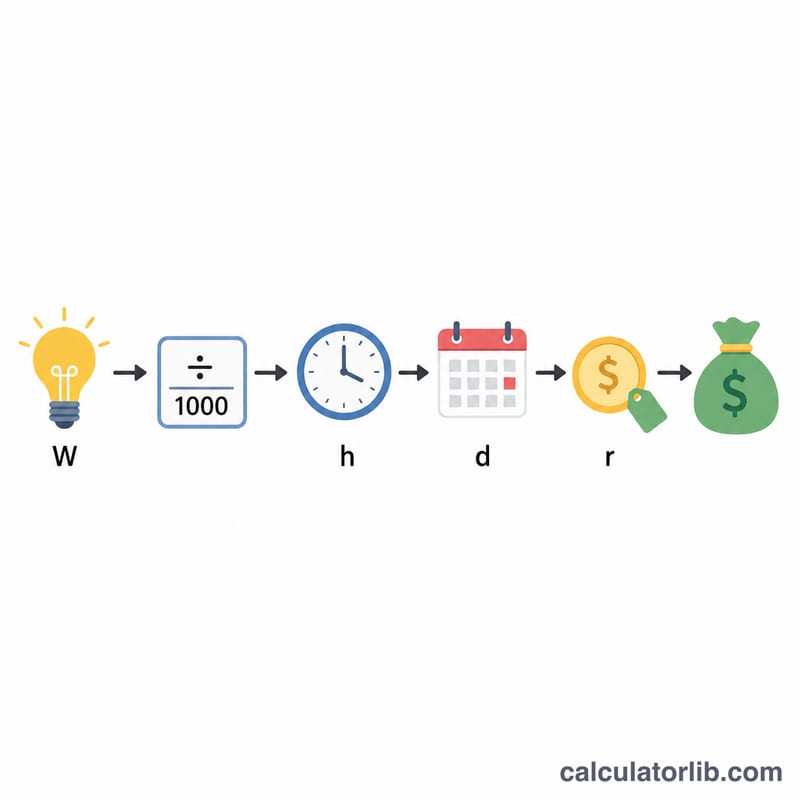
Electricity is billed in kilowatt-hours. First convert watts to kilowatts by dividing by 1000. Multiply by the hours of daily use to get daily energy (kWh), then by the number of days to get monthly energy. Finally multiply by your rate:
$$\text{Cost} = \frac{\text{W}}{1000} \times \text{hours per day} \times \text{days} \times \text{rate}$$
Worked example
Suppose a 1000 W space heater runs 5 hours a day at a rate of 0.15 per kWh over 30 days. Daily energy = \(\frac{1000}{1000} \times 5 = 5\) kWh. Monthly energy = \(5 \times 30 = 150\) kWh. Monthly cost = \(150 \times 0.15 =\) 22.50. Daily cost is 0.75 and the yearly cost is about 273.75.
Typical Wattage of Common Household Devices
The table below lists approximate running power for common household devices. These are rough ranges only. Real consumption varies with the model, age, settings and load. The nameplate or label on the device, or its manual, is the authority for the actual wattage.
| Device | Typical running power (W) |
|---|---|
| LED bulb | 8–12 W |
| Laptop | about 50 W |
| Desktop / gaming PC | 200–500 W |
| Television | 50–150 W |
| Refrigerator (while the compressor runs) | 100–250 W |
| Window air conditioner | 500–1500 W |
| Space heater | 750–1500 W |
| Washing machine | about 500 W |
| Microwave | 600–1200 W |
| Electric kettle | 1500–2000 W |
Some nameplates show the maximum or rated power, which can be higher than what the device draws in everyday use. A plug-in power meter gives the most accurate reading.
How to Calculate Monthly Cost by Hand
- Find the watts. Read the nameplate, the manual, or a plug-in power meter.
- Convert to kilowatts. Divide the watts by 1000. For example, 200 W ÷ 1000 = 0.2 kW.
- Find daily kWh. Multiply kW by the hours used per day: 0.2 kW × 6 h = 1.2 kWh per day.
- Find monthly kWh. Multiply by the days of use: 1.2 kWh × 30 days = 36 kWh.
- Apply your rate. Multiply by the price per kWh from your bill: 36 kWh × 0.15 = 5.40 per month.
The whole calculation in one line:
$$\text{Monthly Cost} = \frac{W}{1000} \times h \times d \times r = \frac{200}{1000} \times 6 \times 30 \times 0.15 = 5.40$$
Shortcut: \(\text{kWh} = W \times h \div 1000\). Compute the kWh first, then multiply by the rate.
Duty cycle: Some devices do not draw full power all the time. A refrigerator compressor may run only about 30–40% of the day. Multiply the hours by that fraction to get effective hours. For a 150 W fridge at 35%: 24 h × 0.35 = 8.4 effective hours, so 150 ÷ 1000 × 8.4 × 30 = 37.8 kWh per month. The same idea applies to thermostat-controlled heaters and air conditioners.
Your bill may also include fixed charges, taxes or tiered rates that this simple method does not capture, so treat the result as an estimate.
FAQ
Where do I find the watts? Check the device label, nameplate, power adapter, or manual. If only amps and volts are listed, watts = volts \(\times\) amps.
What if usage varies day to day? Use your average daily hours — for example, 0.5 hours if you run something 3.5 hours per week.
Does this include standby power? No. Many devices draw a small amount on standby; add those hours if you want a fuller estimate.