
What this calculator does
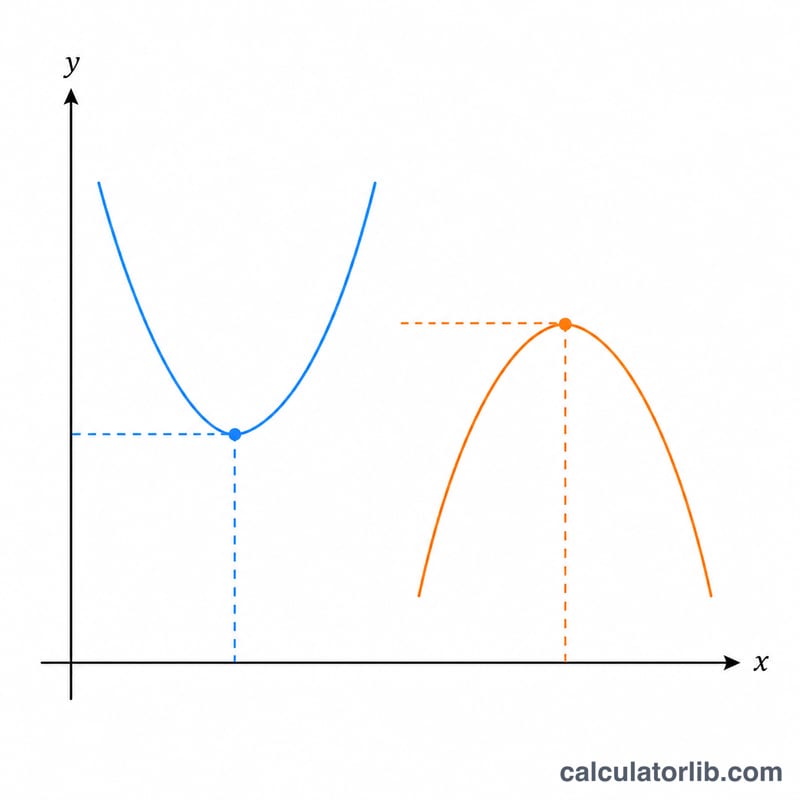
This tool finds the turning point (vertex) of a quadratic function \(f(x) = ax^2 + bx + c\) and reports its minimum or maximum value. When a is positive the parabola opens upward and the vertex is the lowest point — a minimum. When a is negative the parabola opens downward and the vertex is the highest point — a maximum. The tool works for any real coefficients as long as a is not zero.
How to use it
Enter the three coefficients a, b and c from your equation written in standard form \(ax^2 + bx + c\). The calculator returns the x-coordinate of the vertex, the extreme value (the y-coordinate), and whether that value is a minimum or maximum. If you accidentally set \(a = 0\) the expression is linear, not quadratic, and the calculator will prompt you to use a non-zero a.
The formula explained
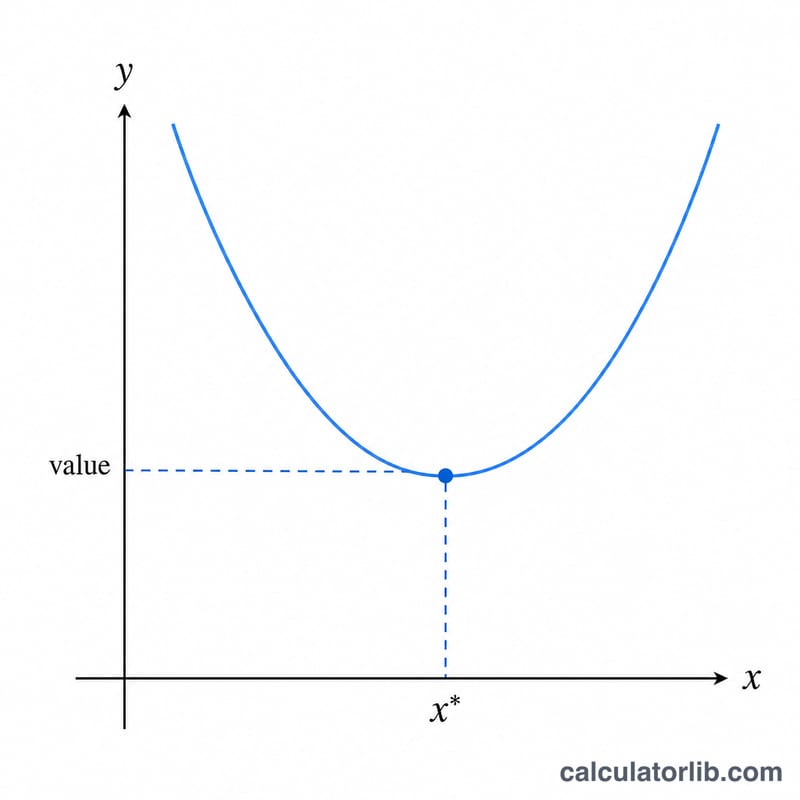
The vertex lies on the axis of symmetry, found by setting the derivative to zero: \(x^* = -b/(2a)\). Substituting this back into the function and simplifying gives the extreme value directly as $$\text{value} = c - \frac{b^2}{4a}.$$ This is algebraically identical to completing the square, which rewrites the quadratic as \(a(x - x^*)^2 + \text{value}\).
Worked example
Take \(f(x) = x^2 - 4x + 3\), so \(a = 1\), \(b = -4\), \(c = 3\). The vertex $$x^* = \frac{-(-4)}{2 \cdot 1} = 2.$$ The minimum $$\text{value} = 3 - \frac{(-4)^2}{4 \cdot 1} = 3 - \frac{16}{4} = 3 - 4 = -1.$$ Because \(a > 0\) the parabola opens upward, so \(-1\) is a minimum, reached at \(x = 2\).
FAQ
Is the answer a minimum or a maximum? It is a minimum when \(a > 0\) (opens upward) and a maximum when \(a < 0\) (opens downward).
What if a equals 0? Then the function is linear and has no vertex; enter a non-zero a.
Does this give the range of the function? Yes — for \(a > 0\) the range is \([\text{value}, \infty)\); for \(a < 0\) it is \((-\infty, \text{value}]\).