What this calculator does
This Electricity Usage Calculator turns an appliance's power rating and how long you run it each day into an estimated monthly electricity cost. It works for any device that lists wattage — heaters, air conditioners, refrigerators, TVs, gaming PCs, water pumps, lights and more — and uses your own local electricity rate, so it applies to any country.
How to use it
Enter the appliance power in watts (check the label or nameplate), how many hours it runs per day, the number of days you want to count in the month, and your electricity rate per kilowatt-hour (kWh) from your utility bill. The calculator returns the monthly cost plus the daily cost and the energy consumed.
The formula explained
Electricity is billed per kilowatt-hour. One kWh is 1,000 watts running for one hour. So we first convert watts to kilowatts (divide by 1,000), multiply by hours per day to get daily kWh, multiply by days to get monthly kWh, then multiply by your rate:
$$\text{Monthly Cost} = \frac{\text{Watts}}{1000} \times \text{Hours/day} \times \text{Days} \times \text{Rate}$$

Worked example
A 1,500 W space heater used 5 hours a day for 30 days at $0.15/kWh: \((1500 \div 1000) = 1.5\) kW. \(1.5 \times 5 = 7.5\) kWh per day. \(7.5 \times 30 = 225\) kWh per month. \(225 \times \$0.15 =\) $33.75 per month.
Typical Appliance Wattage Reference
The values below are approximate typical ranges for common household appliances. Real products vary by model, age, size and settings, so always use the wattage on the appliance's nameplate or label (or its manual) when you have it. Nameplate values take priority over this table.
| Appliance | Approximate typical power (W) |
|---|---|
| LED bulb | 5–15 W |
| Ceiling fan | 50–75 W |
| Television | 50–150 W |
| Refrigerator (running average) | 100–250 W |
| Laptop | 30–90 W |
| Gaming PC | 200–500 W |
| Microwave oven | 600–1,200 W |
| Space heater | 750–1,500 W |
| Window air conditioner | 500–1,500 W |
| Electric water heater | 3,000–4,500 W |
| Washing machine | 400–1,000 W |
Note that some appliances, such as refrigerators, air conditioners and heaters with thermostats, cycle on and off. Their average draw over a day is lower than their rated power, so use realistic "hours of actual running" for the best estimate.
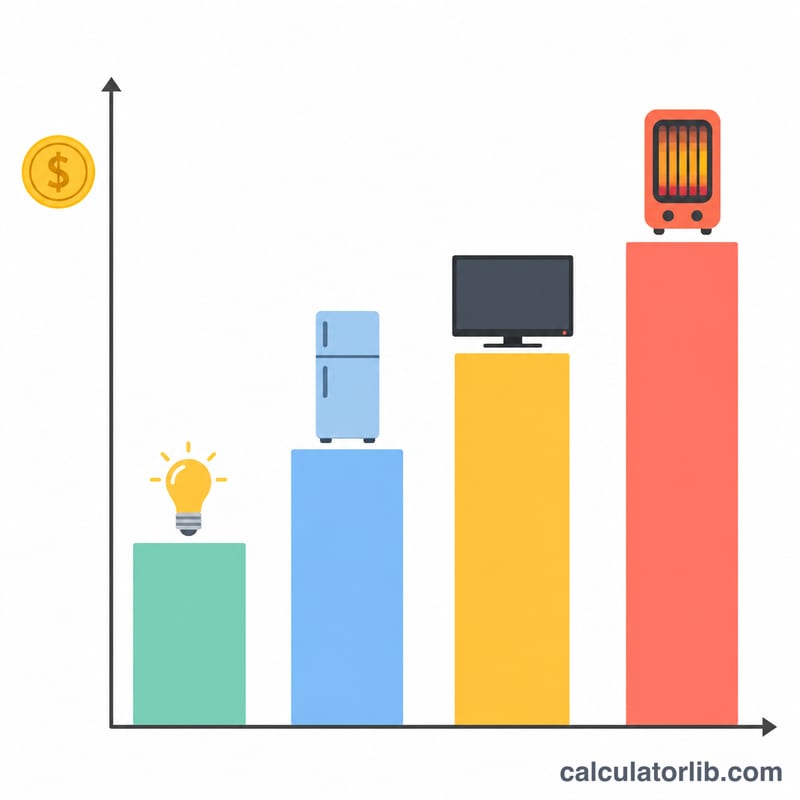
Monthly Cost Comparison for Common Appliances
Assumptions: 30 days per month and a rate of $0.15 per kWh (an example rate only; check your own bill). Formulas: kWh = W ÷ 1000 × hours × 30, and cost = kWh × rate.
| Appliance | Power | Hours/day | Monthly kWh | Monthly cost |
|---|---|---|---|---|
| LED bulb | 10 W | 6 | 0.01 × 6 × 30 = 1.8 kWh | $0.27 |
| Television | 150 W | 4 | 0.15 × 4 × 30 = 18 kWh | $2.70 |
| Gaming PC | 300 W | 4 | 0.3 × 4 × 30 = 36 kWh | $5.40 |
| Space heater | 1,500 W | 5 | 1.5 × 5 × 30 = 225 kWh | $33.75 |
| Air conditioner | 1,000 W | 8 | 1 × 8 × 30 = 240 kWh | $36.00 |
Effect of rate: the same 1,000 W air conditioner running 8 hours a day for 30 days uses 240 kWh either way, but it costs $36.00 at $0.15/kWh and $72.00 at $0.30/kWh. Cost scales linearly with your rate.
Worked example: \(\frac{1500}{1000} \times 5 \times 30 \times 0.15 = 1.5 \times 5 \times 30 \times 0.15 = 225 \times 0.15 = 33.75\) dollars.
Energy and Power Unit Conversions
| Quantity | Equivalent |
|---|---|
| 1 kilowatt (kW) | 1,000 W |
| 1 kilowatt-hour (kWh) | 3.6 MJ = 3,600 kJ |
| 1 horsepower (mechanical) | ≈ 745.7 W |
| 1 horsepower (metric) | ≈ 735.5 W |
| 1 BTU/h | ≈ 0.2931 W |
| 1 ton of refrigeration | 12,000 BTU/h ≈ 3,517 W |
Electrical power: for DC circuits and single-phase purely resistive loads, \(W = V \times A\). For AC loads with motors or electronics, real power is lower than V × A by the power factor, so use the rated watts where possible.
Example: a 12,000 BTU/h air conditioner has a cooling capacity of about 3,517 W, but it draws far less electrical power than that, because an air conditioner moves heat rather than creating it. Check the electrical rating on its label for cost estimates.
FAQ
Where do I find the wattage? It's usually printed on the appliance label, nameplate, or in the manual. If only amps and volts are listed, multiply them (\(W = V \times A\)).
What rate should I use? Use the per-kWh price on your electricity bill. Some plans have tiered or time-of-use rates — use your average for a rough estimate.
Is this exact? It's an estimate. Real usage varies with how the device cycles on and off (e.g. fridges and ACs), so actual costs may differ.