What this calculator does
Paste a protein sequence in one-letter amino-acid code and the calculator returns its average molecular weight in daltons and its molar extinction coefficient at 280 nm. With these two numbers you can turn a spectrophotometer reading into a protein concentration. FASTA header lines starting with > and any non-letter characters are stripped automatically.
How to use it
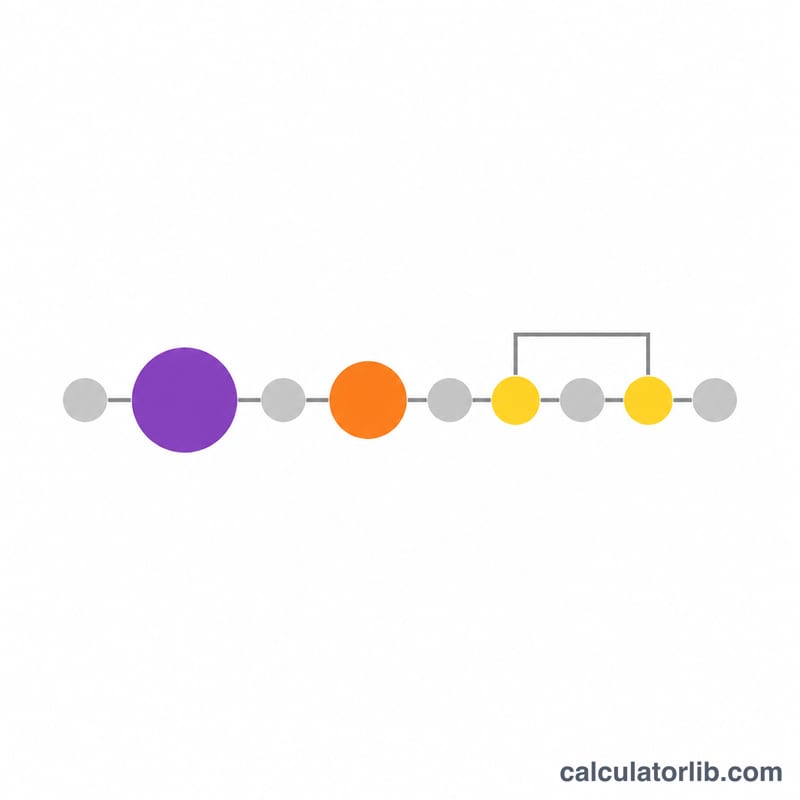
Enter the sequence, then state how many disulfide bonds (cystine pairs) are formed. Leave it at 0 for a reduced protein; the value is capped at half the number of cysteines. Optionally enter a measured A280 and the cuvette path length (usually 1 cm) to obtain the concentration in micromolar and mg/mL.
The formulas
The extinction coefficient uses the Pace method, where \(n_W\) is the number of tryptophans, \(n_Y\) the number of tyrosines and \(n_{SS}\) the number of disulfide bonds:
$$\varepsilon_{280} = 5500\,n_W + 1490\,n_Y + 125\,n_{SS}$$The molecular weight is the sum of average residue masses \(m_i\) plus one water molecule (18.01524 Da), minus about 2.016 Da for each disulfide bond, because forming a bond removes two hydrogens:
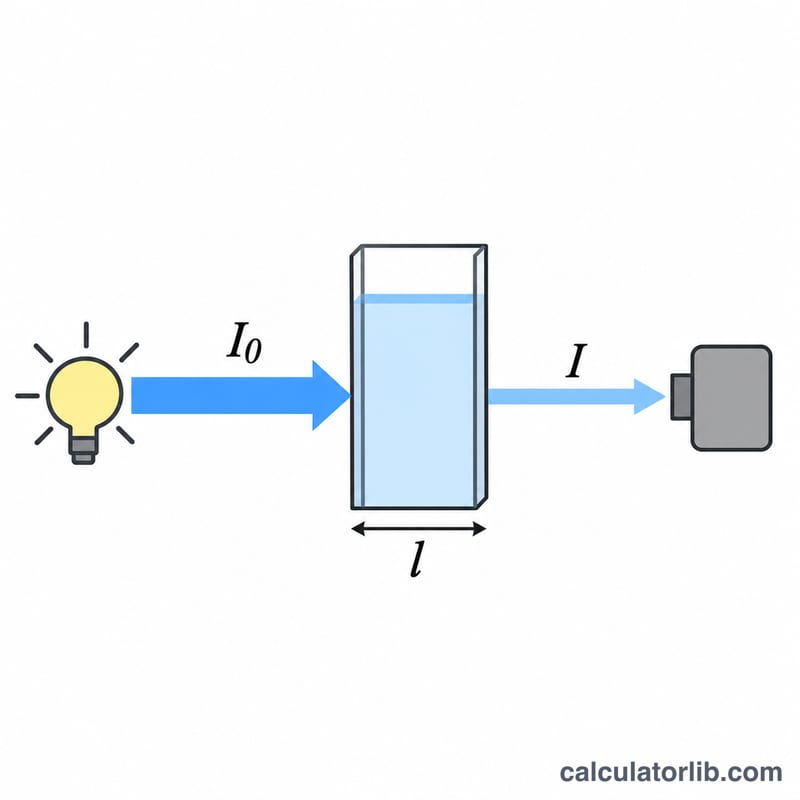
$$MW = \sum_i m_i + 18.01524 - 2.01588\,n_{SS}$$Concentration follows the Beer-Lambert law, \(c = A/(\varepsilon\,l)\), and in mg/mL it equals \(c \times MW\) with \(c\) in mol/L.
Worked example
Take the tripeptide AWY with no disulfides. The residues sum to 71.0788 + 186.2132 + 163.1760 = 420.4680 Da, and adding water gives:
$$MW = 420.468 + 18.01524 = 438.483\,\text{Da}$$$$\varepsilon_{280} = 5500 + 1490 = 6990\,\text{M}^{-1}\text{cm}^{-1}$$An A280 of 1.0 in a 1 cm cell then gives \(c = 1/6990 = 143.1\,\mu\text{M}\), or 0.0627 mg/mL.
Average Residue Masses of the 20 Amino Acids
The calculator sums the average residue mass of every amino acid in the sequence. A residue is the amino acid minus one water (H2O), which is lost when the peptide bond forms. Masses are in daltons (Da, equal to g/mol).
| Amino acid | 3-letter | 1-letter | Average residue mass (Da) |
|---|---|---|---|
| Glycine | Gly | G | 57.0519 |
| Alanine | Ala | A | 71.0788 |
| Serine | Ser | S | 87.0782 |
| Proline | Pro | P | 97.1167 |
| Valine | Val | V | 99.1326 |
| Threonine | Thr | T | 101.1051 |
| Cysteine | Cys | C | 103.1388 |
| Leucine | Leu | L | 113.1594 |
| Isoleucine | Ile | I | 113.1594 |
| Asparagine | Asn | N | 114.1038 |
| Aspartic acid | Asp | D | 115.0886 |
| Glutamine | Gln | Q | 128.1307 |
| Lysine | Lys | K | 128.1741 |
| Glutamic acid | Glu | E | 129.1155 |
| Methionine | Met | M | 131.1926 |
| Histidine | His | H | 137.1411 |
| Phenylalanine | Phe | F | 147.1766 |
| Arginine | Arg | R | 156.1875 |
| Tyrosine | Tyr | Y | 163.1760 |
| Tryptophan | Trp | W | 186.2132 |
After summing all residues, 18.01524 Da (one water) is added for the free N-terminal H and C-terminal OH of the chain. Each disulfide bond then subtracts 2.01588 Da (two hydrogen atoms).
Constants and Coefficients Used
The extinction coefficient at 280 nm follows the Pace method, which estimates ε from the number of Trp, Tyr and cystine residues for a protein in its native, folded state.
| Quantity | Value |
|---|---|
| ε280 of Trp | 5500 M-1 cm-1 |
| ε280 of Tyr | 1490 M-1 cm-1 |
| ε280 of cystine (disulfide) | 125 M-1 cm-1 |
| Water added per chain | 18.01524 Da |
| Mass lost per disulfide bond | 2.01588 Da |
| Default path length | 1 cm |
| Mass units | 1 Da = 1 g/mol; 1 kDa = 1000 Da |
Key relationships:
$$\varepsilon = 5500\,n_W + 1490\,n_Y + 125\,N_{SS}$$
$$A_{0.1\%} = \frac{ \varepsilon }{ M }$$
The number of disulfides used is capped at \(\lfloor n_C/2 \rfloor\), because each disulfide needs two cysteines. Here \(n_W\), \(n_Y\) and \(n_C\) are the counts of Trp, Tyr and Cys in the sequence. A0.1% is the absorbance of a 1 mg/mL solution in a 1 cm path.
Key Terms and Definitions
- Molar extinction coefficient (ε)
- How strongly a substance absorbs light at a given wavelength, per mole per liter per cm of path. It is given in M-1 cm-1. For proteins at 280 nm it is dominated by Trp and Tyr, with a small contribution from disulfides.
- A0.1%
- The absorbance at 280 nm of a 0.1% (1 mg/mL) protein solution in a 1 cm path. It equals ε divided by the molecular weight in Da.
- A280
- The absorbance measured at 280 nm, used to estimate protein concentration.
- Path length
- The distance in cm that light travels through the sample, usually 1 cm for a standard cuvette. Microvolume instruments often use shorter paths.
- Cystine / disulfide bond
- A covalent S–S link formed between two cysteine side chains. Forming it removes two hydrogen atoms (2.01588 Da) and adds a small absorbance at 280 nm.
- Average molecular weight vs. monoisotopic mass
- Average molecular weight weights every element by its natural isotope abundance. It is the value used for concentration and stoichiometry. Monoisotopic mass uses only the most abundant isotope of each element. It is the value used in high-resolution mass spectrometry of smaller peptides.
- Dalton (Da) and kilodalton (kDa)
- 1 Da is numerically equal to 1 g/mol. 1 kDa = 1000 Da.
- Beer-Lambert law
- Absorbance is proportional to concentration and path length: \(A = \varepsilon \cdot c \cdot l\). Rearranged, \(c = A / (\varepsilon \cdot l)\), which gives molar concentration when ε is in M-1 cm-1 and l is in cm. It holds best at absorbances of roughly 0.1 to 1.
FAQ
Why can the result differ from my measurement?
The Pace method is a prediction. Folding, bound cofactors, and nearby residues can shift the true value by several percent, so use a measured coefficient when accuracy matters.
What if my protein has no Trp or Tyr?
The extinction coefficient will be zero or very small, so A280 is not a usable concentration method. Try A205 or a colorimetric assay.
Does it include post-translational modifications?
No. Glycosylation, phosphorylation, tags removed by cleavage, and other modifications are not accounted for.