
What Is Molecular Weight?
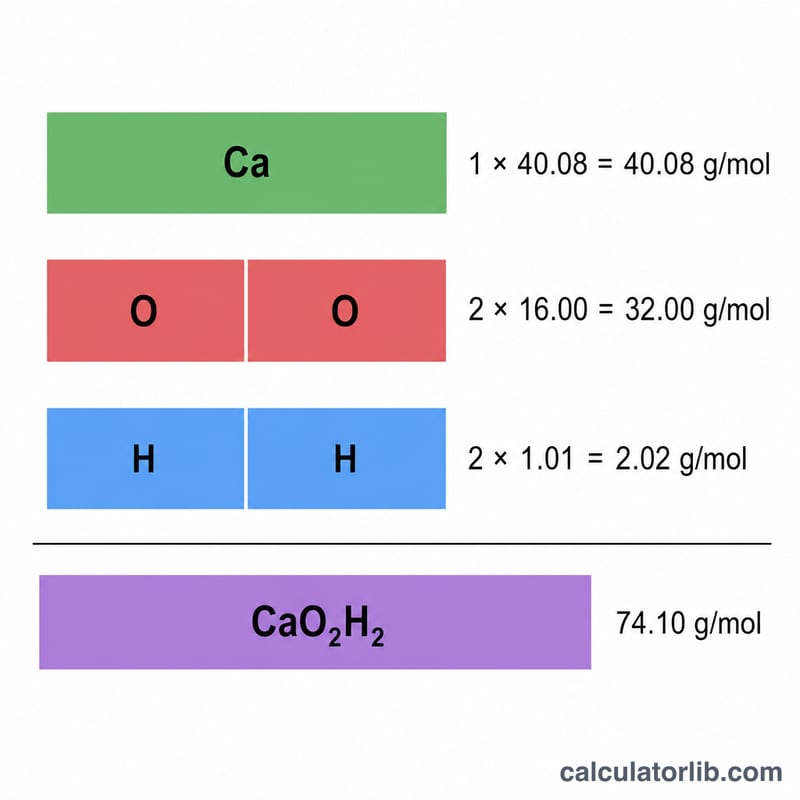
Molecular weight (also called molar mass) is the mass of one mole of a substance, expressed in grams per mole (g/mol). It equals the sum of the atomic masses of every atom present in a chemical formula. This calculator parses a formula, counts each element — including groups wrapped in parentheses — and multiplies each count by its standard atomic weight.
How to Use It
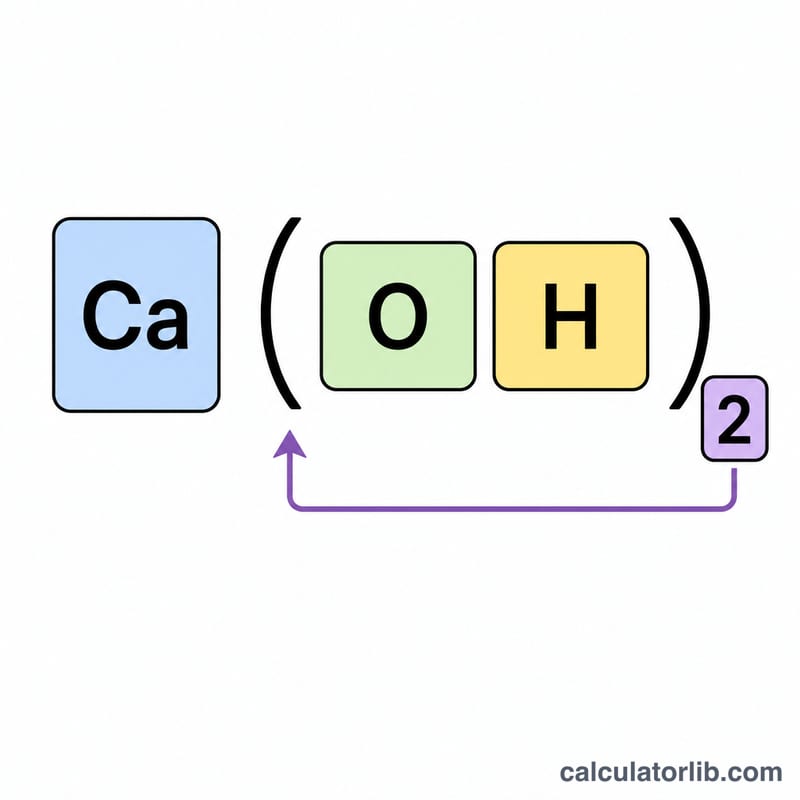
Type a chemical formula using standard, case-sensitive element symbols. Element symbols start with a capital letter and may have a lowercase second letter (e.g. Na, Cl). Numbers after a symbol are subscript counts, and you can use parentheses with a multiplier, such as Ca(OH)2 or Al2(SO4)3. Press calculate to see the molar mass in g/mol along with the total number of atoms.
The Formula Explained
The molecular weight is computed as $$\text{MW} = \sum_i \left( \text{count}_i \times \text{atomic mass}_i \right)$$ For each distinct element, multiply how many atoms appear by that element's atomic mass, then add the products together. Parentheses distribute their inner counts by the trailing multiplier before summing.
Worked Example
For glucose, C₆H₁₂O₆: carbon contributes \(6 \times 12.011 = 72.066\), hydrogen \(12 \times 1.008 = 12.096\), and oxygen \(6 \times 15.999 = 95.994\). Adding these gives $$72.066 + 12.096 + 95.994 = 180.156 \text{ g/mol}$$ the molar mass of glucose.
FAQ
Are symbols case-sensitive? Yes. "CO" means carbon and oxygen, while "Co" means cobalt. Always capitalize the first letter and lowercase the second.
Which atomic masses are used? Standard atomic weights (IUPAC conventional values) for the most common elements.
Can I use hydrates or dots? The dot notation (e.g. CuSO4·5H2O) is not parsed; enter the combined formula instead, such as CuSO9H10.