What Is a Car Lease Payment Calculator?
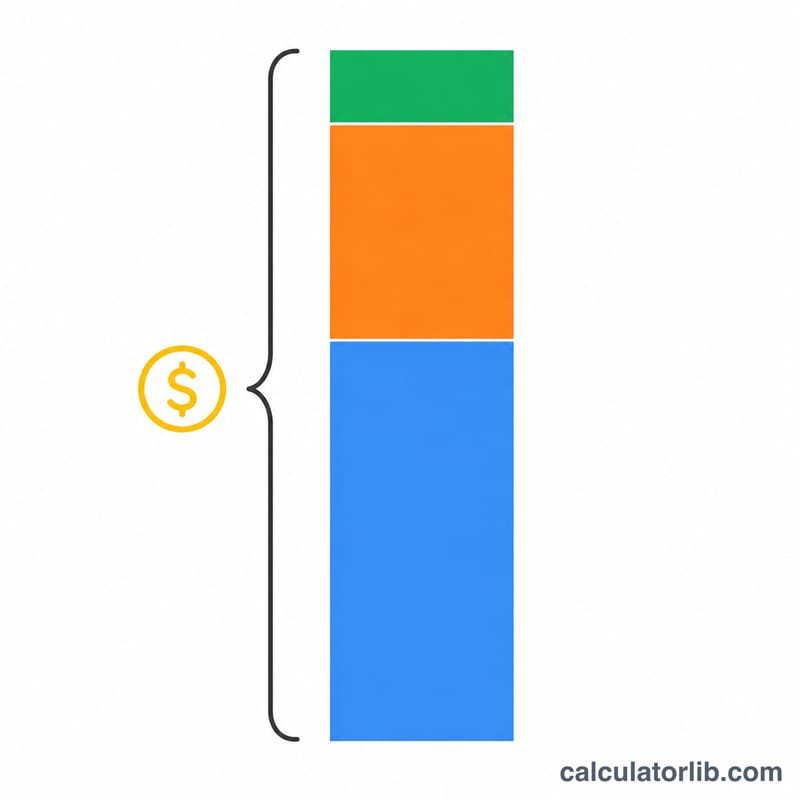
This calculator estimates your monthly auto lease payment using the standard method common in the United States. A lease payment is made up of three parts: a depreciation fee (paying for the value the car loses while you drive it), a finance (rent) fee (the lessor's interest charge), and sales tax applied to the monthly amount. Note that tax treatment varies by state — some tax the full vehicle price up front rather than the monthly payment — so treat the result as an estimate.
How to Use It
Enter the capitalized cost (the negotiated price you agreed to pay), any down payment or cap cost reduction, and the residual value (what the car is worth at lease end, usually set by the leasing company). Add the lease term in months, the money factor (the lease's interest rate; multiply by 2400 to approximate the APR), and your local sales tax rate. The tool returns your monthly payment and a breakdown of each component.
The Formula Explained
First the net capitalized cost is found: $$C_{net} = \text{cap cost} - \text{down payment}$$ The depreciation fee is \(\frac{C_{net} - \text{residual}}{\text{term}}\). The finance fee is \((C_{net} + \text{residual}) \times \text{money factor}\). Add them for the base payment, then add tax: \(\text{base} \times \frac{\text{tax\%}}{100}\).
$$M = \left( \frac{C-R}{n} + (C+R)\cdot f \right)\left(1 + \frac{t}{100}\right)$$where
$$\left\{ \begin{aligned} C &= \text{Cap Cost} - \text{Down Payment} \\ R &= \text{Residual} \\ n &= \text{Term (months)} \\ f &= \text{Money Factor} \\ t &= \text{Tax Rate (\%)} \end{aligned} \right.$$Worked Example
Cap cost $30,000, down payment $2,000, residual $18,000, term 36 months, money factor 0.00125, tax 7%. Net cap = $28,000. Depreciation = \(\frac{28{,}000 - 18{,}000}{36} = \$277.78\). Finance = \((28{,}000 + 18{,}000) \times 0.00125 = \$57.50\). Base = $335.28. Tax = \(\$335.28 \times 0.07 = \$23.47\). Monthly payment ≈ $358.75.
How Lease Payments Change Across Scenarios
The table starts from a $30,000 cap cost (assumed here to equal the MSRP) and a 7% sales tax applied to the monthly payment, which is the US method used by this calculator. The baseline is a 36-month term, no down payment, a money factor of 0.00125 and a residual of $18,000 (60% of MSRP). Each row changes one input from that baseline. For the 24- and 48-month rows the residual is adjusted to 65% ($19,500) and 55% ($16,500). These residual percentages are illustrative, not quoted by any lessor.
| Scenario | Adjusted cap cost | Residual | Depreciation / mo | Finance fee / mo | Tax / mo | Total monthly payment |
|---|---|---|---|---|---|---|
| Baseline: $0 down, MF 0.00125, 36 mo | $30,000 | $18,000 | $333.33 | $60.00 | $27.53 | $420.87 |
| $2,000 down | $28,000 | $18,000 | $277.78 | $57.50 | $23.47 | $358.75 |
| $4,000 down | $26,000 | $18,000 | $222.22 | $55.00 | $19.41 | $296.63 |
| Money factor 0.00250 ($0 down, 36 mo) | $30,000 | $18,000 | $333.33 | $120.00 | $31.73 | $485.07 |
| 24 months (residual 65%) | $30,000 | $19,500 | $437.50 | $61.88 | $34.96 | $534.33 |
| 48 months (residual 55%) | $30,000 | $16,500 | $281.25 | $58.13 | $23.76 | $363.13 |
Example of the formula for the $4,000-down row: \(C = 30{,}000 - 4{,}000 = 26{,}000\). Depreciation is \((26{,}000 - 18{,}000)/36 = 222.22\). The finance fee is \((26{,}000 + 18{,}000)\times 0.00125 = 55.00\). The subtotal is 277.22, and \(277.22 \times 1.07 \approx 296.63\).
Totals are calculated from unrounded values, so a total can differ by one cent from the sum of the rounded columns. Key takeaways: a larger down payment lowers both the depreciation and finance parts; doubling the money factor adds to the finance fee only; and a longer term lowers the monthly payment but spreads the cost over more months.
Lease Terms Glossary
- Capitalized cost (cap cost)
- The price the lease is based on, including the negotiated vehicle price plus any fees or add-ons rolled into the lease. It is the starting point for depreciation.
- Cap cost reduction
- Any amount that lowers the capitalized cost, such as a down payment, trade-in equity or rebates. In this calculator, the down payment is subtracted from the cap cost.
- Residual value
- The lessor's estimate of the vehicle's value at the end of the lease. It is typically quoted as a percentage of MSRP and then converted to a dollar amount.
- Money factor
- The lease's financing rate, expressed as a small decimal such as 0.00125. Multiplying it by 2400 approximates an APR.
- Lease term
- The length of the lease in months, commonly 24, 36 or 48.
- Depreciation fee
- The portion of the payment that covers the vehicle's expected loss in value: (cap cost − residual) ÷ term.
- Finance (rent) fee
- The portion of the payment that covers financing cost: (cap cost + residual) × money factor.
- Acquisition fee
- A fee charged by the lessor to set up the lease. It is sometimes paid upfront and sometimes added to the cap cost.
- Disposition fee
- A fee that may be charged at lease end to cover the lessor's cost of handling and reselling the returned vehicle. It is often waived if you lease or buy another vehicle from the same brand.
- MSRP
- Manufacturer's Suggested Retail Price, the sticker price before negotiation. Residual percentages are usually applied to the MSRP, not to the negotiated price.
Interpreting Your Lease Payment Result
Money factor and APR. Multiplying a money factor by 2400 gives an approximate annual percentage rate. This is a convention used in US car leasing.
| Money factor | Approximate APR (MF × 2400) |
|---|---|
| 0.00125 | 3% |
| 0.00250 | 6% |
| 0.00333 | 8% (7.99%) |
Depreciation share vs finance share. The pre-tax payment has two parts. The depreciation part is the cost of the value the car loses during the term. The finance part is the cost of borrowing. In the baseline scenario ($30,000 cap cost, $18,000 residual, 36 months, MF 0.00125), depreciation is $333.33 and the finance fee is $60.00. That makes depreciation about 85% of the $393.33 pre-tax payment and finance about 15%. A large finance share suggests that the money factor or the cap cost plus residual total is driving the cost. A large depreciation share suggests that the gap between cap cost and residual is the main driver.
Residual value. The residual percentage of MSRP is set by the lessor, often based on projected resale values, and it is generally not negotiable. A higher residual means less depreciation to pay for, and so a lower payment, all else equal. A lower cap cost has the same effect.
What the result leaves out. The calculation covers only depreciation, the finance fee and tax on the monthly payment. It does not include acquisition fees, disposition fees, registration and title fees, insurance, or any mileage and wear charges. Sales-tax treatment of leases differs by US state: some tax the monthly payment, some tax the full cap cost upfront, and some exempt certain components. Check your state's rules and your lease contract. This is general information, not financial advice.
Central bank policy rates today
The latest official policy rates of major central banks, updated automatically — the benchmark that bank deposit and loan rates follow.
- Federal Reserve · United States
- 3.75–4.00%
- As of
- 2026-11-13
- Change in 1 year
- 0 pp
Latest change Up +25 bp Federal Reserve changed its rate on 2026-09-17: from 3.50–3.75% to 3.75–4.00%.
| Central bank | Policy rate | As of | Change in 1 year |
|---|---|---|---|
| Banco Central do Brasil (Selic) · Brazil | 13.75% | 2026-11-16 | −1.25 pp |
| Banco de México · Mexico | 6.25% | 2026-11-10 | −1.00 pp |
| Federal Reserve · United States | 3.75–4.00% | 2026-11-13 | 0 pp |
| ECB | 2.50% | 2026-11-16 | +0.50 pp |
| Sveriges Riksbank · Sweden | 2.00% | 2026-11-16 | +0.25 pp |
| Saudi Central Bank (SAMA) · Saudi Arabia | 4.50% | 2026-10-29 | 0 pp |
| Reserve Bank of Australia · Australia | 4.60% | 2026-10-31 | +1.00 pp |
| Central Bank of the Republic of Türkiye · Türkiye | 36.00% | 2026-11-06 | −3.50 pp |
| Bank of Russia · Russia | 14.00% | 2026-11-10 | −2.50 pp |
| People’s Bank of China · China | 3.00% | 2026-11-10 | 0 pp |
| Bank of Canada · Canada | 2.50% | 2026-11-13 | +0.25 pp |
| Reserve Bank of India · India | 5.50% | 2026-10-19 | 0 pp |
| Bank of England · United Kingdom | 4.00% | 2026-11-16 | 0 pp |
| Bank of Japan · Japan | 1.25% | 2026-11-10 | +0.75 pp |
| Bank of Korea · South Korea | 3.00% | 2026-11-02 | +0.50 pp |
Federal Reserve: key rates and overnight market rates
The rates that frame monetary policy and the overnight market rate they steer, each with the date of its latest published value.
| Rate | Level | As of | Change in 1 year |
|---|---|---|---|
| Federal funds target range | 3.75–4.00% | 2026-11-13 | 0 pp |
| Effective federal funds rate (EFFR) | 3.88% | 2026-11-13 | 0 pp |
| Secured Overnight Financing Rate (SOFR) | 3.90% | 2026-11-13 | −0.10 pp |
Each rate keeps the date of its own latest published value; overnight market rates are published on the next business day.
Latest figure: 2026-11-13 Data last updated 2026-11-16 · current
Source: Banco Central do Brasil ODbL; Bank for International Settlements (BIS) Terms of permitted use of BIS statistics; Federal Reserve Bank of New York New York Fed Terms of Use; Board of Governors of the Federal Reserve System Public domain (U.S. government work); European Central Bank ECB reuse policy; Sveriges Riksbank Riksbank open data terms; The World Bank Group CC BY 4.0; Reserve Bank of Australia 2026 RBA copyright terms (Cash Rate); Bank of Canada Bank of Canada terms of use; Bank of England Open Government Licence v3.0
The one-year change is computed by CalculatorLib from these data. The EFFR and SOFR are subject to the Terms of Use posted at newyorkfed.org. The New York Fed is not responsible for publication of the EFFR and SOFR by CalculatorLib, does not sanction or endorse any particular republication, and has no liability for your use.
Source details and methodology
- Banco Central do Brasil
- Bank for International Settlements (BIS) — Central bank policy rates
- Federal Reserve Bank of New York — Reference rates (EFFR, SOFR)
- Board of Governors of the Federal Reserve System
- European Central Bank
- Sveriges Riksbank
- The World Bank Group — World Development Indicators (FR.INR.LEND, FR.INR.RINR)
- Reserve Bank of Australia 2026
- Bank of Canada
- Bank of England
FAQ
What is a money factor? It's the lease equivalent of an interest rate. Multiply it by 2,400 to get the approximate APR — \(0.00125 \approx 3\%\).
Why does a down payment lower my payment? A cap cost reduction lowers the amount being financed, reducing both the depreciation and finance portions of every payment.
Is this exact for my state? No. Tax rules differ widely; some states tax the entire selling price, the down payment, or use other methods. Use this for planning and confirm with your dealer.