What Is the Car Payment Affordability Calculator?
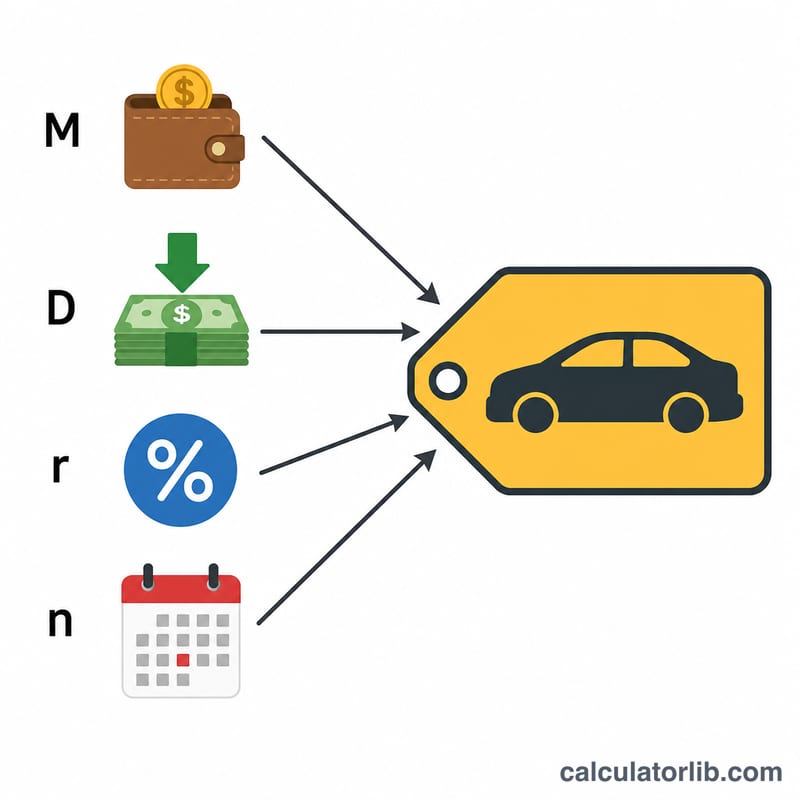
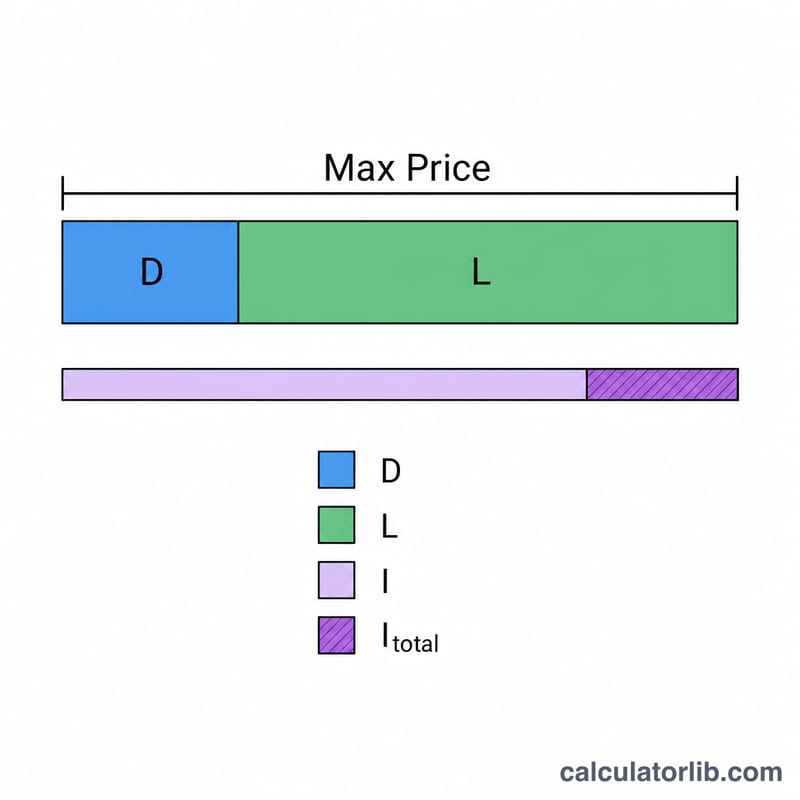
This calculator works backward from your monthly budget to tell you the maximum car price you can afford. Instead of starting with a sticker price, you enter how much you can comfortably pay each month, your down payment, the loan's annual interest rate (APR), and the term in months. It then computes the largest loan you can support and adds your down payment to reveal the total vehicle price within reach.
How to Use It
Enter your monthly payment budget, the cash you plan to put down, the APR your lender quotes, and the loan term in months. The result shows the maximum car price, the financed loan amount, and the total interest you would pay over the life of the loan. Adjust the inputs to see how a larger down payment or shorter term changes what you can afford.
The Formula Explained
The financed loan amount is the present value of an annuity:
$$\text{loan} = M \cdot \frac{1 - (1+r)^{-n}}{r}$$where M is the monthly payment, r is the monthly interest rate (\(\text{APR} \div 12 \div 100\)), and n is the number of months. The maximum car price is that loan amount plus your down payment. Total interest equals total payments (\(M \times n\)) minus the financed loan amount.
Worked Example
With a $400 monthly budget, $3,000 down, 6% APR, and a 60-month term: \(r = 0.005\), \(n = 60\). The financed loan \(\approx \$20{,}690.22\), so the maximum car price \(\approx \$23{,}690.22\). Total payments \(= \$400 \times 60 = \$24{,}000\), so total interest \(\approx \$24{,}000 - \$20{,}690.22 = \$3{,}309.78\).
How Term, APR, and Down Payment Change Your Maximum Car Price
The table below fixes the monthly budget at $400 and the down payment at $3,000, then varies the loan term and APR. Each row uses the annuity formula \(\text{Loan} = M \cdot \frac{1-(1+r)^{-n}}{r}\) with \(r = \text{APR}/1200\) and \(n\) in months. Maximum price = loan + $3,000 down, and total interest = \(M \cdot n - \text{Loan}\). Figures are rounded to the nearest dollar and exclude taxes, fees, and insurance.
| Term (months) | APR | Financed loan amount | Maximum car price | Total interest |
|---|---|---|---|---|
| 36 | 4% | $13,548 | $16,548 | $852 |
| 48 | 4% | $17,716 | $20,716 | $1,484 |
| 60 | 4% | $21,720 | $24,720 | $2,280 |
| 72 | 4% | $25,567 | $28,567 | $3,233 |
| 84 | 4% | $29,264 | $32,264 | $4,336 |
| 36 | 6% | $13,148 | $16,148 | $1,252 |
| 48 | 6% | $17,032 | $20,032 | $2,168 |
| 60 | 6% | $20,690 | $23,690 | $3,310 |
| 72 | 6% | $24,136 | $27,136 | $4,664 |
| 84 | 6% | $27,381 | $30,381 | $6,219 |
| 36 | 9% | $12,579 | $15,579 | $1,821 |
| 48 | 9% | $16,074 | $19,074 | $3,126 |
| 60 | 9% | $19,269 | $22,269 | $4,731 |
| 72 | 9% | $22,191 | $25,191 | $6,609 |
| 84 | 9% | $24,862 | $27,862 | $8,738 |
Worked check (60 months, 6% APR): \(r = 6/1200 = 0.005\), so \(\frac{1-1.005^{-60}}{0.005} = \frac{1-0.741372}{0.005} \approx 51.7256\). Loan \(\approx 400 \times 51.7256 = \$20,690\). Max price \(= 20{,}690 + 3{,}000 = \$23,690\). Total interest \(= 400 \times 60 - 20{,}690 = \$3,310\).
Takeaways: moving from 36 to 84 months at 6% raises the affordable price by about $14,200 but multiplies total interest roughly five-fold. A higher APR lowers the price you can reach at every term. Each extra dollar of down payment adds exactly one dollar to the maximum price.
Interpreting Your Result
The maximum price is a pre-tax, pre-fee figure. It assumes your entire monthly budget goes to the loan payment. Sales tax, registration, documentation fees, and add-ons are not included, and neither are insurance, fuel, and maintenance. If those costs are rolled into the loan or paid up front, the car you can actually buy is cheaper than the result shown. Reserve part of your budget, or part of your down payment, for them.
Total interest shows the cost of borrowing. Compare it with total payments (monthly budget × months). In the table, a 60-month loan at 6% costs $3,310 in interest out of $24,000 paid, about 13.8%. An 84-month loan at 9% costs $8,738 out of $33,600, about 26.0%. A higher interest share means more of your money pays for the loan rather than the car.
Longer terms raise the affordable price but also raise interest. Stretching the term lowers the payment per dollar borrowed, so the same budget supports a larger loan. You then pay interest for longer. Cars also lose value quickly, especially in the first years. On a long loan, especially with little or no down payment, the balance can exceed the car's market value. This is called negative equity (being "upside down"), and it becomes a problem if the car is totaled, sold, or traded in before the loan is paid down.
Common rules of thumb. One widely published guideline, often called the 20/4/10 rule, suggests:
- a down payment of at least 20%,
- a loan term of no more than 4 years (48 months),
- total vehicle costs (payment plus insurance, and sometimes fuel) of no more than about 10% of gross income.
Versions of this rule vary between sources, and it is a general benchmark, not a requirement. Your own income, other debts, savings, and local costs matter more. Comparing your result with such benchmarks can show whether a plan is conservative or stretched.
This is general information, not financial advice. Loan terms and rates vary by lender and country, so confirm the actual offer before you commit.
FAQ
Does this include taxes and fees? No — the result is the vehicle price your loan and down payment can cover. Budget extra for sales tax, registration, and dealer fees.
What if my APR is 0%? With a promotional 0% rate, the loan amount is simply your monthly payment times the number of months.
Should I spend my entire budget? Leave room for insurance, fuel, and maintenance. Many advisors suggest keeping total car costs under 15–20% of take-home pay.