
What is linear thermal expansion?
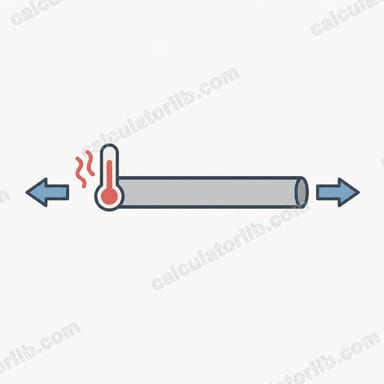
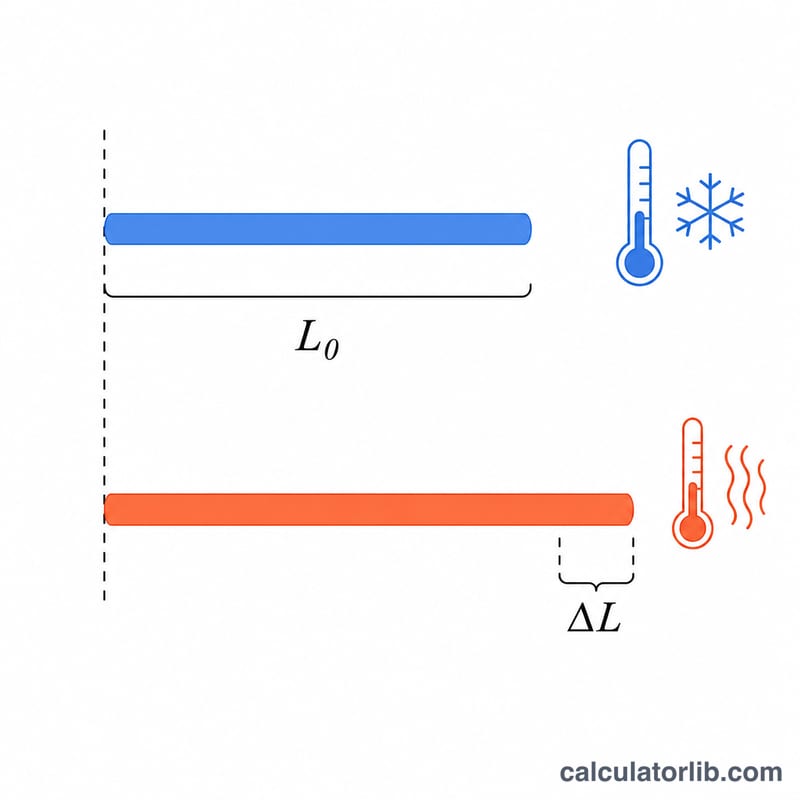
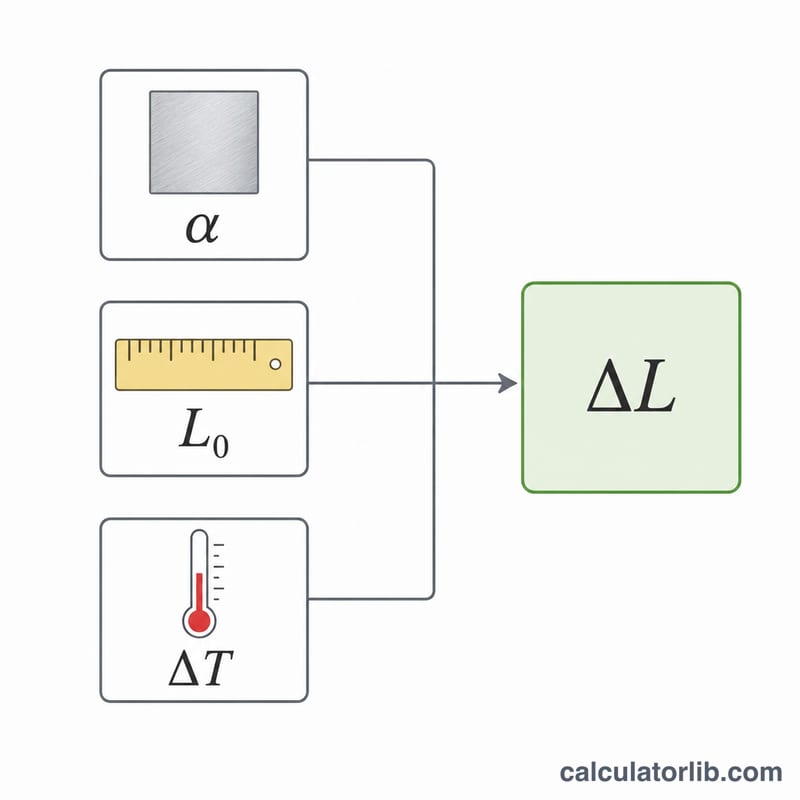
Most solid materials expand when heated and contract when cooled. Linear thermal expansion describes how the length of a one-dimensional object — such as a rod, rail, pipe, or beam — changes with temperature. This calculator computes the change in length (\(\Delta L\)) and the resulting final length using the standard physics relation $$\Delta L = \alpha \times L_0 \times \Delta T.$$ It is a universal physics tool and applies anywhere.
How to use the calculator
Enter four values: the coefficient of linear expansion \(\alpha\) (a material property, in 1/°C), the original length \(L_0\) (in meters), the initial temperature \(T_1\), and the final temperature \(T_2\) (both in °C). The calculator finds the temperature change \(\Delta T = T_2 - T_1\), multiplies it by \(\alpha\) and \(L_0\) to get the expansion \(\Delta L\), and adds it to \(L_0\) for the final length. Typical \(\alpha\) values: steel \(\approx 12\times10^{-6}\), aluminum \(\approx 23\times10^{-6}\), copper \(\approx 17\times10^{-6}\), glass \(\approx 9\times10^{-6}\) per °C.
The formula explained
$$\Delta L = \alpha \cdot L_0 \cdot \Delta T.$$ Here \(\alpha\) (alpha) is how much one unit of length grows per degree of temperature rise. Because the expansion is proportional to the starting length, longer objects expand more for the same temperature change. A negative \(\Delta T\) (cooling) yields a negative \(\Delta L\), meaning the object contracts.
Worked example
An aluminum rod 1 m long (\(\alpha = 23.1\times10^{-6}\) /°C) is heated from 20 °C to 100 °C. \(\Delta T = 80\) °C. $$\Delta L = 0.0000231 \times 1 \times 80 = 0.001848 \text{ m} \approx 1.85 \text{ mm}.$$ The final length is 1.001848 m.
FAQ
Does the unit of length matter? \(\Delta L\) comes out in the same unit you used for \(L_0\). If you enter \(L_0\) in meters, \(\Delta L\) is in meters.
Can I use °F or Kelvin? A temperature difference of 1 K equals 1 °C, so Kelvin works directly. For Fahrenheit you must use an \(\alpha\) expressed per °F, since a 1 °F change is smaller than 1 °C.
What about area or volume expansion? This tool is for length only. Area expansion uses \(\sim 2\alpha\) and volume expansion uses \(\sim 3\alpha\) for isotropic materials.