What Is a Car Lease Calculator?
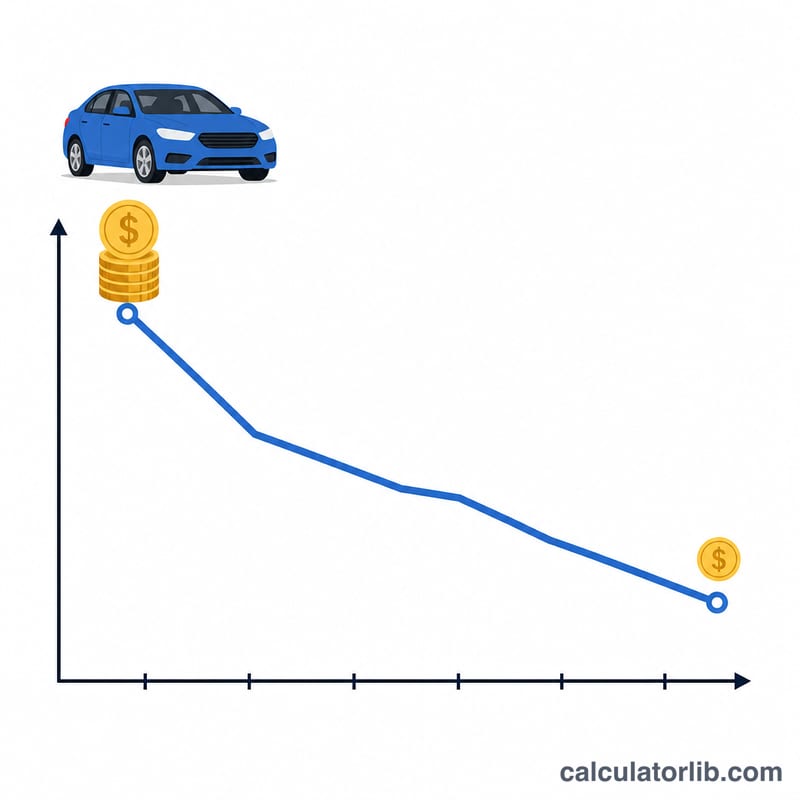
A car lease calculator estimates the monthly payment you'll make when leasing a vehicle instead of buying it. Leasing essentially means paying for the vehicle's depreciation over the lease term plus a finance charge (called the "rent charge"). This tool breaks your payment into those two components and shows the total cost over the lease.
How to Use It
Enter the capitalized cost (the negotiated price of the car plus any added fees), the residual value (the car's predicted worth at lease end, often a percentage of MSRP), the lease term in months, and the money factor from your dealer. Add an optional down payment (cap cost reduction) and sales tax rate to refine the estimate. The calculator instantly shows the depreciation portion, finance charge, base payment, tax, and total lease cost.
The Formula Explained
The standard lease payment formula is: \(\text{Monthly} = (\text{Cap Cost} - \text{Residual}) \div \text{Term} + (\text{Cap Cost} + \text{Residual}) \times \text{Money Factor}\).
$$M = (D + F)\left(1 + \frac{\text{Tax \%}}{100}\right) \\[1.5em] \text{where}\quad \left\{ \begin{aligned} A &= \text{Cap Cost} - \text{Down} \\ D &= \dfrac{A - \text{Residual}}{\text{Term}} \\ F &= (A + \text{Residual})\cdot\text{Money Factor} \end{aligned} \right.$$The first term spreads the vehicle's depreciation evenly across each month. The second term is the finance charge — the money factor (e.g. \(0.0025\)) multiplied by the sum of cap cost and residual. To convert a money factor to an approximate APR, multiply it by 2400 (\(0.0025 \times 2400 = 6\%\) APR).
Worked Example
Suppose a car has a $30,000 cap cost, an $18,000 residual, a 36-month term, and a 0.0025 money factor, with no down payment and no tax. Depreciation = \((30{,}000 - 18{,}000) \div 36 = \$333.33/\text{mo}\). Finance charge = \((30{,}000 + 18{,}000) \times 0.0025 = \$120/\text{mo}\). Monthly payment = \(333.33 + 120 =\) $453.33.
Car Lease Terms Glossary
- Capitalized cost (cap cost)
- The price your lease is based on: the negotiated vehicle price plus any fees or add-ons rolled in, minus any trade-in credit or incentives. This is the Cap Cost input. A lower cap cost directly lowers depreciation and the finance charge.
- Cap cost reduction
- Money that reduces the capitalized cost up front, such as a cash down payment, a trade-in credit, or a rebate. In the calculator this is the Down input, and the adjusted cap cost is \(A = \text{Cap Cost} - \text{Down}\). Any money you put down is not refunded if the car is stolen or totaled early, so many people keep it small.
- Residual value
- The lessor's estimate of what the car will be worth at the end of the lease, usually stated as a percentage of MSRP. This is the Residual input. A higher residual means less depreciation to pay for.
- Money factor
- The lease's finance rate, written as a small decimal such as 0.0025. This is the Money Factor input. Multiply by 2400 for an approximate APR (see the conversion table below).
- Lease term
- The length of the lease in months (the Term input), commonly 24, 36, or 48. The depreciation is spread over this many payments.
- Depreciation fee
- The part of each payment that covers the car's expected loss in value: \(D = \dfrac{A - \text{Residual}}{\text{Term}}\).
- Rent charge (finance charge)
- The monthly interest-like cost: \(F = (A + \text{Residual}) \times \text{Money Factor}\). It is charged on the average of the adjusted cap cost and the residual.
- MSRP
- Manufacturer's Suggested Retail Price, the sticker price. It is not a calculator input, but the residual is normally quoted as a percentage of MSRP, and the negotiated cap cost is often below it.
- Acquisition fee
- A fee charged by the lessor to set up the lease. It is not a separate field; if it is rolled into the lease, add it to Cap Cost. If you pay it at signing, it is not part of the monthly payment.
- Disposition fee
- A fee some lessors charge when you return the car at lease end. It is not included in the monthly payment or in this calculator, so add it to your total-cost estimate separately if your contract has one.
- Mileage allowance
- The number of miles per year included in the lease. It is not a calculator input, but it affects the residual the lessor sets, and excess miles are billed per mile at turn-in, which is an extra cost beyond the monthly payment.
- Tax %
- The Tax % input. The calculator multiplies the pre-tax payment by \(1 + \text{Tax}/100\). How lease tax is actually applied (on payments, on the full price, or at signing) varies by jurisdiction, so check your local rule.
Lease Payment Scenario Comparison
All rows use a $30,000 cap cost and an $18,000 residual, with 0% tax so you see the pre-tax payment. Each uses \(M = D + F\) with \(D = \dfrac{A - 18000}{\text{Term}}\) and \(F = (A + 18000)\times \text{MF}\). Total cost = monthly payment × term + down payment.
| Term (months) | Money factor | Down | Depreciation / mo | Finance charge / mo | Monthly payment | Total cost |
|---|---|---|---|---|---|---|
| 36 | 0.0015 | $0 | $333.33 | $72.00 | $405.33 | $14,592.00 |
| 36 | 0.0025 | $0 | $333.33 | $120.00 | $453.33 | $16,320.00 |
| 36 | 0.0035 | $0 | $333.33 | $168.00 | $501.33 | $18,048.00 |
| 36 | 0.0015 | $3,000 | $250.00 | $67.50 | $317.50 | $14,430.00 |
| 36 | 0.0025 | $3,000 | $250.00 | $112.50 | $362.50 | $16,050.00 |
| 36 | 0.0035 | $3,000 | $250.00 | $157.50 | $407.50 | $17,670.00 |
| 24 | 0.0025 | $0 | $500.00 | $120.00 | $620.00 | $14,880.00 |
| 48 | 0.0025 | $0 | $250.00 | $120.00 | $370.00 | $17,760.00 |
| 24 | 0.0025 | $3,000 | $375.00 | $112.50 | $487.50 | $14,700.00 |
| 48 | 0.0025 | $3,000 | $187.50 | $112.50 | $300.00 | $17,400.00 |
Worked example (36 months, MF 0.0025, $0 down)
\(A = 30000 - 0 = 30000\)
\(D = \dfrac{30000 - 18000}{36} = \dfrac{12000}{36} = 333.33\)
\(F = (30000 + 18000) \times 0.0025 = 120.00\)
\(M = 333.33 + 120.00 = 453.33\) per month.
What the comparison shows
- Money factor: each 0.0010 increase adds \(48000 \times 0.0010 = \$48\) per month at $0 down.
- Down payment: $3,000 down cuts depreciation by \(3000/36 = \$83.33\) per month and the finance charge slightly, but the total cost is lower by only a few hundred dollars because the $3,000 is paid up front.
- Term: longer terms lower the monthly payment but raise total cost, since the finance charge is paid for more months.
Important caveat: these term rows hold the residual fixed at $18,000 to isolate the effect of term. In real offers the residual usually changes with term, normally falling as the term gets longer, because the car is older at lease end. A 48-month lease would typically have a lower residual than a 24-month one, which raises depreciation and narrows or removes the payment savings shown above.
Money Factor to APR Conversion Table
Lessors quote a money factor rather than an interest rate. The common approximation is \(\text{APR} \approx \text{MF} \times 2400\). The table also shows the monthly finance charge on a base of $48,000, which is the adjusted cap cost plus residual in the $30,000 cap cost / $18,000 residual example with no down payment.
| Money factor | Approximate APR | Monthly finance charge on $48,000 |
|---|---|---|
| 0.0010 | 2.4% | $48.00 |
| 0.0015 | 3.6% | $72.00 |
| 0.0020 | 4.8% | $96.00 |
| 0.0025 | 6.0% | $120.00 |
| 0.0030 | 7.2% | $144.00 |
| 0.0040 | 9.6% | $192.00 |
Reverse conversion: \(\text{MF} \approx \dfrac{\text{APR (in percent)}}{2400}\). For example, a 6% APR gives \(6 / 2400 = 0.0025\).
The factor 2400 comes from 2 (the finance charge is applied to the average of cap cost and residual, which is half their sum) × 12 months × 100 (to express the rate as a percent). This is an approximation used in North American lease quotes; it is not an exact APR in the loan sense, and the conventions may differ in other countries. When comparing offers, use the money factor exactly as written in your lease contract.
Central bank policy rates today
The latest official policy rates of major central banks, updated automatically — the benchmark that bank deposit and loan rates follow.
- Federal Reserve · United States
- 3.75–4.00%
- As of
- 2026-11-13
- Change in 1 year
- 0 pp
Latest change Up +25 bp Federal Reserve changed its rate on 2026-09-17: from 3.50–3.75% to 3.75–4.00%.
| Central bank | Policy rate | As of | Change in 1 year |
|---|---|---|---|
| Banco Central do Brasil (Selic) · Brazil | 13.75% | 2026-11-16 | −1.25 pp |
| Banco de México · Mexico | 6.25% | 2026-11-10 | −1.00 pp |
| Federal Reserve · United States | 3.75–4.00% | 2026-11-13 | 0 pp |
| ECB | 2.50% | 2026-11-16 | +0.50 pp |
| Sveriges Riksbank · Sweden | 2.00% | 2026-11-16 | +0.25 pp |
| Saudi Central Bank (SAMA) · Saudi Arabia | 4.50% | 2026-10-29 | 0 pp |
| Reserve Bank of Australia · Australia | 4.60% | 2026-10-31 | +1.00 pp |
| Central Bank of the Republic of Türkiye · Türkiye | 36.00% | 2026-11-06 | −3.50 pp |
| Bank of Russia · Russia | 14.00% | 2026-11-10 | −2.50 pp |
| People’s Bank of China · China | 3.00% | 2026-11-10 | 0 pp |
| Bank of Canada · Canada | 2.50% | 2026-11-13 | +0.25 pp |
| Reserve Bank of India · India | 5.50% | 2026-10-19 | 0 pp |
| Bank of England · United Kingdom | 4.00% | 2026-11-16 | 0 pp |
| Bank of Japan · Japan | 1.25% | 2026-11-10 | +0.75 pp |
| Bank of Korea · South Korea | 3.00% | 2026-11-02 | +0.50 pp |
Federal Reserve: key rates and overnight market rates
The rates that frame monetary policy and the overnight market rate they steer, each with the date of its latest published value.
| Rate | Level | As of | Change in 1 year |
|---|---|---|---|
| Federal funds target range | 3.75–4.00% | 2026-11-13 | 0 pp |
| Effective federal funds rate (EFFR) | 3.88% | 2026-11-13 | 0 pp |
| Secured Overnight Financing Rate (SOFR) | 3.90% | 2026-11-13 | −0.10 pp |
Each rate keeps the date of its own latest published value; overnight market rates are published on the next business day.
Latest figure: 2026-11-13 Data last updated 2026-11-16 · current
Source: Banco Central do Brasil ODbL; Bank for International Settlements (BIS) Terms of permitted use of BIS statistics; Federal Reserve Bank of New York New York Fed Terms of Use; Board of Governors of the Federal Reserve System Public domain (U.S. government work); European Central Bank ECB reuse policy; Sveriges Riksbank Riksbank open data terms; The World Bank Group CC BY 4.0; Reserve Bank of Australia 2026 RBA copyright terms (Cash Rate); Bank of Canada Bank of Canada terms of use; Bank of England Open Government Licence v3.0
The one-year change is computed by CalculatorLib from these data. The EFFR and SOFR are subject to the Terms of Use posted at newyorkfed.org. The New York Fed is not responsible for publication of the EFFR and SOFR by CalculatorLib, does not sanction or endorse any particular republication, and has no liability for your use.
Source details and methodology
- Banco Central do Brasil
- Bank for International Settlements (BIS) — Central bank policy rates
- Federal Reserve Bank of New York — Reference rates (EFFR, SOFR)
- Board of Governors of the Federal Reserve System
- European Central Bank
- Sveriges Riksbank
- The World Bank Group — World Development Indicators (FR.INR.LEND, FR.INR.RINR)
- Reserve Bank of Australia 2026
- Bank of Canada
- Bank of England
FAQ
What is a money factor? It's the lease equivalent of an interest rate, shown as a small decimal. Multiply by 2400 to get the approximate APR.
Does a down payment lower my payment? Yes — a cap cost reduction lowers the financed amount, reducing both depreciation and finance portions.
Is sales tax included? In most US states, tax is applied to the monthly payment. Enter your local rate to include it; leave it at 0 to see the pre-tax payment.