
What Is an Emergency Fund?
An emergency fund is a cash reserve set aside to cover unexpected costs such as job loss, medical bills, or urgent repairs. Financial advisors commonly recommend keeping three to six months of essential living expenses in an easily accessible account. This calculator helps you set a concrete savings target and shows how long it will take to get there.
How to Use This Calculator
Enter your monthly essential expenses — rent or mortgage, utilities, groceries, insurance, transport and minimum debt payments (not discretionary spending). Choose how many months of coverage you want, then add your current savings and a planned monthly contribution. The tool returns your target fund, the amount still needed, how funded you already are, and the number of months to reach your goal.
The Formula Explained
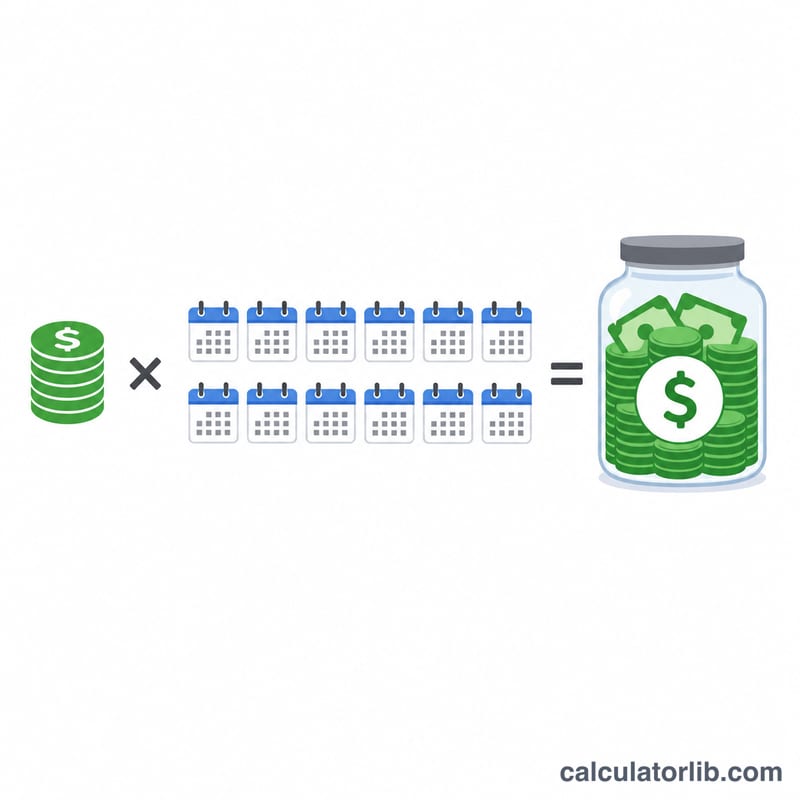
The core calculation is simple: Target Fund = Monthly Essential Expenses × Months of Coverage. To estimate the timeline, the calculator subtracts your current savings from the target and divides the remaining amount by your monthly contribution, rounding up to the next whole month.
$$\text{Months to Goal} = \left\lceil \frac{T - \text{Savings}}{\text{Contribution}} \right\rceil \quad\text{where}\quad T = \text{Expenses} \times \text{Months}$$
$$\text{Funded} = \frac{\text{Savings}}{\text{Expenses} \times \text{Months}} \times 100\%$$
Worked Example
Suppose your essential expenses are $2,500 per month and you want 6 months of coverage. Your target is \(2{,}500 \times 6 = \$15{,}000\). If you already have $3,000 saved, you still need $12,000. Contributing $300 a month, you would reach your goal in $$\left\lceil 12{,}000 \div 300 \right\rceil = 40 \text{ months},$$ and you are currently 20% funded.
FAQ
How many months should I save? Three months is a reasonable minimum; six months gives a stronger buffer, and freelancers or single-income households may aim for nine to twelve.
Should I include discretionary spending? No. Base the figure on essential, non-negotiable costs so the fund stretches as far as possible during a true emergency.
Where should I keep it? In a liquid, low-risk account such as a high-yield savings account so the money is safe and available quickly.