
What Is a Savings Plan Calculator?
A savings plan calculator projects how much your money will grow over time when you start with an initial deposit and make regular contributions that earn compound interest. It combines two growth engines: the lump-sum you begin with and a stream of recurring deposits, both compounding at the same periodic rate.
How to Use It
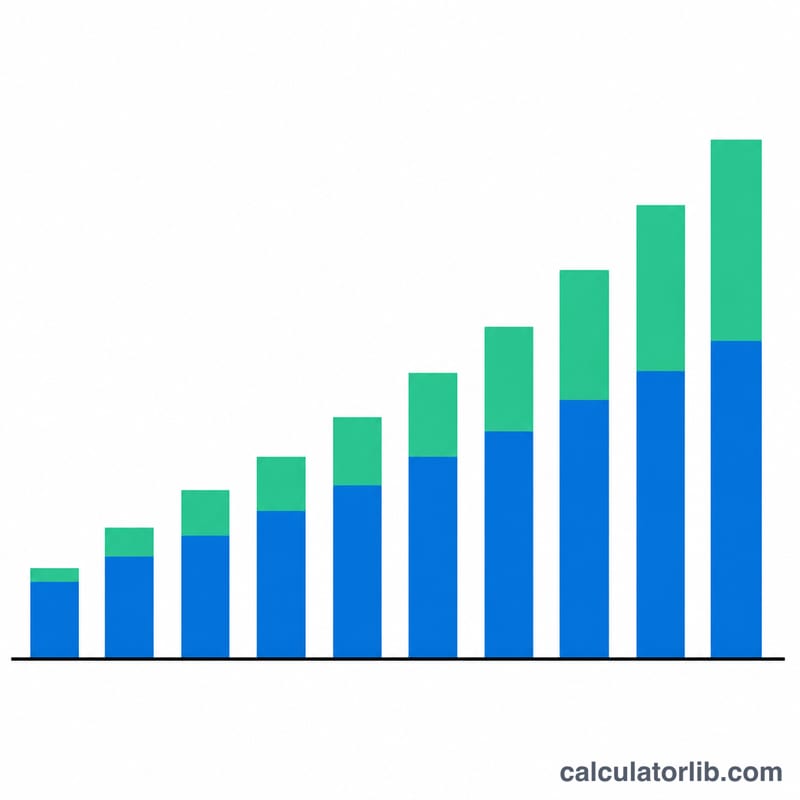
Enter your initial deposit, the amount you contribute each period, your expected annual interest rate, the number of years you plan to save, and how often you contribute (monthly, quarterly, or annually). The calculator returns your projected future value, the total you contributed, and the interest earned.
The Formula Explained
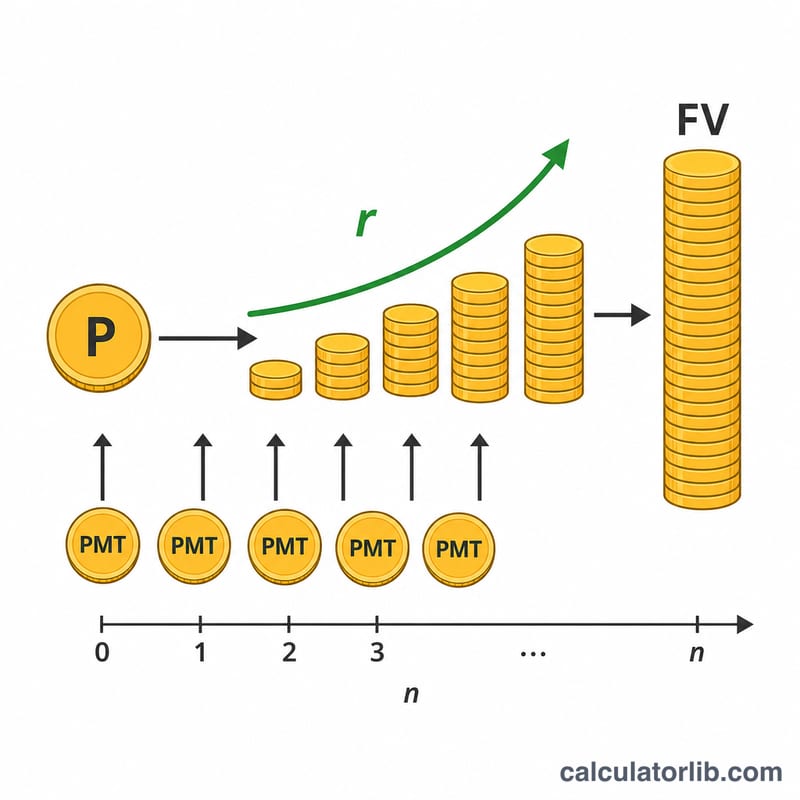
The future value is calculated as $$FV = P(1+r)^{n} + PMT \times \frac{(1+r)^{n} - 1}{r}$$ Here P is the initial deposit, PMT is the per-period contribution, r is the periodic interest rate (annual rate divided by frequency), and n is the total number of periods (years \(\times\) frequency). The first term grows your starting balance; the second is the future value of an ordinary annuity.
Worked Example
Suppose you deposit $1,000, add $100 every month, earn 5% annually, and save for 10 years. The monthly rate is \(0.05 / 12 \approx 0.0041667\) and the number of periods is \(120\). The initial deposit grows to about $1,647, and the contributions grow to about $15,528, for a future value near $17,175 from $13,000 contributed — roughly $4,175 in interest.
FAQ
Does it assume contributions at period end? Yes — it uses the ordinary annuity formula, where each contribution is made at the end of the period.
What if my interest rate is 0%? The calculator falls back to simply summing your deposits, since there is no compounding.
Are returns guaranteed? No. This is a projection based on a constant rate. Real investment returns vary, so treat the result as an estimate.