What is bend deduction?
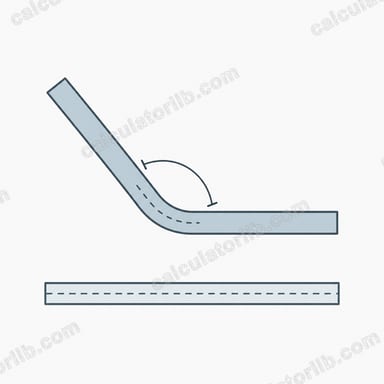
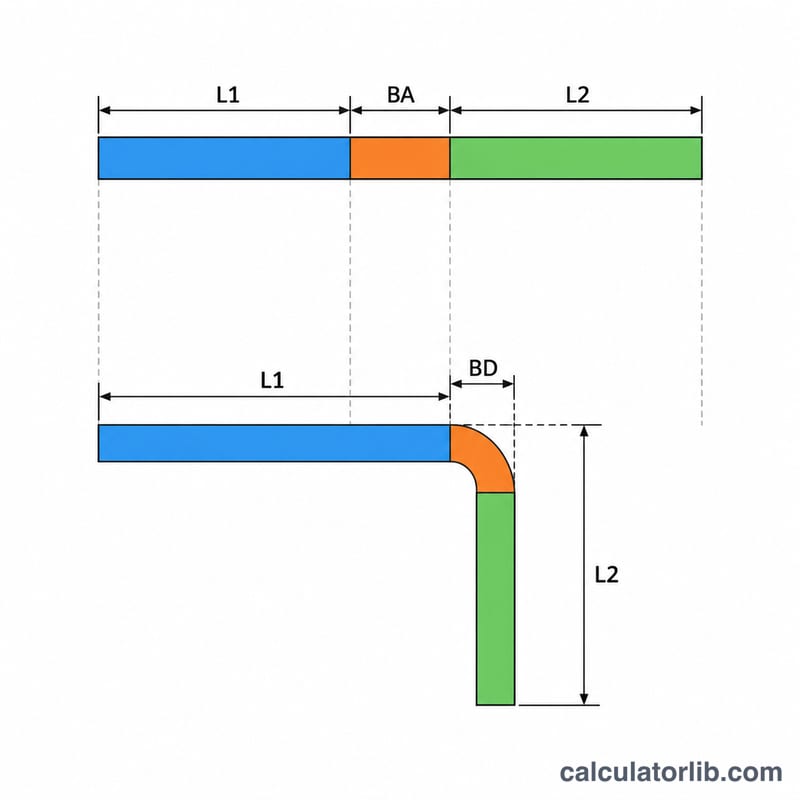
When a flat sheet is bent, the neutral axis of the material stays at constant length while the outer surface stretches and the inner surface compresses. Bend deduction (BD) is the amount you subtract from the sum of the two outside leg dimensions to get the flat blank length. This calculator also gives the bend allowance (BA) and the outside setback (OSSB).
How to use it
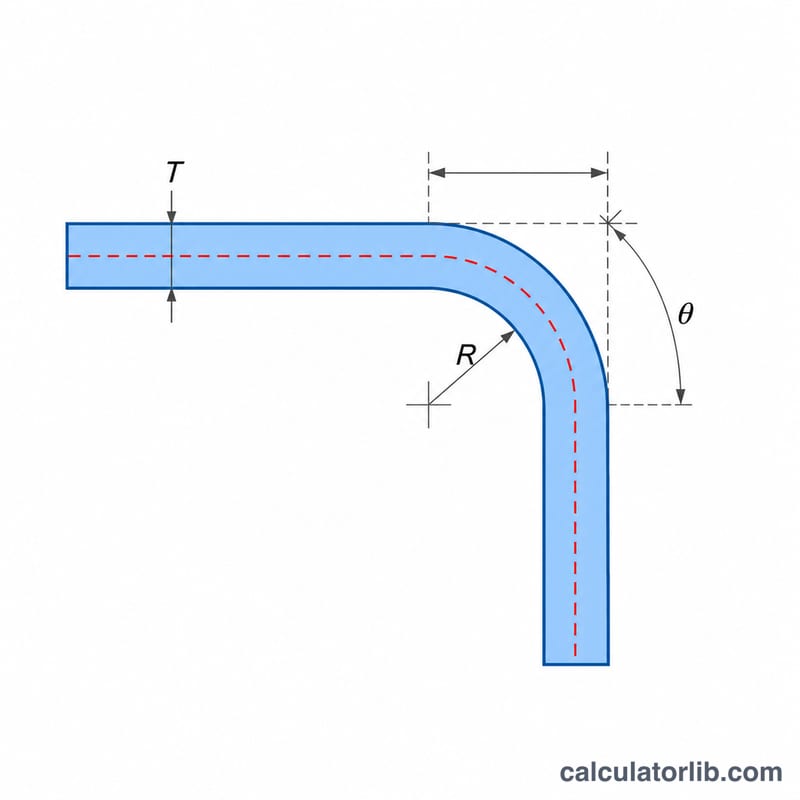
Enter the material thickness, the inside bend radius, the bend angle in degrees and the K-factor. Optionally enter both outside leg lengths to get the flat pattern length. Use one length unit throughout. A K-factor of about 0.33 suits tight bends in soft material, and 0.5 suits larger radii.
The formulas
With \(\theta\) the bend angle in radians, \(R\) the inside radius, \(T\) the thickness and \(K\) the K-factor:
$$\text{BA} = \theta\,(R + K\,T)$$$$\text{OSSB} = \tan\left(\tfrac{\theta}{2}\right)(R+T)$$$$\text{BD} = 2\,\text{OSSB} - \text{BA}$$$$L_{flat} = L_1 + L_2 - \text{BD}$$Here \(L_1\) and \(L_2\) are the outside leg lengths measured to the virtual sharp.
Worked example
For \(T = 2\) mm, \(R = 2\) mm, a 90 degree bend and \(K = 0.33\):
$$\text{BA} = \tfrac{\pi}{2}(2 + 0.33 \times 2) = 4.178\,\text{mm}$$$$\text{OSSB} = \tan 45^\circ \times 4 = 4\,\text{mm}$$$$\text{BD} = 2 \times 4 - 4.178 = 3.822\,\text{mm}$$With legs of 50 mm and 30 mm the flat length is \(80 - 3.822 = 76.178\) mm.
Typical K-Factor Values by Material and Bend Radius
The K-factor is the neutral-axis position divided by material thickness (K = t/T). It is usually between 0.30 and 0.50. The values below are commonly cited starting estimates from general fabrication charts. They group materials into soft, medium and hard classes: soft aluminum is in the soft class, mild/cold-rolled steel in the medium class, and stainless steel and hard brass/copper in the hard class. They are not guaranteed values. Verify them with test bends or your fabricator's own data, because tooling, grain direction, die width, springback and the exact alloy and temper all shift the real K-factor.
| Bending method | Inside radius R vs. thickness T | Soft aluminum (soft class) | Mild / cold-rolled steel (medium class) | Stainless, hard brass/copper (hard class) |
|---|---|---|---|---|
| Air bend | R/T about 1 or less | 0.33 | 0.38 | 0.40 |
| Air bend | R/T from 1 to 3 | 0.40 | 0.43 | 0.45 |
| Air bend | R/T above 3 | 0.50 | 0.50 | 0.50 |
| Bottoming | R/T about 1 or less | 0.42 | 0.44 | 0.46 |
| Bottoming | R/T from 1 to 3 | 0.46 | 0.47 | 0.48 |
| Bottoming | R/T above 3 | 0.50 | 0.50 | 0.50 |
| Coining | R/T about 1 or less | 0.38 | 0.41 | 0.44 |
| Coining | R/T from 1 to 3 | 0.44 | 0.46 | 0.47 |
| Coining | R/T above 3 | 0.50 | 0.50 | 0.50 |
- A tighter radius relative to thickness pushes the neutral axis toward the inside of the bend, so K is lower.
- A large radius relative to thickness brings K toward 0.50, the mid-thickness position.
- Harder, less ductile materials generally have a higher K-factor at the same R/T.
- A common default when nothing else is known is K = 0.33 to 0.44, but treat it only as a first guess.
Bend Terms and Variables
- Neutral axis
- The imaginary line inside the sheet thickness that neither stretches nor compresses during bending. It lies between the inside and outside surfaces, usually closer to the inside. The length of the neutral axis through the bend is the bend allowance.
- K-factor
- The neutral-axis offset ratio, K = t/T. Here t is the distance from the inside surface to the neutral axis and T is the material thickness. It is dimensionless. The calculator uses it in \(BA = \theta (R + K \cdot T)\).
- Inside radius (R)
- The radius of the inside surface of the bend. In air bending it is set mainly by the die opening and the material, and with bottoming or coining by the punch nose radius.
- Bend angle (θ)
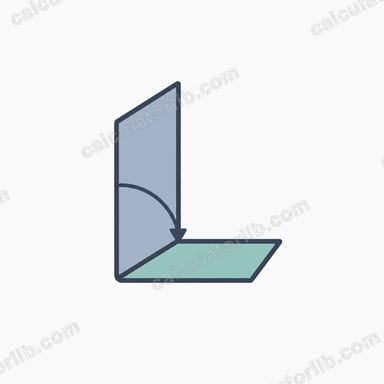
- The amount the sheet is turned away from flat. A flat sheet has a bend angle of 0°, and a right-angle bend has a bend angle of 90°. This is different from the included angle between the two legs, which equals 180° − bend angle. A 90° bend has a 90° included angle, but a 60° bend has a 120° included angle. This calculator expects the bend angle (the amount of turn), and converts it with \(\theta = \text{Angle} \cdot \pi/180\).
- Virtual sharp
- The point where the extended outside surfaces of the two legs would meet if the bend had a sharp corner instead of a radius. Outside leg dimensions are normally measured to this point.
- Outside setback (OSSB)
- The distance from the tangent point where the bend begins to the virtual sharp, measured along the leg. It is \(OSSB = \tan(\theta/2)(R + T)\). For a 90° bend it simplifies to R + T. The formula is not defined for a 180° bend, because the tangent becomes infinite.
- Bend allowance (BA)
- The arc length of the neutral axis through the bend: \(BA = \theta (R + K \cdot T)\). It is the amount of flat material that forms the bend.
- Bend deduction (BD)
- The amount subtracted from the sum of the two virtual-sharp (outside) leg lengths to get the flat length: \(BD = 2\,OSSB - BA\). It is also called bend compensation.
- Flat pattern
- The unfolded sheet before bending. For one bend with legs measured to the virtual sharp, \(L_{flat} = L_1 + L_2 - BD\). The same value is obtained from setbacks and allowance as the two flat legs (each leg minus OSSB) plus BA.
Convention note: use the same units for thickness, radius and leg lengths (all mm or all inches). The leg lengths must be outside dimensions measured to the virtual sharp, matching the formula above. If your drawing gives inside dimensions or an included angle, convert them first so that the angle entered is the bend angle.
FAQ
What K-factor should I use?
It depends on the material, tooling and radius-to-thickness ratio. Ask your fabricator for the value from their press brake, or use test bends. 0.33 to 0.5 is typical.
Is bend deduction the same as bend allowance?
No. Bend allowance is the neutral-axis arc length. Bend deduction is what you subtract from the outside dimensions, and it equals twice the setback minus the allowance.
Does this work for angles over 90 degrees?
The formula is valid for any bend angle between 0 and 180 degrees, where the angle is the amount the sheet is turned.