
What is Body Surface Area?
Body surface area (BSA) is the measured or estimated total surface area of the human body, expressed in square metres (m²). It is widely used in medicine because it correlates better than body weight with many physiological parameters such as cardiac output, glomerular filtration rate, and metabolic rate. BSA is especially important for calculating drug doses (notably chemotherapy) and for normalizing clinical measurements.
How to use this calculator
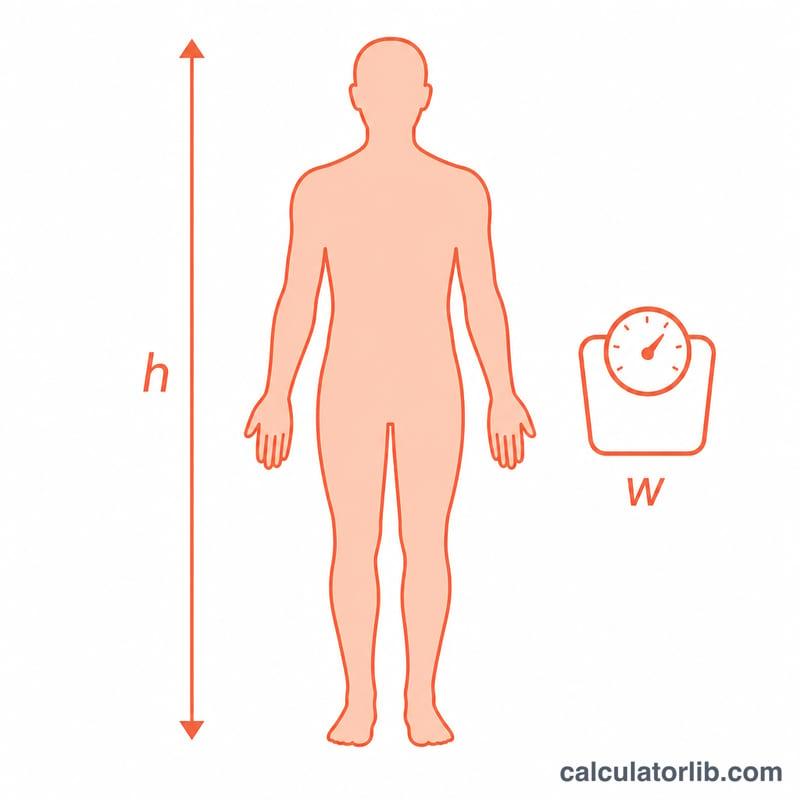
Enter your height in centimetres and your weight in kilograms, then submit. The calculator returns BSA using two well-known formulas: the simple Mosteller equation (highlighted as the main result) and the classic DuBois & DuBois equation, plus the average of the two for convenience.
The formulas explained
The Mosteller formula is $$\text{BSA}_{\text{Mosteller}} = \sqrt{\dfrac{\text{Height (cm)} \times \text{Weight (kg)}}{3600}}$$ It is easy to compute and gives results very close to more complex equations. The DuBois & DuBois formula, published in 1916, is $$\text{BSA}_{\text{DuBois}} = 0.007184 \times \text{Height (cm)}^{0.725} \times \text{Weight (kg)}^{0.425}$$ where height is in cm and weight in kg.
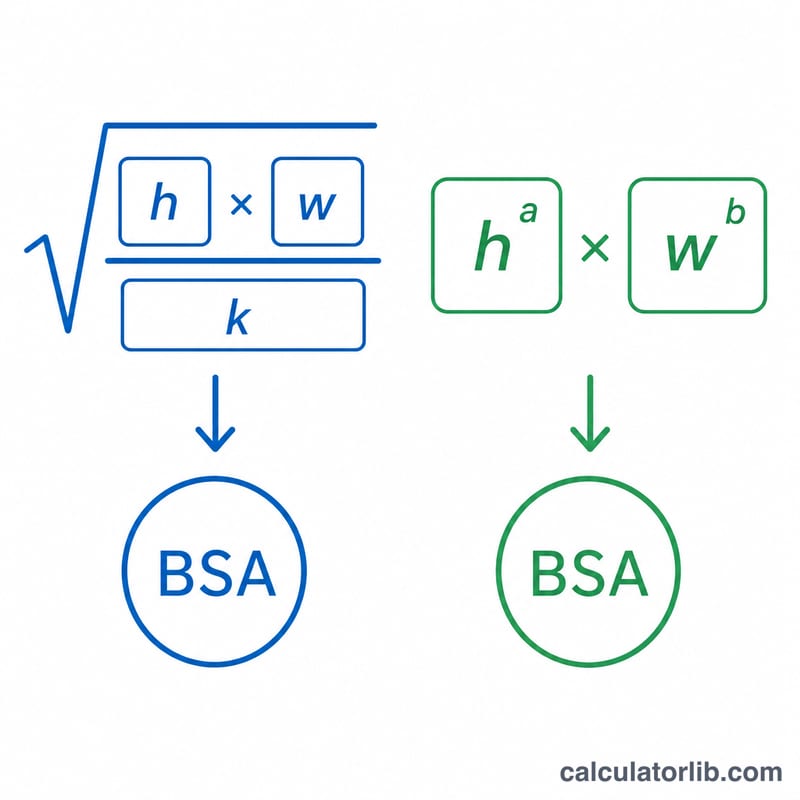
Worked example
For a person 180 cm tall weighing 80 kg: Mosteller BSA $$= \sqrt{\dfrac{180 \times 80}{3600}} = \sqrt{\dfrac{14400}{3600}} = \sqrt{4} = 2.00 \text{ m}^2$$ DuBois BSA $$= 0.007184 \times 180^{0.725} \times 80^{0.425} \approx 1.997 \text{ m}^2$$ The two agree closely.
Typical BSA Values by Age and Sex
Body surface area (BSA) increases from birth through adulthood and is influenced by both height and weight. The figures below are widely documented average values used as general references. Individual results computed from the Mosteller or DuBois & DuBois formulas will vary with actual body size.
| Group | Approximate average BSA (m²) |
|---|---|
| Neonate (newborn) | ~0.25 |
| Child (≈9 years) | ~1.07 |
| Adult women | ~1.6 |
| Adult men | ~1.9 |
| Overall adult average (standard normalization value) | ~1.73 |
The 1.73 m² figure is the conventional adult-average BSA used to normalize physiological measurements such as glomerular filtration rate (GFR).
Interpreting Your BSA Result
Body surface area expresses the total external area of the body in square meters. The standard reference value of 1.73 m² represents the average BSA of a typical adult and is the figure used to normalize clinical measurements so that results can be compared between people of different sizes.
BSA is commonly used in two main contexts. First, certain medications—particularly chemotherapy agents—are dosed per square meter of body surface area, because BSA correlates more closely with metabolic rate and blood volume than body weight alone. Second, glomerular filtration rate (GFR) is conventionally reported per 1.73 m² of body surface area, allowing kidney function to be compared on a common scale regardless of an individual's body dimensions.
Because BSA depends on both height and weight, larger individuals will have values above 1.73 m² and smaller individuals below it; the Mosteller and DuBois & DuBois formulas typically agree closely, though small differences between methods are expected. This page provides general educational information about how BSA is calculated and used and is not a substitute for professional medical advice. Any dosing or clinical decision should be made by a qualified healthcare provider using the appropriate verified measurements.
FAQ
Which formula should I use? Mosteller is the most popular for clinical drug dosing because of its simplicity and accuracy. DuBois is a long-standing reference.
What is a normal BSA? An average adult has a BSA of roughly 1.7 m² (about 1.6 m² for women and 1.9 m² for men), but it varies with body size.
Do units matter? Yes. This calculator requires height in centimetres and weight in kilograms. Convert other units first.