
What is the Pre-Pregnancy BMI Calculator?
This tool estimates your Body Mass Index (BMI) using your weight before pregnancy and your height, then maps that BMI to the recommended total pregnancy weight gain range. The weight gain ranges are based on the widely used Institute of Medicine (IOM) guidelines for a single (one baby) pregnancy. They are general guidance, not a substitute for advice from your midwife, obstetrician, or doctor.
How to use it
Enter your weight before becoming pregnant in kilograms and your height in centimetres. The calculator converts your height to metres, computes BMI, classifies it into one of four categories, and shows the matching recommended total gain over the whole pregnancy.
The formula explained
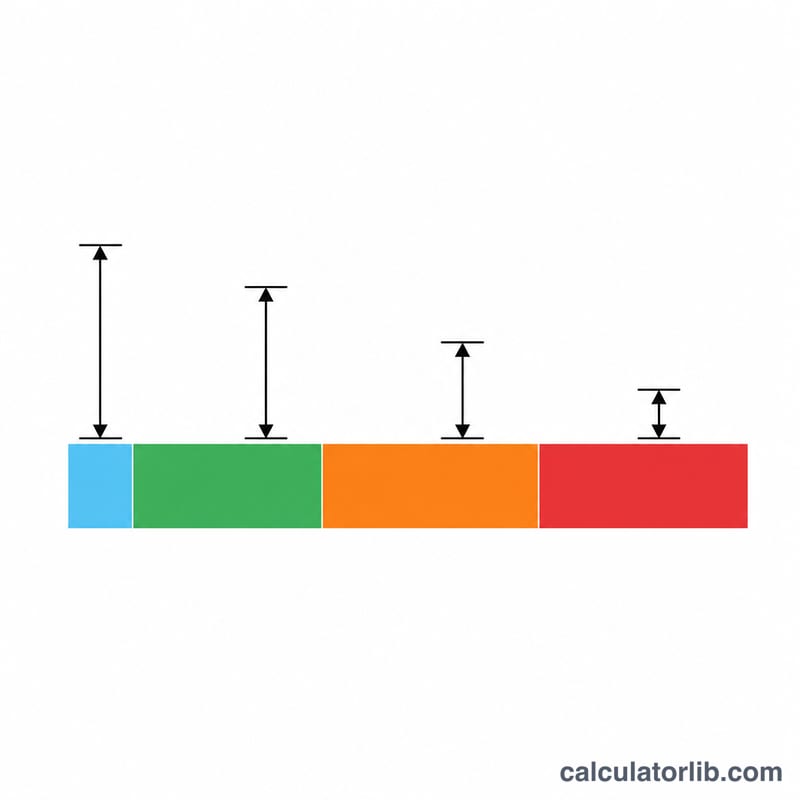
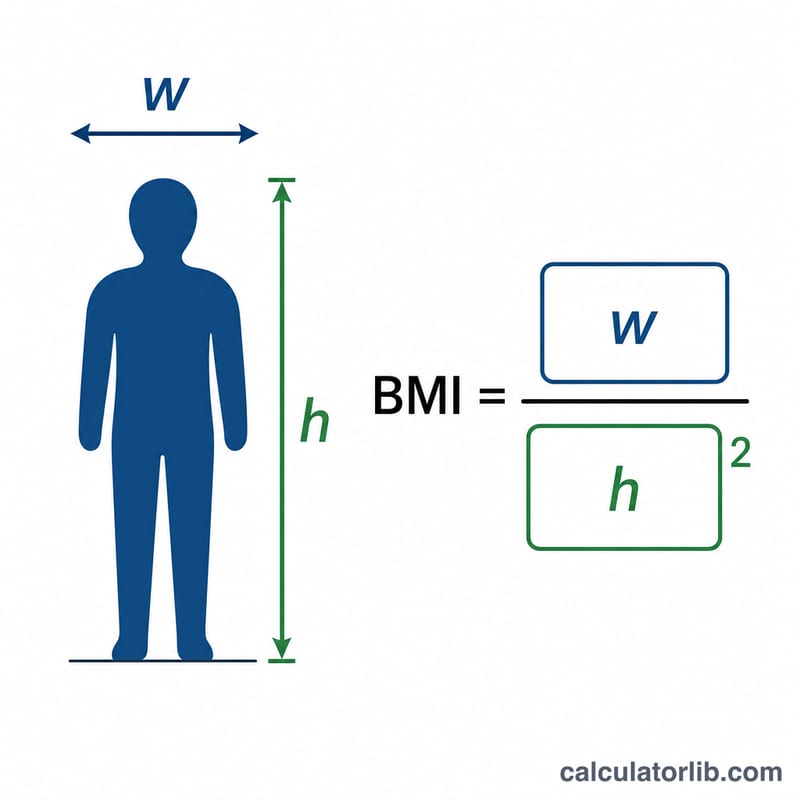
$$\text{BMI} = \frac{\text{Weight (kg)}}{\left(\dfrac{\text{Height (cm)}}{100}\right)^2}$$ For example, with height 165 cm = 1.65 m, the denominator is \(1.65 \times 1.65 = 2.7225\). Categories: underweight is BMI below 18.5 (gain 12.5–18 kg), normal weight is 18.5–24.9 (gain 11.5–16 kg), overweight is 25–29.9 (gain 7–11.5 kg), and obese is 30 or above (gain 5–9 kg).
Worked example
A woman weighing 60 kg at 165 cm tall: $$\text{BMI} = 60 \div 2.7225 \approx 22.0$$ That falls in the normal-weight range, so the recommended total weight gain is 11.5–16 kg across the pregnancy.
FAQ
Should I use my current weight or pre-pregnancy weight? Always use your weight from before pregnancy — the ranges are calibrated to that starting point.
Do these ranges apply to twins? No. The figures here are for a single pregnancy; twin pregnancies have higher recommended ranges.
Is gaining outside the range dangerous? Gaining too little or too much can carry risks, but individual needs vary. Use this as a starting point and discuss your target with your healthcare provider.