
What this calculator does
The Cardio Calorie Burn Calculator estimates how many calories you burn during steady cardio exercise based on your average heart rate, body weight, age, and how long you trained. Instead of relying on generic activity tables, it uses the Keytel equations — published heart-rate-based formulas derived from laboratory testing. Because your heart rate reflects how hard your body is actually working, this approach tends to be more personal than a one-size-fits-all "calories per minute" chart. The formulas are gender-specific, so the calculator applies a different equation for men and women.
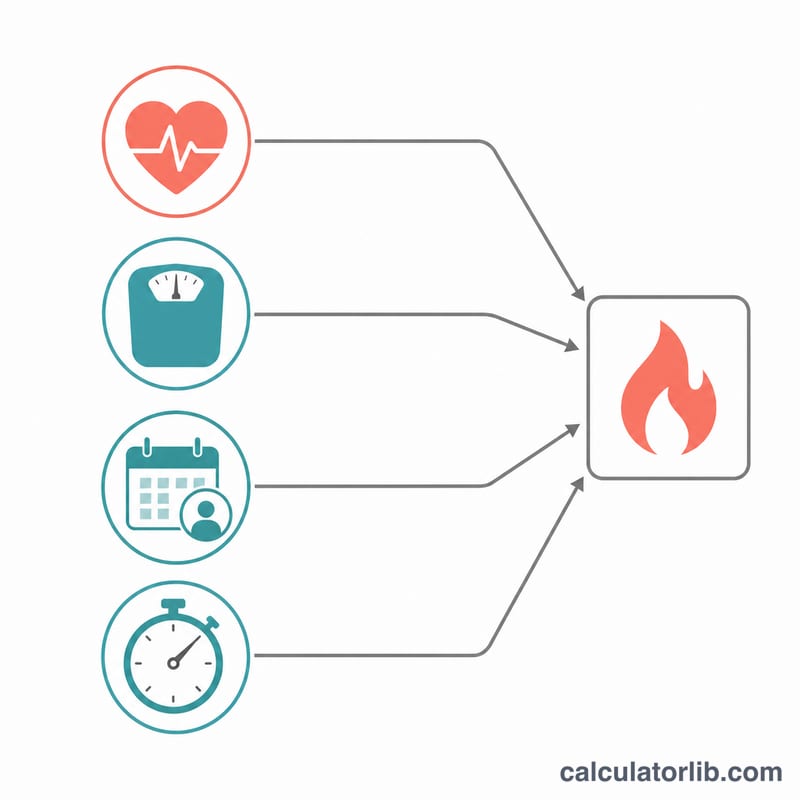
The inputs you provide
- Gender — selects which Keytel equation is used (men and women have different coefficients).
- Average Heart Rate (bpm) — your mean heart rate during the session, ideally from a chest strap or watch.
- Weight (kg) — your body weight in kilograms.
- Age (years) — your age, which factors into the calculation.
- Duration (minutes) — total exercise time at that heart rate.
The formula explained
For men, the calculator computes calories per minute as:
$$\text{kcal/min} = \frac{-55.0969 + 0.6309 \times \text{HR} + 0.1988 \times \text{weight} + 0.2017 \times \text{age}}{4.184}$$
For women it uses the female coefficients:
$$\text{kcal/min} = \frac{-20.4022 + 0.4472 \times \text{HR} - 0.1263 \times \text{weight} + 0.074 \times \text{age}}{4.184}$$
The division by \(4.184\) converts kilojoules to kilocalories. The result is clamped at zero (no negative burn), then multiplied by your duration in minutes to get the total calories burned.
Worked example
Suppose a man, age 35, weighing 80 kg, runs for 30 minutes at an average heart rate of 150 bpm:
- $$\text{kcal/min} = \frac{-55.0969 + 0.6309 \times 150 + 0.1988 \times 80 + 0.2017 \times 35}{4.184}$$
- $$= \frac{-55.0969 + 94.635 + 15.904 + 7.0595}{4.184}$$
- $$= \frac{62.50}{4.184} \approx 14.94 \text{ kcal/min}$$
- $$\text{Total} = 14.94 \times 30 \approx \mathbf{448 \text{ calories}}$$
Frequently asked questions
How accurate is it? The Keytel equations were validated for steady-state aerobic exercise within a normal heart-rate range. They are estimates — useful for tracking trends, not exact medical measurements.
Do I need a heart rate monitor? For best results, yes. A chest strap or fitness watch gives a reliable average heart rate, which is the single most influential input.
Why does weight lower the result for women? The female equation has a small negative weight coefficient (\(-0.1263\)) from the original research, so weight slightly reduces the estimate, unlike the male formula where it adds to it.