
What is a contraction timer?
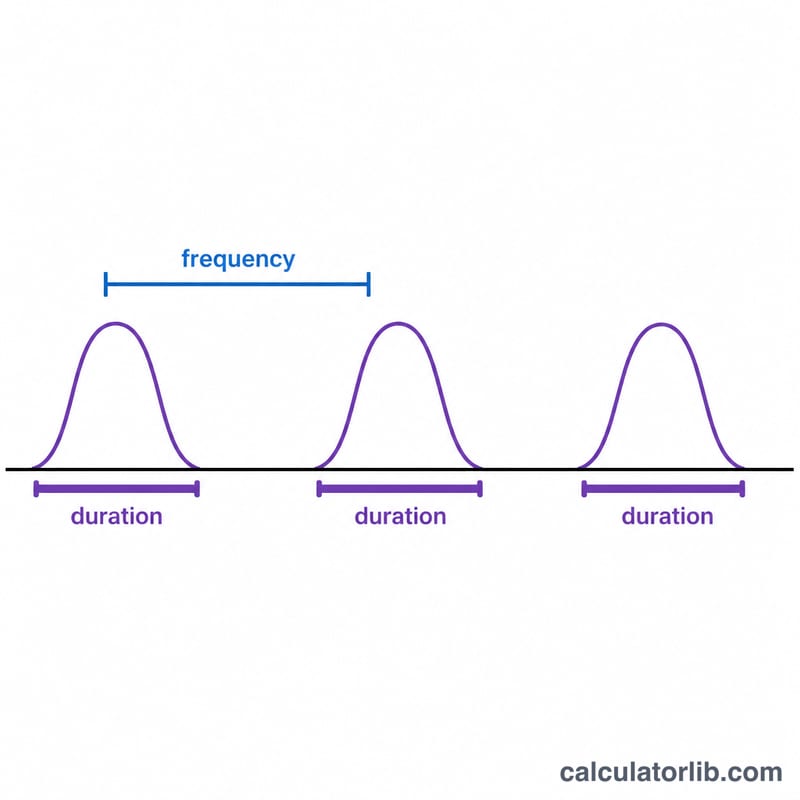
During labor, two numbers matter most: how far apart your contractions are (frequency) and how long each one lasts (duration). Timing them helps you and your healthcare provider judge how labor is progressing and when it may be time to head to the hospital or birth center. This calculator turns the clock times you record into clear frequency and duration figures.
How to use it
Note the moment each contraction begins and ends. Enter the start and end time of two consecutive contractions in minutes (measured from any common starting point — for example, minutes past the hour). The calculator computes the frequency from the gap between the two starts, and the duration of each contraction from its own start and end.
The formula explained
Frequency is measured start-to-start, not from the end of one contraction to the start of the next: $$\text{frequency} = \text{start}_2 - \text{start}_1$$ Duration is simply \(\text{duration} = \text{end} - \text{start}\) for a single contraction. The calculator also averages the two durations and shows the result in seconds for convenience.
Worked example
Contraction 1 starts at minute 0 and ends at 0.75 (45 seconds). Contraction 2 starts at minute 5 and ends at 5.8. $$\text{Frequency} = 5 - 0 = 5 \text{ minutes}$$ Durations are 0.75 min (45 s) and 0.8 min (48 s), so the average duration is $$\frac{0.75 + 0.8}{2} = 0.775 \text{ min} \approx 46.5 \text{ seconds}$$
FAQ
Do I measure from the end or the start? Always start-to-start. Measuring end-to-start understates frequency.
What is the 5-1-1 rule? A common guideline: contractions ~5 minutes apart, each ~1 minute long, sustained for ~1 hour. Follow your provider's specific instructions.
Can I enter clock times? Convert to minutes (e.g. 2:05 → 125 if counting minutes past midnight, or just use minutes past a reference). Only the differences matter.