What this calculator does
The Weld Metal Deposition Rate Calculator estimates how much weld metal is laid down per hour and how much filler wire is consumed, based on your wire feed speed and welding parameters. Fabricators, estimators, and welding engineers use it to plan consumable purchases, quote jobs, and compare processes such as GMAW, FCAW, and submerged arc welding.
The formula explained
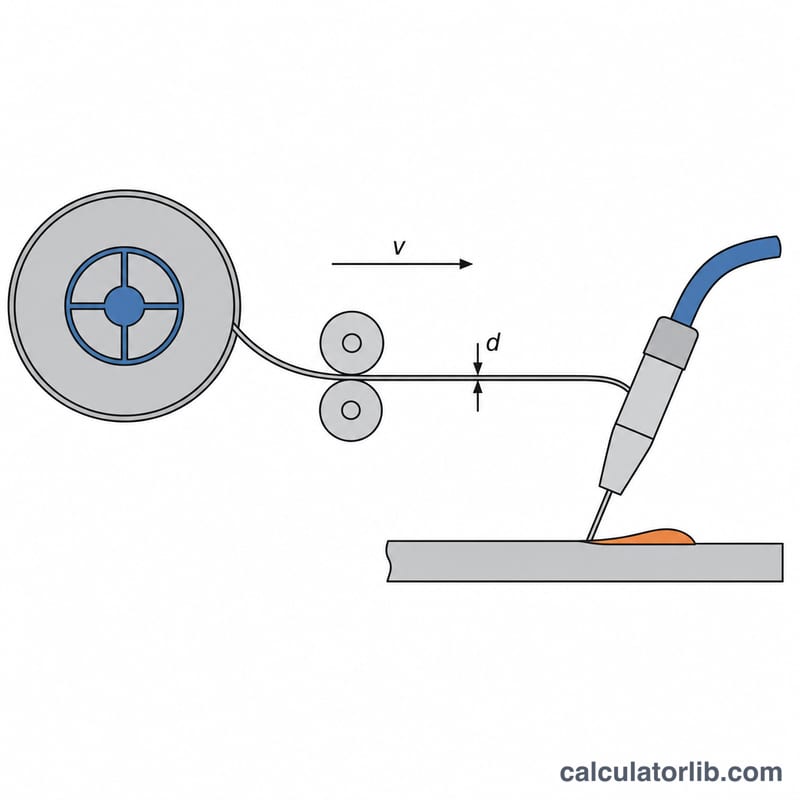
Deposition rate depends on the volume of wire fed per unit time, the density of that wire, and how much of it actually ends up in the joint. The governing equation is:
$$\text{DR} = \frac{\pi}{4} d^2 \times S \times 60 \times \rho \times \frac{\eta}{100}$$
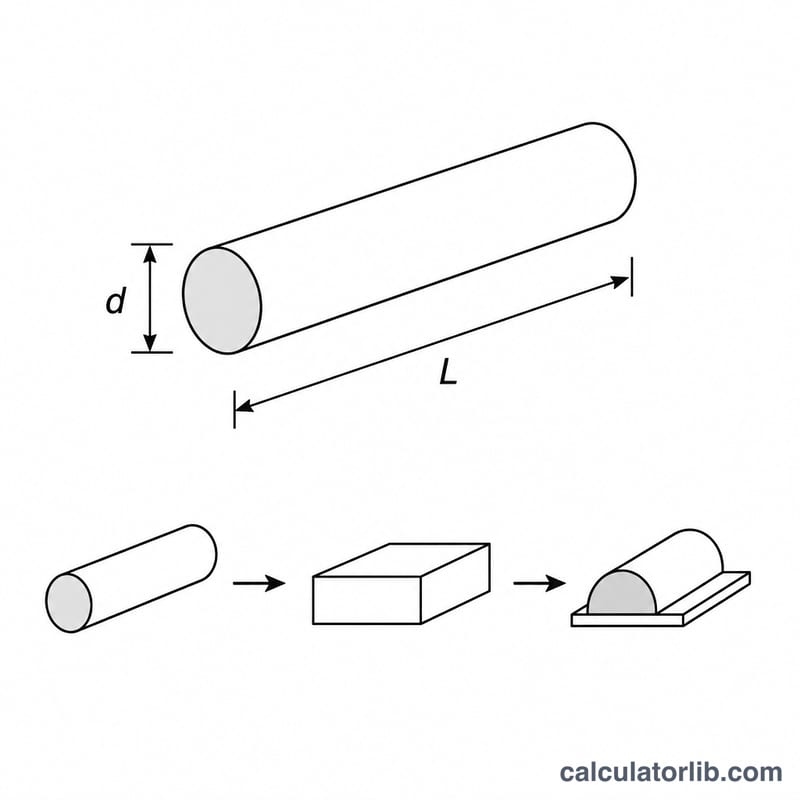
where \(d\) = wire diameter in inches, \(S\) = wire feed speed in in/min, \(\rho\) = wire density in lb/in³ (about 0.284 for carbon steel), and \(\eta\) = deposition efficiency in percent. The factor \(60\) converts minutes to hours. The term \(\tfrac{\pi}{4}d^2\) is the cross-sectional area \(A\) of the wire.
How to use it
Enter the wire feed speed, wire diameter, the wire density for your alloy, and the deposition efficiency for your process. Typical efficiencies are roughly 95% for solid-wire GMAW, 85% for flux-cored, and 60% for stick electrodes. The calculator returns the deposition rate, the wire cross-sectional area, and the total filler consumption before efficiency losses.
Worked example
For \(d = 0.045\,\text{in}\), \(S = 300\,\text{in/min}\), \(\rho = 0.284\,\text{lb/in}^3\), and \(\eta = 95\%\):
$$A = \frac{\pi}{4}(0.045)^2 = 0.00159\,\text{in}^2$$
$$\text{DR} = 0.00159 \times 300 \times 60 \times 0.284 \times 0.95 = 7.72\,\text{lb/hr}$$
FAQ
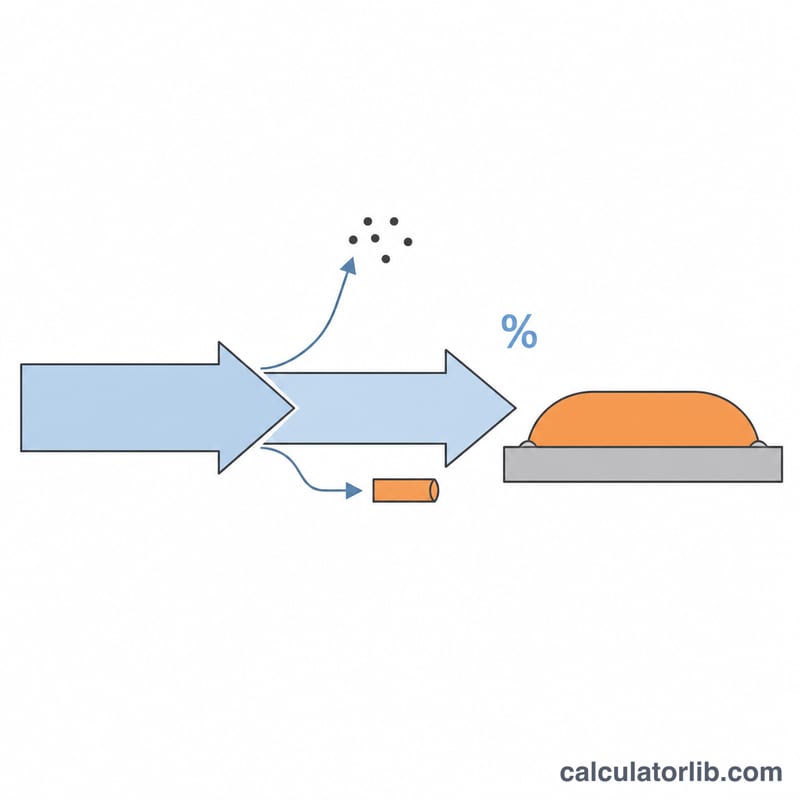
What is the difference between deposition rate and melting rate? Melting rate is all the wire consumed; deposition rate is only the portion that stays in the weld after spatter and losses, so \(\text{DR} = \text{MR} \times \tfrac{\eta}{100}\).
What density should I use? Carbon and low-alloy steel is about \(0.284\,\text{lb/in}^3\); aluminum is near \(0.098\) and stainless around \(0.29\).
Does higher wire feed speed always mean faster deposition? Yes, deposition scales linearly with feed speed, but efficiency and duty cycle limit real-world throughput.