What is the Kiln Firing Time Calculator?
This calculator estimates how long a kiln firing will take by adding up each programmed ramp segment and the hold at the target cone temperature. Potters, glass artists, and studio technicians use it to plan a firing schedule, know when a kiln will finish, and schedule electricity use or overnight firings with confidence.
The formula explained
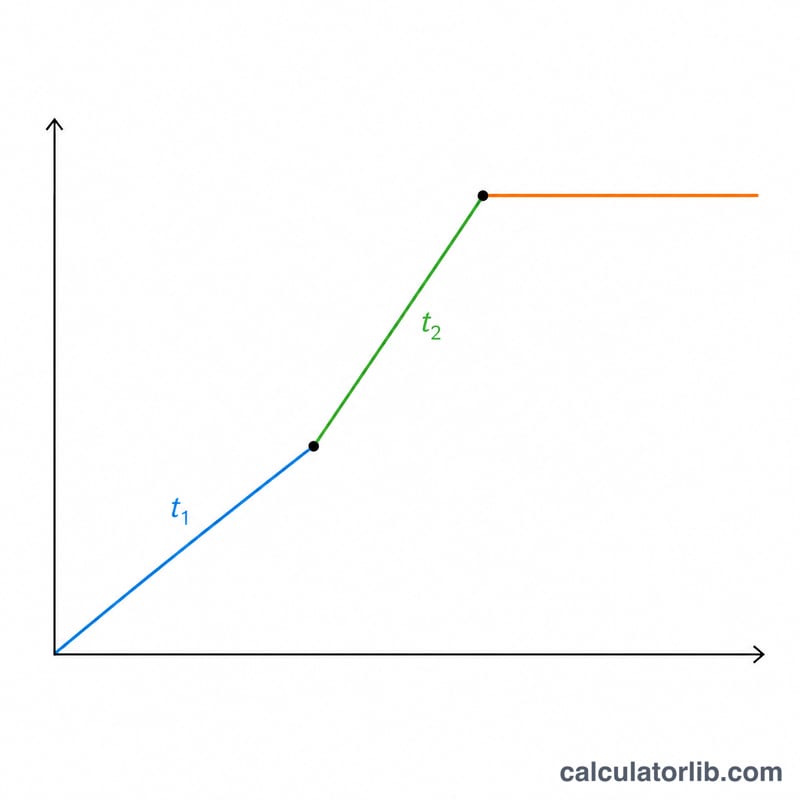
Total firing time is the sum of two ramp durations plus the hold time. Each ramp duration is the temperature climb divided by the ramp rate:
$$\text{T}_{total} = \frac{\Delta T_1}{R_1} + \frac{\Delta T_2}{R_2} + \text{H}$$where \(\Delta T_1\) = intermediate temp minus start temp, \(\Delta T_2\) = target temp minus intermediate temp, \(R_1\) and \(R_2\) = the two ramp rates in degrees per hour, and \(\text{H}\) = hold time in hours. Splitting the climb into two segments lets you model a slow candling stage followed by a faster climb to the target cone.
How to use it
Enter the starting temperature (usually room temperature), an intermediate temperature where the ramp rate changes, and the target cone temperature. Add the two ramp rates and the hold time at target. The result shows the total firing time and a breakdown per segment.
Worked example
Start at 20 °C, ramp at 100 °C/hr to 600 °C, then 150 °C/hr to 1200 °C, and hold 0.5 hr:
$$\frac{600-20}{100} = 5.8\,\text{hr}, \quad \frac{1200-600}{150} = 4.0\,\text{hr}$$$$\text{T}_{total} = 5.8 + 4.0 + 0.5 = 10.3\,\text{hr}$$FAQ
Does this include cooling time? No. It covers the heating ramps and hold only; natural cooling can take longer and depends on kiln mass and insulation.
Can I use Fahrenheit? Yes, as long as temperatures and ramp rates use the same unit; the result stays in hours.
Why two ramp segments? Real schedules often candle slowly to drive off moisture, then climb faster, so two segments approximate typical programs better than one.