What this calculator does
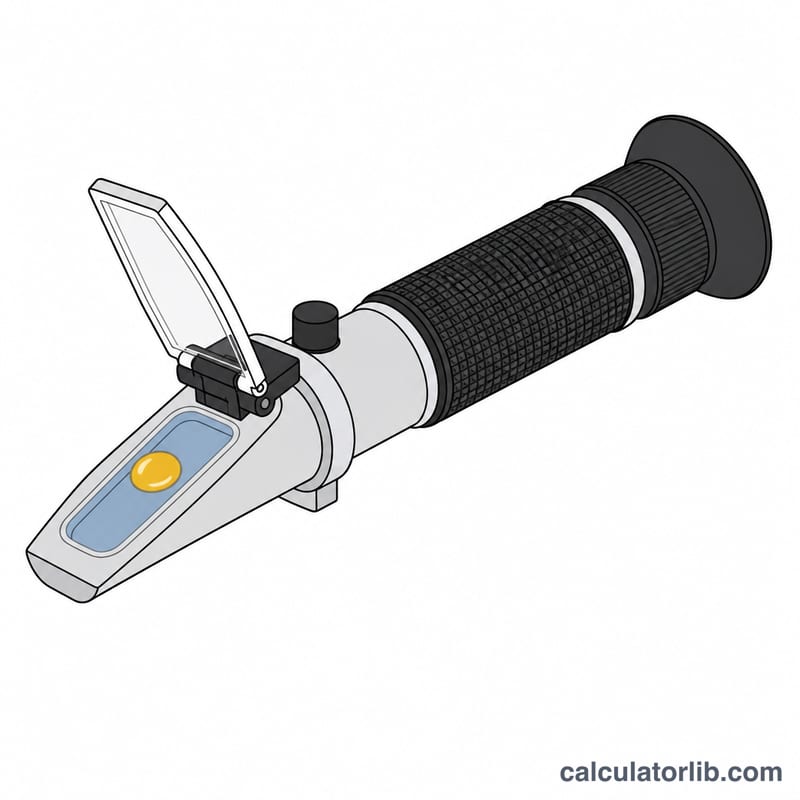
Beekeepers judge whether honey is ripe by its water content. Uncapped or early-harvested honey holds too much water and can ferment in the jar. This tool converts a reading from a standard sucrose (Brix) refractometer into an estimated honey moisture percentage so you can decide if a frame is ready to spin.
How to use it
Place a drop of honey on your refractometer, read the value on the Brix (°Bx) scale, and enter it above. The calculator returns the estimated moisture and a harvest guideline. Most refractometers designed for honey also print a moisture scale, but many general sugar refractometers only show Brix, which is where this conversion helps.
The formula explained
The relationship between the Brix scale and honey water content is close to linear across the normal harvest range. This calculator uses a straight-line fit of the honey refractometer scale:
$$\text{Moisture \%} = 90 - 0.86 \times \text{Brix}$$
Here \(\text{Brix}\) is the reading in \(^\circ\text{Bx}\) and the result is the percentage of water by weight. As the Brix reading rises, dissolved sugars increase and water falls, so the coefficient is negative.
Worked example
Suppose your refractometer shows \(85\,^\circ\text{Bx}\). Then:
$$\text{Moisture} = 90 - 0.86 \times 85 = 90 - 73.1 = 16.9\%$$
Because \(16.9\%\) is below \(18\%\), the honey is ripe and safe to harvest.

FAQ
What moisture is safe? Below about \(18\%\) is ideal. Between \(18\%\) and \(20\%\) store carefully and use quickly; above \(20\%\) fermentation is likely.
Is this exact? No. It is a practical linear approximation of the refractometer scale and can vary a little with temperature and calibration. Always let your refractometer settle to room temperature and zero it first.
Which scale do I enter? The Brix (°Bx) sucrose scale, typically reading between 76 and 90 for honey.