What this calculator does
A commercial water heater has two jobs during busy periods: store enough hot water to cover the surge, and heat new water fast enough to keep up. This calculator splits your peak hour demand into those two parts and returns the storage tank volume, the recovery rate in gallons per hour, and the burner or element input in BTU/hour and kW.
How to use it
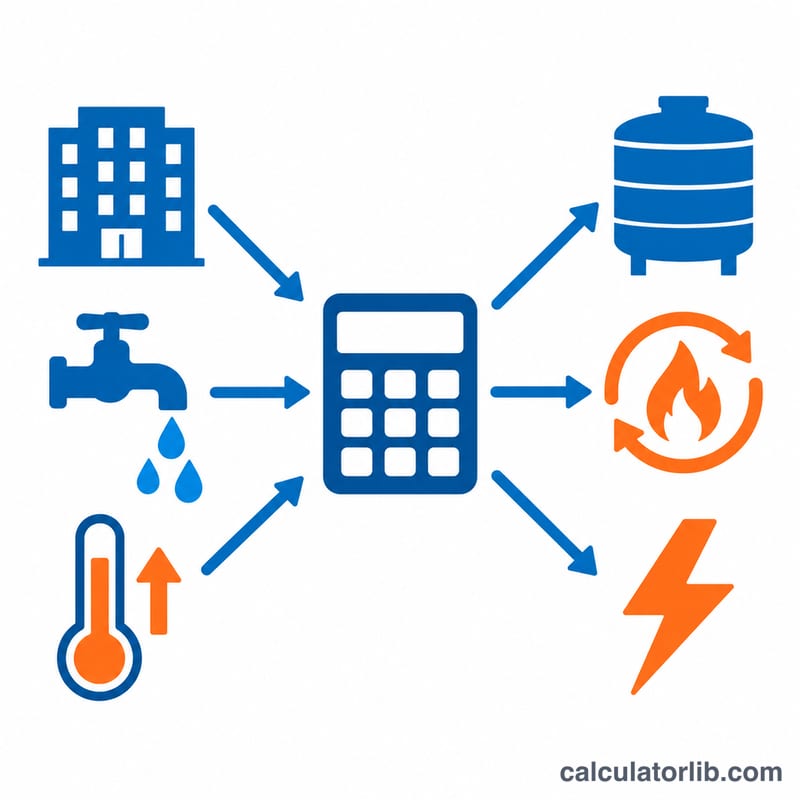
Choose the building type, enter your peak hour hot-water demand in gallons per hour (at the storage setpoint), the cold inlet temperature, the storage setpoint, the heater thermal efficiency and the usable fraction of the tank. Each building type carries a typical peak duration and recovery share, because apartments and hotels see long morning surges while schools and offices have short, sharp ones.
The formulas
Recovery rate is a share \(r\) of peak demand: \(R = r \times H\). The remaining demand must come from storage over the peak duration \(D\):
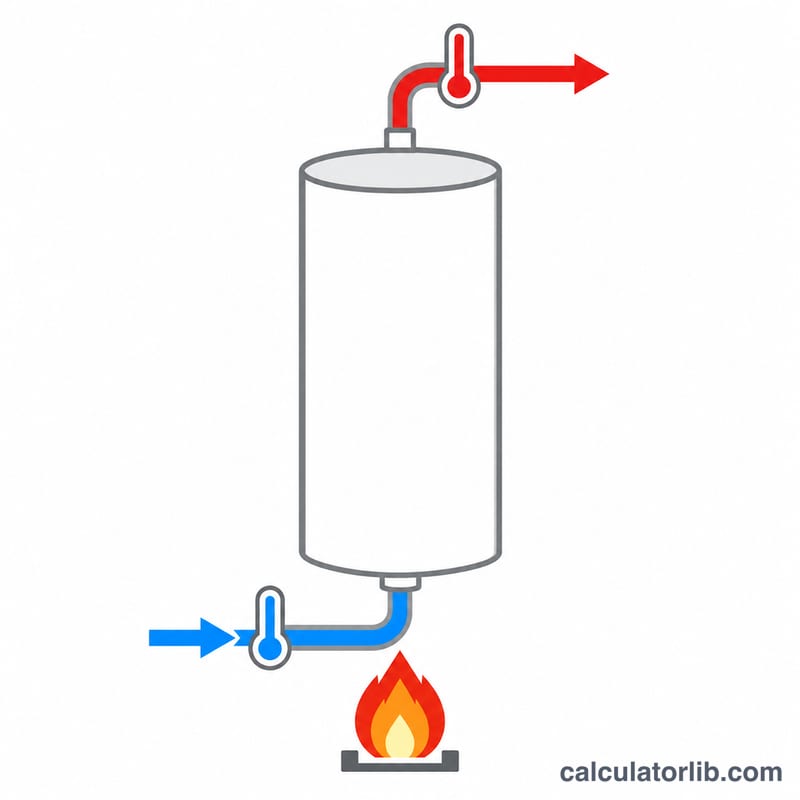
$$V_{\text{tank}} = \frac{H \times (1 - r) \times D}{u}$$Heater input follows from the energy needed to lift \(R\) gallons per hour through \(\Delta T\) degrees F, where one gallon of water weighs 8.33 lb:
$$Q = \frac{R \times 8.33 \times \Delta T}{\eta}$$Divide BTU/hour by 3,412 to get kilowatts.
Worked example
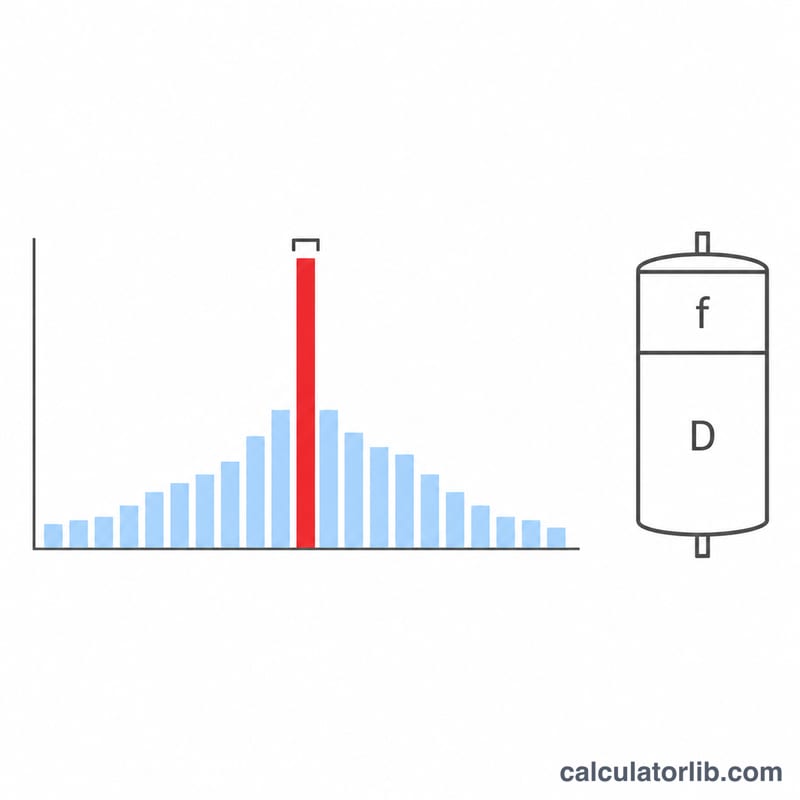
An apartment building has a peak demand of 300 gal/h, 50°F inlet water, a 140°F setpoint, 95% efficiency and 70% usable tank volume. With \(r = 0.35\) and \(D = 3\) h:
$$R = 0.35 \times 300 = 105\,\text{gal/h}$$$$V_{\text{tank}} = \frac{300 \times 0.65 \times 3}{0.70} = 835.7\,\text{gal}$$$$Q = \frac{105 \times 8.33 \times 90}{0.95} \approx 82{,}862\,\text{BTU/h} \approx 24.3\,\text{kW}$$Typical Peak Duration and Recovery Share by Building Type
The sizing formulas use two building-specific parameters: the peak duration \(D\) (hours the peak demand is sustained) and the recovery share \(r\) (the fraction of peak-hour demand that the heater supplies directly as recovery, with the rest drawn from storage). The usable tank fraction \(u\) is the part of the tank volume that can be drawn before the water becomes too cool. The values below are planning-level typical values for rough sizing, not code requirements. The article's apartment example uses \(r = 0.35\) and \(D = 3\) h.
| Building type | Peak duration D (h) | Recovery share r | Usable tank fraction u |
|---|---|---|---|
| Apartment building | 3 | 0.35 | 0.70 |
| Hotel / motel | 2 | 0.40 | 0.70 |
| Office | 1 | 0.40 | 0.70 |
| School | 1 | 0.40 | 0.70 |
| Restaurant | 2 | 0.50 | 0.70 |
| Hospital / nursing home | 3 | 0.35 | 0.70 |
| Dormitory | 3 | 0.30 | 0.70 |
The equations are \(R = r\,H\) for recovery in gph and \(V = \dfrac{H\,(1-r)\,D}{u}\) for tank volume, where \(H\) is the peak-hour demand in gal/h.
Note: these figures change with the sizing method. ASHRAE-style procedures, manufacturer sizing software and local plumbing codes each use different peak durations, storage factors and safety margins. A 70% usable fraction is a common assumption for storage tanks, and the real value depends on tank design and thermostat setting. Confirm the final selection against the method your jurisdiction or the manufacturer requires.
Scenario Comparison: How Inputs Change the Result
All scenarios use \(R = rH\), \(V = H(1-r)D/u\) and \(Q_{\text{in}} = R \times 8.33 \times \Delta T / \eta\), with \(P_{\text{kW}} = Q_{\text{in}}/3412\). Values are rounded. The setpoint is 140°F in every case.
| Scenario | Inputs | Recovery (gph) | Tank (gal) | Input (BTU/h) | Input (kW) |
|---|---|---|---|---|---|
| A. Apartment baseline | H = 300 gph, r = 0.35, D = 3 h, u = 70%, inlet 50°F (ΔT = 90°F), η = 95% | 105 | 835.7 | 82,862 | 24.3 |
| B. Apartment, colder inlet | Same as A but inlet 40°F (ΔT = 100°F) | 105 | 835.7 | 92,068 | 27.0 |
| C. Apartment, 80% efficiency | Same as A but η = 80% | 105 | 835.7 | 98,398 | 28.8 |
| D. Short-peak office | H = 150 gph, r = 0.40, D = 1 h, u = 70%, ΔT = 90°F, η = 95% | 60 | 128.6 | 47,350 | 13.9 |
Scenario A in full:
\(R = 0.35 \times 300 = 105\) gph
\(V = \dfrac{300 \times 0.65 \times 3}{0.70} = \dfrac{585}{0.70} \approx 835.7\) gal
\(Q_{\text{in}} = \dfrac{105 \times 8.33 \times 90}{0.95} = \dfrac{78{,}718.5}{0.95} \approx 82{,}862\) BTU/h, so \(P_{\text{kW}} = 82{,}862/3412 \approx 24.3\) kW.
Takeaways:
- A colder inlet raises the temperature rise and therefore the input, but it does not change the tank volume.
- Lower efficiency raises the fuel input only. Recovery and storage stay the same.
- A short peak duration cuts the storage requirement sharply, as in scenario D.
Scenario D uses office values from the planning table above. The calculator's fixed formula uses \(f = 0.35\) and \(D = 3\) h for the apartment case.
Constants and Conversion Factors Used
| Quantity | Value | Notes |
|---|---|---|
| Weight of water | 8.33 lb/gal | Approximate, for water near room temperature (US gallon) |
| Specific heat of water | 1 BTU/lb·°F | Together with the weight, gives 8.33 BTU to raise 1 gal by 1°F |
| Energy per gallon per °F | 8.33 BTU/gal·°F | \(1 \times 8.33\) |
| BTU/h per kW | 3,412 BTU/h | 1 kW ≈ 3,412 BTU/h (more precisely 3,412.14) |
| Therm | 100,000 BTU | A gas input of 100,000 BTU/h equals 1 therm per hour |
Typical heater efficiencies
| Heater type | Typical efficiency η |
|---|---|
| Standard gas (non-condensing) | about 80% |
| Condensing gas | about 90–98% |
| Electric resistance | about 99–100% |
These are typical ranges. Use the rated thermal or combustion efficiency from the manufacturer's data for a real project. Efficiencies and fuel units differ by country, and the gallon, BTU and therm values above are US customary units.
FAQ
Is this a code-compliant design? No. It is a planning estimate; confirm with local plumbing code, ASHRAE guidance and manufacturer sizing data.
Why is usable tank volume below 100%? Cold water mixes in at the bottom of a storage tank, so only about 70 to 80% of the volume is delivered hot.
Can I add a safety margin? Yes, increase the peak demand input by 10 to 25% for future growth.