What this calculator does
The Gutter Sizing Calculator helps you choose a rain gutter that can carry the water shed by your roof during a heavy storm. Undersized gutters overflow, sending water down walls and into foundations, while oversized gutters waste material. By combining your roof drainage area with the local rainfall intensity, this tool estimates the peak runoff flow and recommends a practical K-style gutter size.
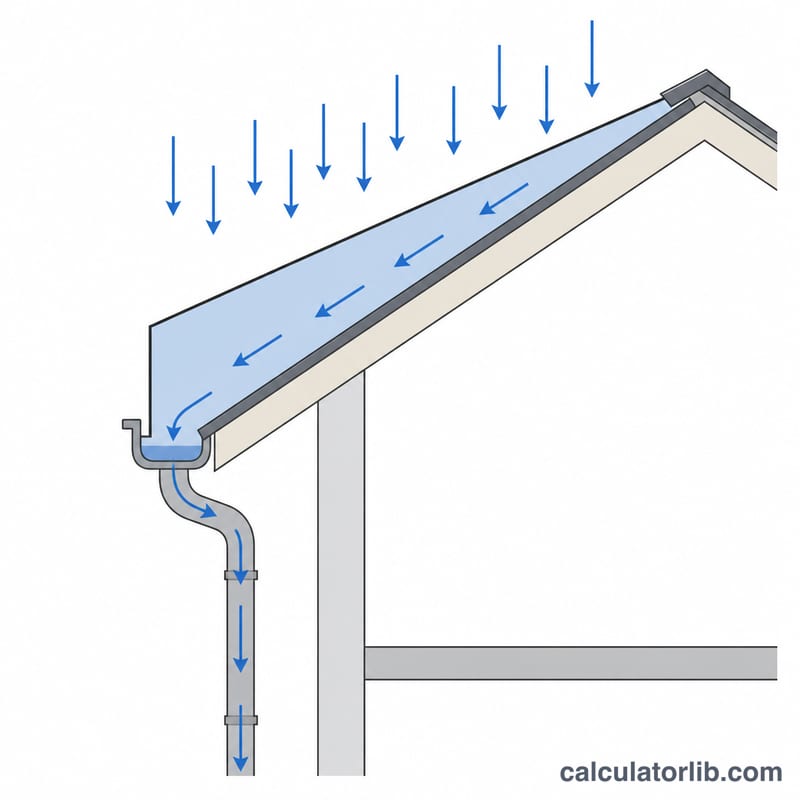
The formula explained
Peak flow is driven by how much rain falls on the roof each hour. One inch of rain over one square foot equals about 0.623 gallons, and dividing by 60 minutes gives the convenient constant used here:
$$Q = A \times i \times 0.0104$$where \(Q\) = required flow in gallons per minute, \(A\) = roof drainage area in square feet, and \(i\) = rainfall intensity in inches per hour. Because manufacturers rate gutter capacity at a standard design rainfall of 4 in/hr, we also convert your roof to an equivalent adjusted area:
$$A_{e} = \frac{A \times i}{4}$$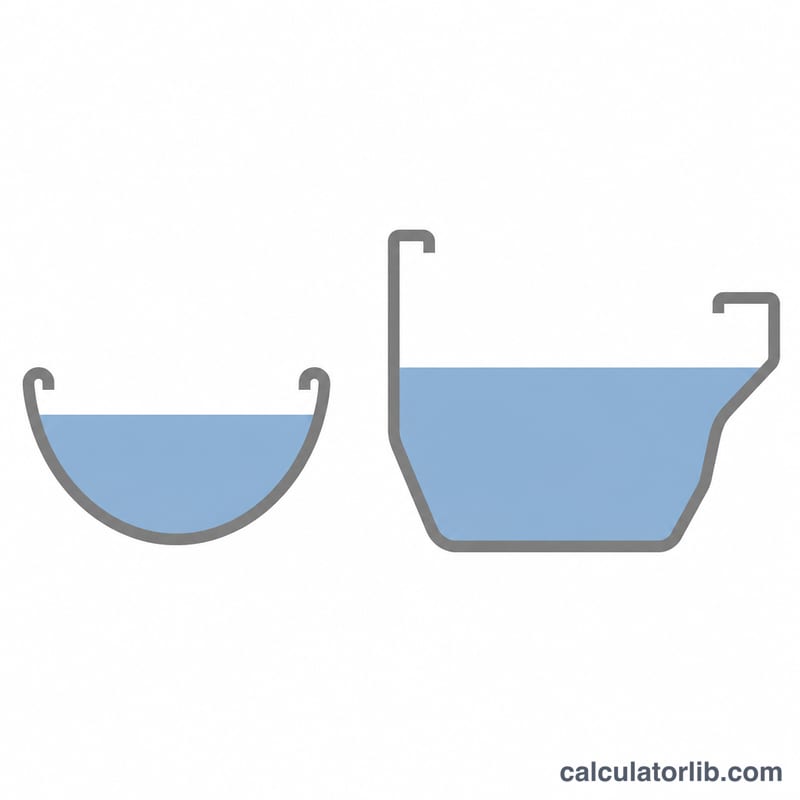
How to use it
Enter the flat (plan) area of the roof that drains toward the gutter, then enter your area rainfall intensity. Local values typically range from 3 to 8 in/hr for a 5-minute, 100-year storm. The calculator returns the required flow, the adjusted area, and a suggested gutter: 5-inch K-style up to 2,500 sq ft, 6-inch up to 3,840 sq ft, and larger gutters or extra downspouts above that.
Worked example
A roof draining \(1000\) sq ft in a region with \(4\) in/hr rainfall gives:
$$Q = 1000 \times 4 \times 0.0104 = 41.6\,\text{gpm}$$$$A_{e} = \frac{1000 \times 4}{4} = 1000\,\text{sq ft}$$Since the adjusted area is under 2,500 sq ft, a 5-inch K-style gutter is sufficient.
FAQ
Do I use the sloped or flat roof area? Use the horizontal (plan) projection, since rain falls vertically. For steep roofs many designers add a small factor for wind-driven rain.
What if my adjusted area is large? Add more downspouts or split the roof into sections; two downspouts roughly double capacity.
Why 4 in/hr? It is the common reference rainfall for published gutter capacity charts, so the adjusted area lets you compare directly.