What this calculator does
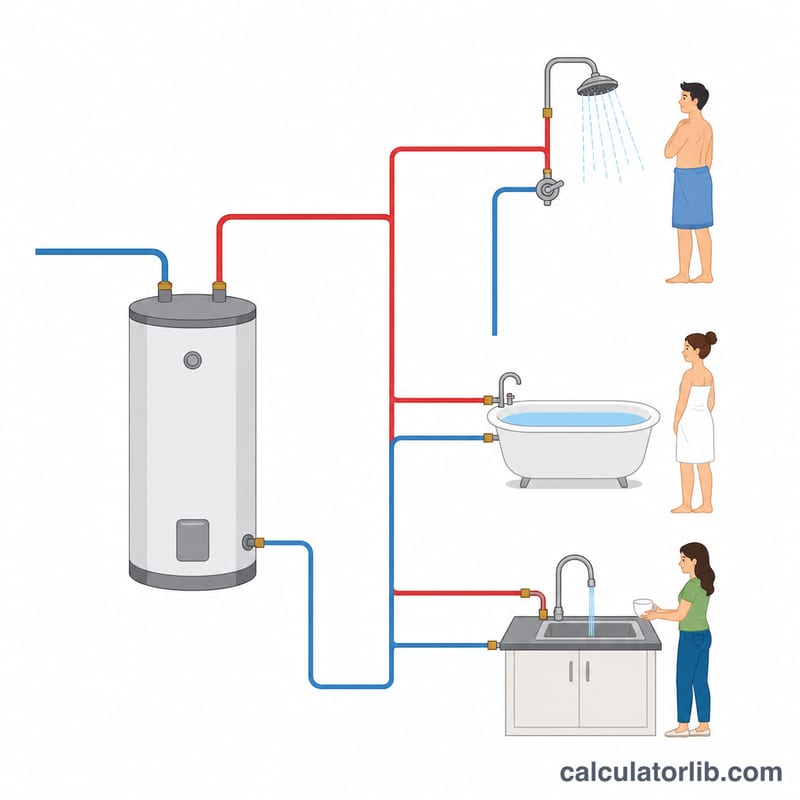
The Water Heater Sizing Calculator estimates the storage tank capacity your home needs to meet its hot water demand during the busiest hour of the day, known as the peak hour. Undersizing leads to cold showers, while oversizing wastes energy on standby heat loss. This tool balances the two by translating your usage habits into a recommended gallon capacity.
The formula explained
The core estimate is the peak hour demand (PHD), measured in gallons of hot water:
$$\text{PHD} = (N_s \times t \times f) + (P \times g)$$where \(N_s\) = number of showers in the peak hour, \(t\) = minutes per shower, \(f\) = hot water flow rate in gallons per minute, \(P\) = people in the household, and \(g\) = other hot water gallons per person for sinks, kitchen, and laundry. Because a tank never delivers all its stored water usefully, the recommended capacity divides demand by an estimated 70 percent usable fraction:
$$\text{Tank} = \frac{\text{PHD}}{0.70}$$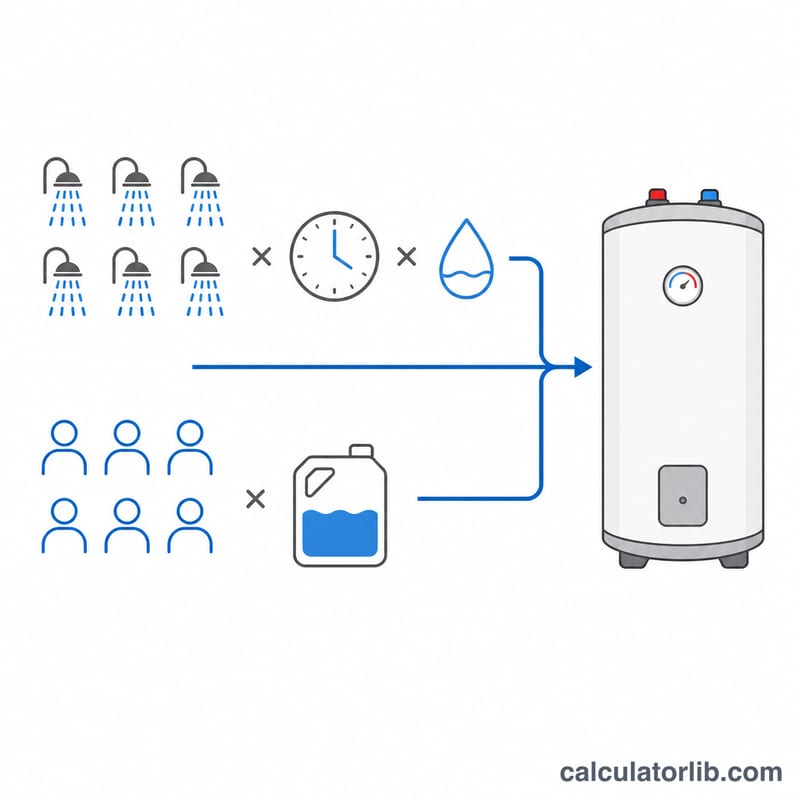
How to use it
Enter the number of people, how many showers happen in your busiest hour, the length and hot flow of a typical shower, and an allowance for other fixtures. The calculator returns your peak demand, the required usable capacity, and the nearest standard tank size (30 to 120 gallons).
Worked example
For a family of four with three back-to-back 8 minute showers at \(2\) GPM of hot water and \(5\) gallons of other use per person:
$$\text{PHD} = (3 \times 8 \times 2) + (4 \times 5) = 68\,\text{gal}$$$$\text{Tank} = \frac{68}{0.70} \approx 97\,\text{gal}$$That rounds up to a 100 gallon standard tank, or suggests a tankless or dual-tank setup.
Hot Water Usage Reference Data
The values below are typical figures for household fixtures using U.S. customary units (gallons and gallons per minute, GPM). Flow-rate limits reflect U.S. federal standards and the U.S. EPA WaterSense program; actual flow varies by fixture, water pressure, and local plumbing codes, so treat these as planning estimates rather than exact measurements.
Typical flow rates (GPM)
| Fixture | Typical flow rate (GPM) | Notes |
|---|---|---|
| Standard showerhead | ~2.5 | U.S. federal maximum since 1994; older units can be higher |
| Low-flow / WaterSense showerhead | ~1.5 – 2.0 | WaterSense certifies at 2.0 GPM or less |
| Bathroom faucet | ~1.5 – 2.2 | Federal max 2.2 GPM; WaterSense aerators ~1.5 GPM |
| Kitchen faucet | ~1.5 – 2.2 | Higher end common for filling pots |
| Dishwasher (per cycle) | ~3 – 6 gallons total | Modern ENERGY STAR units use less; older units more |
| Clothes washer (hot/warm load) | ~7 – 20 gallons hot water | Depends on load size and temperature setting |
Typical ‘other use’ allowance per person (for g)
Use the values below to estimate the per-person ‘other use’ gallons (the term g in the formula), covering hot water drawn outside of showers — hand and dish washing at sinks, kitchen tasks, and laundry.
| Use category | Typical hot water per person per day (gal) |
|---|---|
| Bathroom & hand sinks | ~2 – 4 |
| Kitchen (dishes, cooking, dishwasher share) | ~3 – 6 |
| Laundry (hot/warm share) | ~2 – 5 |
| Combined ‘other use’ per person | ~7 – 15 |
The peak hour demand formula combines shower demand and this other use:
$$\text{PHD} = (N_s \times t \times f) + (P \times g)$$
where \(N_s\) is the number of showers during the peak hour, \(t\) the minutes per shower, \(f\) the shower flow rate (GPM), \(P\) the number of people, and \(g\) the ‘other use’ gallons per person. For example, 3 showers of 8 minutes at 2.5 GPM plus 4 people at 10 gallons of other use gives \((3 \times 8 \times 2.5) + (4 \times 10) = 60 + 40 =\) 100 gallons of peak hour demand.
Standard Tank Sizes and First-Hour Ratings
Storage water heaters in the United States are commonly sold in the nominal tank sizes below (in U.S. gallons). The first-hour rating (FHR) is a U.S. Department of Energy / Federal Trade Commission EnergyGuide metric that measures how many gallons of hot water a full heater can deliver in one hour of continuous use. FHR depends on both tank volume and recovery (heating) speed, so gas units typically post higher FHRs than electric units of the same tank size. The ranges below are approximate and span typical gas and electric models.
| Nominal tank size (gal) | Typical suited household | Approx. first-hour rating (gal) |
|---|---|---|
| 30 | 1 – 2 people | ~40 – 50 |
| 40 | 2 – 3 people | ~50 – 70 |
| 50 | 3 – 4 people | ~60 – 85 |
| 66 | 4 – 5 people | ~75 – 100 |
| 80 | 5 – 6 people | ~85 – 120 |
| 100 | 6 – 7 people | ~110 – 140 |
| 120 | 7+ people | ~130 – 160 |
How FHR relates to peak hour demand: Size the heater so that its first-hour rating meets or slightly exceeds your calculated peak hour demand (PHD), not just the raw tank volume. Because recovery adds hot water during the hour, a heater can have an FHR larger than its physical tank. A practical rule is to choose a model whose FHR is within about 1 – 2 gallons of your PHD, or a little above it. Household-size guidance above is a rough starting point; a home with long showers or simultaneous fixture use should size by FHR against PHD rather than by occupant count alone.
FAQ
Should I round up or down? Always round up to the next standard size so you never run short during peak demand.
What if my result exceeds 120 gallons? Consider two tanks in series or a high-recovery or tankless unit rather than one oversized tank.
Does flow rate matter? Yes. A low-flow showerhead can cut hot water use dramatically, often letting you choose a smaller, cheaper tank.