What this calculator does
A storage water heater is sized by the busiest hour of the day, not by the daily total. This calculator converts your peak-hour habits - how many showers run back to back, how long they last, how fast the shower head flows - into liters of stored hot water, then recommends a standard tank capacity. It uses metric units (liters and degrees Celsius) and applies to any electric, gas or heat-pump storage cylinder.
How to use it
Enter the number of people, then the showers that realistically overlap inside one hour (usually the morning rush), the minutes per shower and the shower head flow rate. A modern low-flow head delivers about 7-9 L/min, an older head 12-15 L/min. Add any other hot water drawn in that same hour - a dishwasher fill, a sink of washing-up, a laundry cycle - as liters of tank-temperature water. Finally set your storage, use and cold-inlet temperatures.
The formula explained
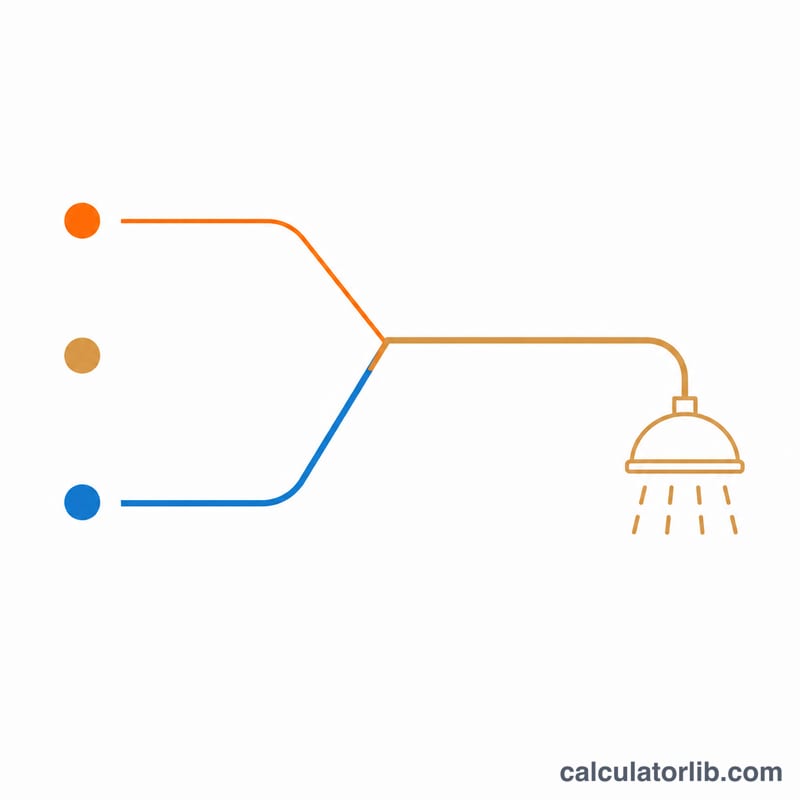
Shower water is a blend, so only part of it comes from the tank. With \(T_h\) = tank temperature, \(T_u\) = shower temperature and \(T_c\) = cold inlet temperature, the hot fraction is
$$f = \frac{T_u - T_c}{T_h - T_c}$$Peak demand and required volume then follow, where \(n\) = showers per hour, \(t\) = minutes each and \(\dot{V}\) = flow in L/min:
$$V = \frac{ n \times t \times \dot{V} \times f + Q_{\text{other}}}{0.75}$$The 0.75 divisor is the usable draw fraction: cold inlet water mixes into the tank during a long draw, so roughly a quarter of the stored volume is no longer hot enough to use.
The tank size is rounded up to the next common commercial capacity (30, 50, 80, 100, 120, 150, 200, 250, 300 L, then steps of 50 L). Only about 75% of a tank can be drawn before the outlet water turns lukewarm, which is why the required capacity is larger than the raw demand.
Worked example
A family of four takes three 8-minute showers in the peak hour at 9 L/min, plus 30 L of other hot water. Tank 60 °C, shower 40 °C, inlet 15 °C.
$$f = \frac{40 - 15}{60 - 15} = 0.556$$$$Q_{\text{peak}} = 3 \times 8 \times 9 \times 0.556 + 30 = 150\,\text{L}$$$$V = \frac{150}{0.75} = 200\,\text{L}$$A 200 L cylinder is the right pick.
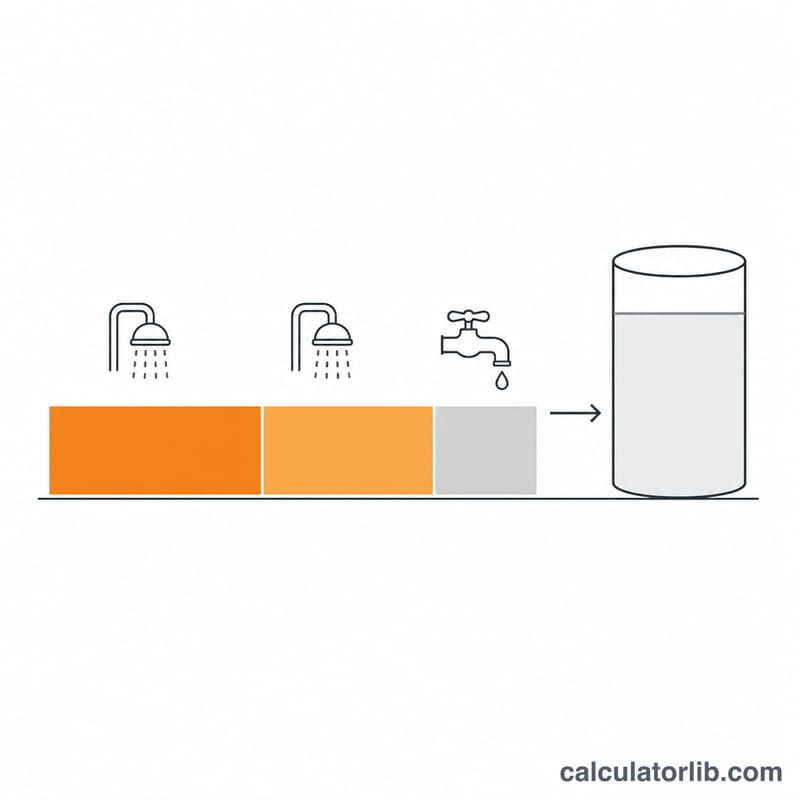
Typical Hot Water Draw by Fixture and Appliance
The calculator adds up hot water at tank temperature, because that is what the cylinder actually stores. A tap or shower normally delivers blended water at about 40 °C, so only part of each event comes out of the tank. With a stored temperature of 60 °C and a cold inlet of 15 °C, the mixing fraction is
$$f = \frac{T_{\text{use}} - T_{\text{cold}}}{T_{\text{tank}} - T_{\text{cold}}} = \frac{40 - 15}{60 - 15} \approx 0.556$$So every 100 L of 40 °C shower water uses about 56 L of 60 °C stored water. The right-hand column below is already converted this way, so those figures can be added directly into the Other Hot Water field as \(Q_{\text{other}}\) for everything that is not a shower (showers are entered separately as count × minutes × flow).
| Event | Typical delivered volume | Delivered temp | Hot water at 60 °C tank temp |
|---|---|---|---|
| Shower, low-flow head (7–9 L/min), 8 min | 56–72 L | ≈40 °C | ≈31–40 L |
| Shower, standard head (9–12 L/min), 8 min | 72–96 L | ≈40 °C | ≈40–53 L |
| Shower, older or rain head (12–15 L/min), 8 min | 96–120 L | ≈40 °C | ≈53–67 L |
| Full bath | 120–150 L | ≈40 °C | ≈65–85 L |
| Kitchen sink, washing-up bowl | 15–20 L | ≈45 °C | ≈10–15 L |
| Hand basin wash / shave | 3–5 L | ≈40 °C | ≈2–3 L |
| Dishwasher, hot-fill connection | 10–15 L | tank temp | ≈10–15 L |
| Washing machine, 40 °C cycle, hot-fill connection | 15–25 L | tank temp | ≈15–25 L |
| Dishwasher or washing machine, cold-fill only | — | — | 0 L |
Cold-fill appliances contribute nothing. Most machines sold in Europe (and an increasing share elsewhere) are cold-fill only and heat their own water electrically, so they must be entered as 0 L no matter how much water they use. Only add a dishwasher or washing machine if it is physically plumbed to the hot supply. Appliance volumes vary by model and programme — check the manufacturer's data sheet where the exact figure matters.
Shower flow rates depend on head type and supply pressure; low-flow heads sold under water-efficiency labelling schemes in several countries are typically rated at or below 9 L/min at a stated test pressure. If you can measure, do: run the shower into a bucket for 30 seconds and double the litres collected.
Standard Cylinder Sizes and Typical Household Match
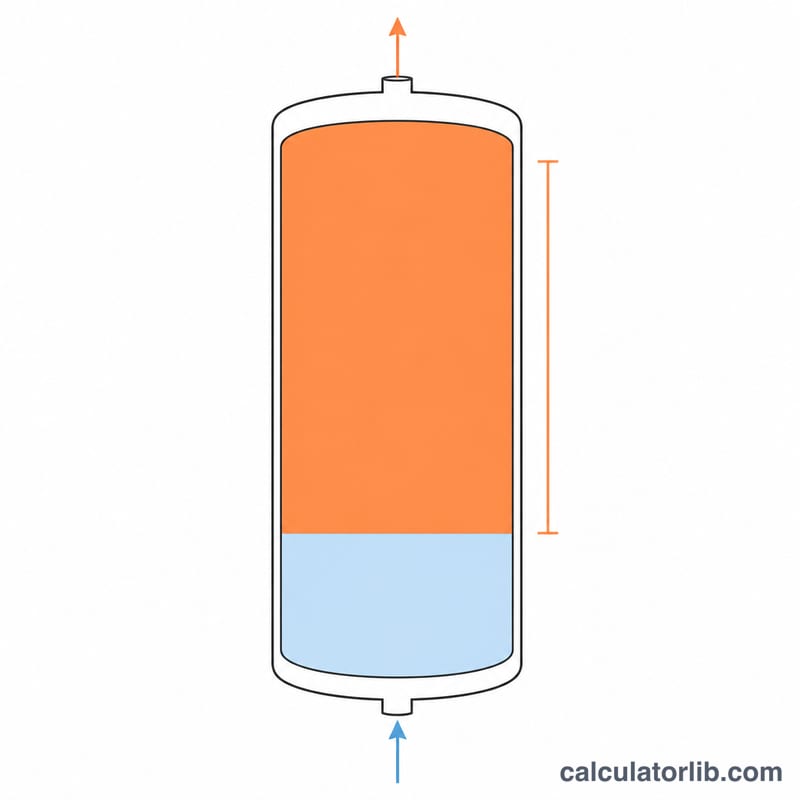
Storage cylinders are sold in a small set of nominal capacities. You cannot draw the full nominal volume as usable hot water, because incoming cold water mixes with and stratifies below the stored hot water as the tank empties. This calculator uses a usable-capacity (draw) fraction of 0.75, so a 200 L cylinder is treated as delivering about 150 L at tank temperature before the outlet temperature falls away.
The demand column below converts that usable hot volume into 40 °C blended water at the same 60 °C / 15 °C assumption (divide by 0.556, i.e. multiply by 1.8), and into standard 8-minute showers at 9 L/min (≈40 L of stored hot water each).
| Nominal capacity | Usable hot volume (75%) | Peak-hour demand covered (blended 40 °C) | Standard showers | Typically suits |
|---|---|---|---|---|
| 30 L | 22.5 L | ≈40 L | — | Point-of-use: single basin, small kitchen, cloakroom |
| 50 L | 37.5 L | ≈68 L | ≈1 short | 1 person, one short low-flow shower, light sink use |
| 80 L | 60 L | ≈108 L | ≈1.5 | 1 person with a generous shower, or a couple showering hours apart |
| 100 L | 75 L | ≈135 L | ≈2 | Couple, 2 back-to-back showers, minimal other draw |
| 120 L | 90 L | ≈162 L | ≈2 | Couple, 2 showers plus washing-up (120 L calculated) |
| 150 L | 112.5 L | ≈203 L | ≈3 | Family of 3, three morning showers |
| 200 L | 150 L | ≈270 L | ≈4 | Family of 4 with back-to-back showers plus kitchen use |
| 250 L | 187.5 L | ≈338 L | ≈4–5 | Family of 5, or family of 4 where one bath is filled in the peak hour |
| 300 L | 225 L | ≈405 L | ≈5–6 | Large household, two bathrooms in simultaneous use, bath plus showers |
Heat pump cylinders are usually sized one step larger. An air-source hot water heat pump typically reheats a cylinder over several hours rather than the 20–60 minutes of a high-output gas or direct-electric unit, so there is little useful recovery inside the peak hour. The same applies to solar-assisted tanks and to electric cylinders on a single overnight off-peak window. Sizing from stored volume alone, with a step up, is the safe approach.
These capacities are the common metric range; the exact sizes stocked, their insulation ratings and their standing-loss limits differ by country and by the applicable product standard. Treat this table as a sanity check on the calculated figure, not a replacement for it — two households of the same size can differ by a factor of two in peak-hour demand depending on shower head flow, shower length and whether anyone takes baths.
Choosing and Setting Up Your Tank
Worked example — a family of three, each taking an 8-minute shower at 9 L/min in the same hour, plus about 15 L of hot water for washing-up:
$$S = 3 \times 8 \times 9 = 216\ \text{L at }40\ ^\circ\text{C}, \qquad f = \frac{40 - 15}{60 - 15} = 0.556$$$$V_{\text{req}} = \frac{216 \times 0.556 + 15}{0.75} = \frac{120 + 15}{0.75} = 180\ \text{L}$$The requirement is 180 L, which is not a stocked size — so this household buys a 200 L cylinder.
- Always round up to the next standard size, never down. A cylinder that runs out mid-shower is a daily annoyance; the extra capacity costs a modest amount of standby loss. If the calculation lands within a few litres above a size, check whether trimming a shower head to a lower flow rate brings you comfortably under it.
- Do not oversize by more than one step. A tank loses heat 24 hours a day, every day, whether or not you use it, and the loss scales with surface area and stored temperature. Jumping from 200 L to 300 L "just in case" buys capacity you use a few times a year and pays for it every night.
- Set the stored temperature to at least 60 °C. Legionella bacteria proliferate in stagnant water roughly between 20 °C and 45 °C and are killed rapidly at 60 °C and above. Storing at 60 °C is the standard risk-control recommendation in guidance such as the WHO's Legionella and the prevention of legionellosis and the UK HSE's ACOP L8; many national codes require or assume it. Storing lower to save energy is a genuine health trade-off, not just an efficiency choice.
- Fit a thermostatic mixing valve (TMV) if you store at 60 °C. Water at 60 °C causes a full-thickness scald in a few seconds, and far faster on children and older adults. A TMV on the outlet blends the stored water down to about 40 °C at showers and basins, so you get Legionella control in the tank and safe delivery at the fixture. Several countries mandate temperature limiting at baths and basins in new or renovated dwellings — check what applies where you live.
- Go one size up when recovery is slow. Heat pump cylinders, off-peak electric heating with a single overnight window, and solar-assisted systems all recover too slowly to help inside the peak hour. Size up as well if your cold inlet drops sharply in winter — the calculator's mixing fraction rises as \(T_{\text{cold}}\) falls, so the same showers consume more stored water. Re-run the numbers with a winter inlet temperature (often 5–10 °C in cold climates versus 15–20 °C in summer) and size for the worse case.
- Go smaller, with conditions, if the peak can be spread. If showers can genuinely be staggered across two or three hours, or if a timer or smart controller can add a mid-afternoon reheat before evening use, a smaller cylinder with lower standing loss is often the better buy. A tankless (instantaneous) unit removes the sizing question entirely but shifts the constraint to instantaneous power or gas input, and to simultaneous-outlet performance — a point worth checking against your incoming supply capacity before choosing one.
- Check the whole system, not just the litres. Recovery rate (kW input and litres per hour at a given temperature rise), insulation class and standing loss, working pressure rating, expansion vessel sizing and available space and access all constrain the choice as much as volume does.
This is general sizing practice for domestic hot water storage, offered as information rather than as a design for your specific property. Installation of water heaters is governed by local plumbing, electrical, gas, ventilation and pressure-vessel codes, and unvented or pressurised cylinders in particular are restricted to qualified installers in many jurisdictions. Have the final specification and installation confirmed by a licensed plumber or heating engineer who knows the rules that apply where you are.
FAQ
Should I just buy the biggest tank? No. An oversized tank loses heat around the clock and costs more to run, so match it to the peak hour with only a small margin.
What if I have a tankless heater? Tankless units are sized by flow rate, not volume - compare the peak mixed flow (here \(n \times \dot{V}\)) with the unit rated L/min at your temperature rise.
Why store water hotter than I use it? Storing at 60 °C suppresses bacteria and stretches capacity, because each stored liter blends into nearly two liters at shower temperature. Fit a thermostatic mixing valve to avoid scalding.