What is water heater recovery rate?
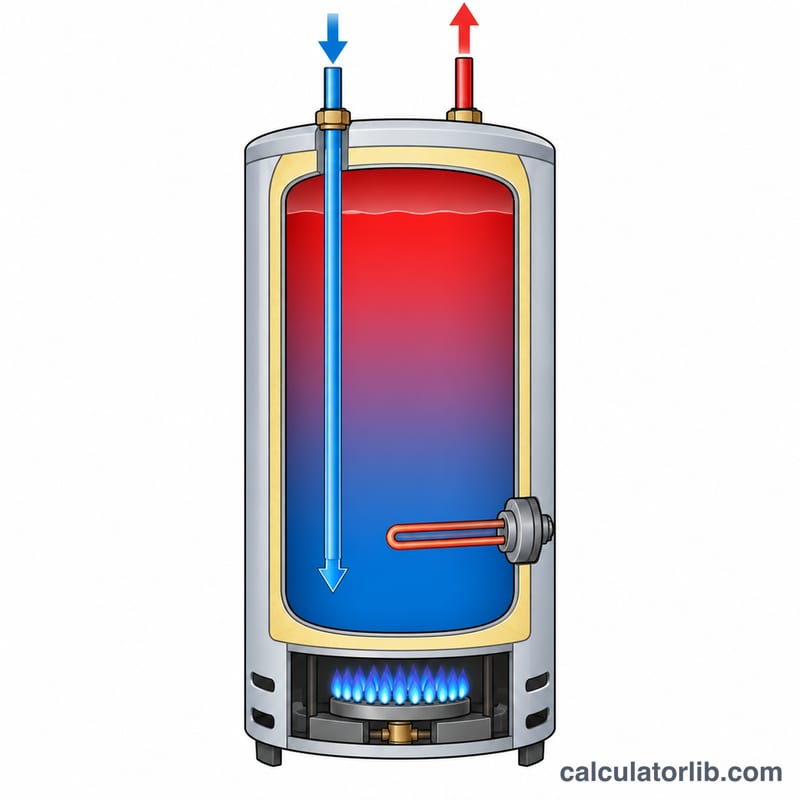
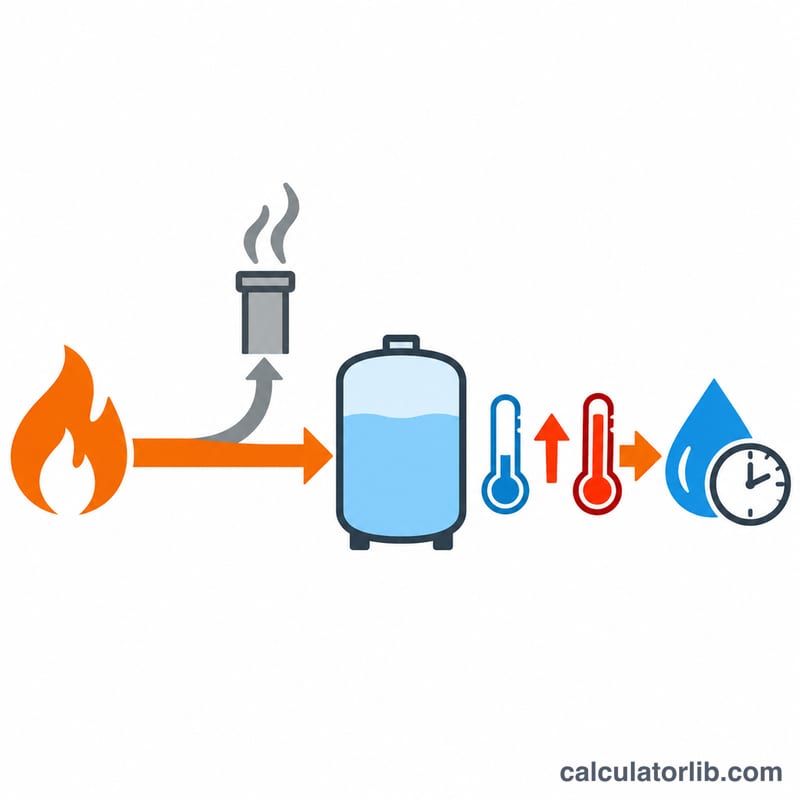
The recovery rate is how many gallons of water a storage water heater can bring up to temperature in one hour. Together with tank size it sets the first-hour rating, so it tells you whether a heater can keep up with back-to-back showers, a bathtub or a dishwasher running at the same time. This calculator uses US units: US gallons, degrees Fahrenheit and BTU per hour.
How to use the calculator
Choose gas or electric. For gas, enter the burner input in BTU/h from the rating plate. For electric, enter the element wattage in kW. Most tanks run only one element at a time, so enter the power of one element, not both added together. Next, enter the efficiency: about 98 to 100% for electric resistance, 76 to 82% for standard gas tanks, and up to 95% for condensing models. Last, enter the temperature rise. This is the target temperature minus the incoming cold-water temperature, for example 120 °F minus 50 °F gives 70 °F.
The formula explained
Heating one pound of water by 1 °F takes one BTU, and one US gallon of water weighs about 8.34 lb. So:
$$\text{GPH} = \frac{\text{BTU/h} \times \eta}{8.34 \times \Delta T}$$Here \(\eta\) is efficiency as a decimal and \(\Delta T\) is the temperature rise in °F. For electric heaters, first convert the rating with \(\text{BTU/h} = \text{kW} \times 3412.14\).
Worked example
Take a 40,000 BTU/h gas heater with 80% efficiency and a 90 °F rise:
$$\text{GPH} = \frac{40000 \times 0.80}{8.34 \times 90} = \frac{32000}{750.6} \approx 42.63\,\text{gal/h}$$A 4.5 kW electric element at 98% efficiency gives \(4.5 \times 3412.14 \times 0.98 \approx 15048\) BTU/h. At the same rise, that is only about 20.05 gal/h. This gap is why electric tanks are usually larger than gas tanks.
Sizing Tips Based on Your Recovery Rate
Recovery rate tells you how many gallons per hour (GPH) the heater can bring up to temperature. It does not tell you how much hot water you can use in your busiest hour. To size a heater, combine the recovery rate with the tank's stored volume and compare the total with your household's peak-hour demand. All volumes here are US gallons, which is what the 8.34 lb/gal constant in the formula assumes.
- Estimate the first-hour rating (FHR). Only part of a tank's stored water can be drawn before cold incoming water dilutes the outlet temperature. A common rule of thumb is: $$\text{FHR} \approx 0.7 \times \text{Tank Capacity (gal)} + \text{Recovery (GPH)}$$ For example, take a 40-gallon gas tank with a 40,000 BTU/h burner, 80% efficiency and a 90 °F rise. The recovery is \(\frac{40{,}000 \times 0.80}{8.34 \times 90} = \frac{32{,}000}{750.6} \approx\) 42.63 GPH. The estimated FHR is then \(0.7 \times 40 + 42.6 = 28 + 42.6 \approx 70.6\) gallons.
- Add up your peak-hour demand. Think about the busiest hour of a typical day, usually the morning, and total the hot water used in it. Typical draws are: a shower, about 10 to 20 gal depending on length and flow rate; a bath, about 20 gal; a dishwasher, about 6 gal; and a clothes washer, about 7 gal. Two 15-gallon showers, one dishwasher cycle and one wash load come to \(2 \times 15 + 6 + 7 = 43\) gallons. Choose a heater whose FHR equals or exceeds your peak-hour total, with some margin if your habits vary.
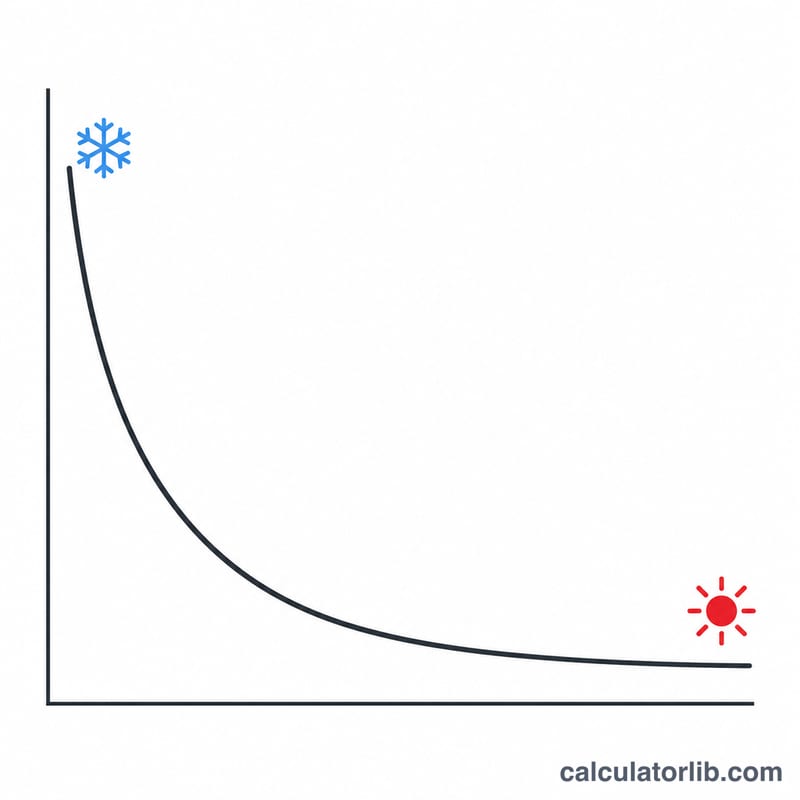
- Size for the coldest season. Temperature rise is the setpoint minus the incoming water temperature. Groundwater is coldest in winter, so the rise is largest and the recovery rate lowest then. Enter the winter inlet temperature for your area when you calculate the rise. A heater that is adequate in summer can fall short in January.
- Watch for low recovery on electric tanks. A standard electric resistance tank usually runs only one element at a time, so its recovery is far lower than a gas burner's. A 4.5 kW element (about 15,350 BTU/h) at a 90 °F rise recovers only about 20 GPH. If the electric recovery rate leaves you short of your peak-hour demand, you have three main options. You can pick a larger tank so stored water covers more of the peak. You can consider a heat-pump water heater, which has high efficiency but often also modest recovery, so check its FHR. Or, where gas service is available, a gas unit typically recovers much faster.
- Spread out heavy draws. If the numbers are close, avoid running showers, the dishwasher and the washer in the same hour. This gives the heater time to recover between uses and can avoid the need for a bigger unit.
- Trust the label over the estimate. The 0.7 × capacity rule is only an approximation. In the United States, the manufacturer's tested first-hour rating is printed on the yellow FTC EnergyGuide label and on the heater's rating plate. Elsewhere, check the rating plate or the product data sheet. When a tested FHR is available, use it in place of the estimate above.
These figures are general sizing guidance. Local codes, the heater's installation instructions and a qualified plumber or installer should guide your final choice.
FAQ
Why does the recovery rate change in winter?
Groundwater gets colder in winter, so the temperature rise gets bigger. The rise is in the denominator, so recovery drops. Going from a 60 °F rise to a 90 °F rise cuts recovery by one third.
Should I add both electric elements together?
Usually not. Standard dual-element tanks are wired so that only one element heats at a time. Use the wattage of a single element.
Is recovery rate the same as first-hour rating?
No. First-hour rating combines usable stored hot water with one hour of recovery, so it is always higher than the recovery rate alone.