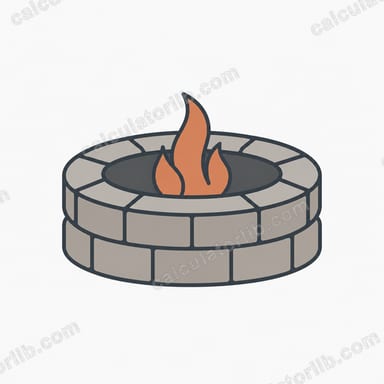
What this fire pit block calculator does
A ring fire pit is usually built from tapered or standard retaining wall blocks stacked in rows, called courses. This calculator works out how many blocks fit around one ring, how many rings you need to reach your wall height, and how many blocks to buy in total, with an optional extra allowance for broken or cut blocks.
How to use it
Enter the inside diameter of the fire pit (the open fire area), the wall height you want, and three block measurements: face length, height and depth. All measurements are in inches. Add a waste percentage if you want spares; 5–10% is common. The result shows blocks per course, number of courses, the total before extras, and the total to buy.
The formula explained
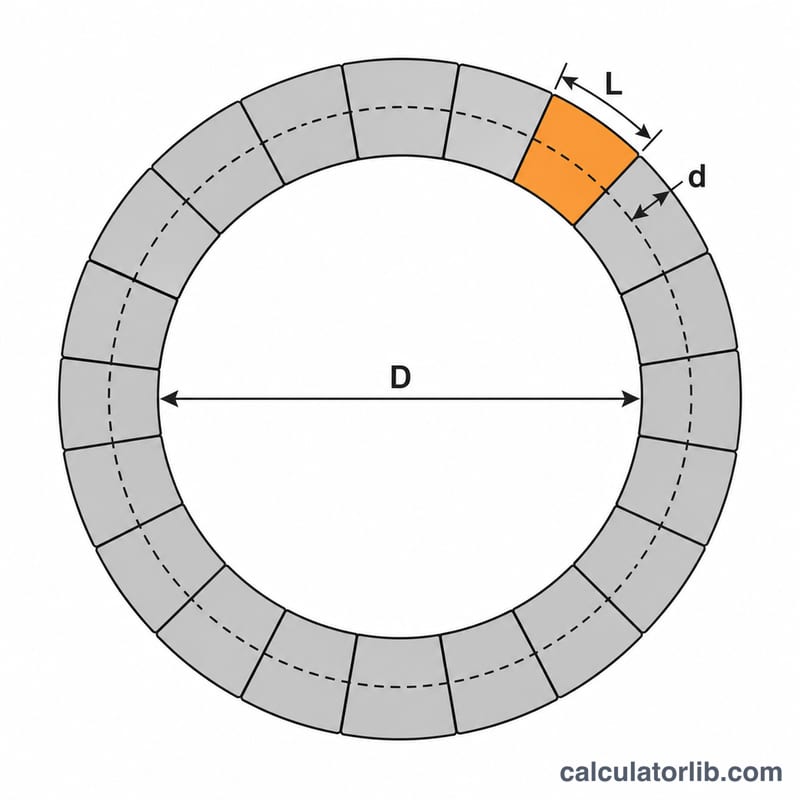
Blocks sit around a circle whose diameter is measured through the middle of the wall, so the centerline diameter is the inside diameter plus one block depth. The number of blocks per course is that circumference divided by the block face length, rounded up:
$$B = \left\lceil \frac{\pi (D + d)}{L} \right\rceil$$Here \(D\) is the inside diameter, \(d\) the block depth and \(L\) the face length. Courses are \(C = \lceil H / h \rceil\), where \(H\) is the target height and \(h\) the block height. Total blocks are \(B \times C\), and the purchase total multiplies this by \(1 + w/100\) and rounds up.
Worked example
A 36-inch inside diameter pit, 12 inches tall, using blocks 12 in long, 4 in high and 6 in deep:
$$\pi \times (36 + 6) = 131.95\,\text{in}$$$$B = \left\lceil \frac{131.95}{12} \right\rceil = \lceil 10.996 \rceil = 11$$$$C = \left\lceil \frac{12}{4} \right\rceil = 3, \quad N = 11 \times 3 = 33\ \text{blocks}$$With a 10% extra allowance you would buy \(\lceil 33 \times 1.1 \rceil = 37\) blocks.
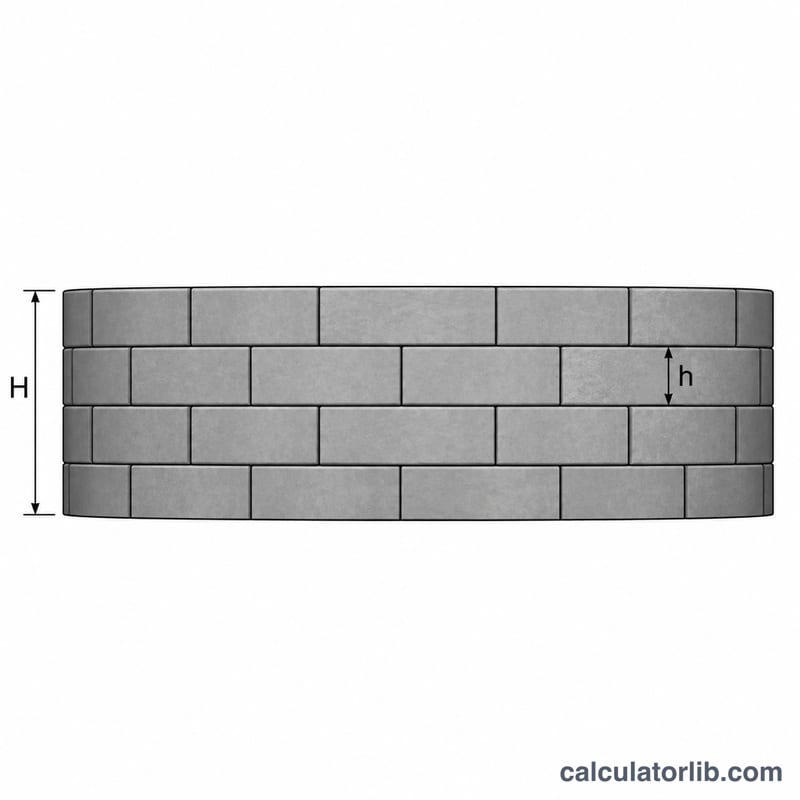
Block Counts for Common Fire Pit Sizes
The table below assumes a common block measuring 12 in long on the face, 4 in high and 6 in deep. The ring is measured along its centerline, at the middle of the block depth. That gives a circumference of \(\pi(D + d)\), where \(D\) is the inside diameter and \(d = 6\) in is the block depth. Divide that length by the 12 in face length and round up to get the blocks per course. Divide the wall height by the 4 in block height and round up to get the number of courses.
| Inside diameter | Wall height | Centerline circumference π(D+d) | Blocks per course | Courses ⌈H/4⌉ | Total blocks | Total with 10% extra |
|---|---|---|---|---|---|---|
| 36 in | 12 in | 131.95 in | 11 | 3 | 33 | 37 |
| 42 in | 12 in | 150.80 in | 13 | 3 | 39 | 43 |
| 48 in | 12 in | 169.65 in | 15 | 3 | 45 | 50 |
| 36 in | 16 in | 131.95 in | 11 | 4 | 44 | 49 |
| 42 in | 16 in | 150.80 in | 13 | 4 | 52 | 58 |
| 48 in | 16 in | 169.65 in | 15 | 4 | 60 | 66 |
Here is the full calculation for the 42 in pit:
$$B = \left\lceil \frac{\pi(42 + 6)}{12} \right\rceil = \left\lceil \frac{150.80}{12} \right\rceil = \lceil 12.57 \rceil = 13$$$$C = \left\lceil \frac{12}{4} \right\rceil = 3, \qquad N = \lceil 13 \times 3 \times 1.10 \rceil = \lceil 42.9 \rceil = 43$$A pit 6 in wider in diameter needs about two more blocks in every course. Adding a fourth course raises the total by one full ring of blocks.
Typical Retaining Wall Block Sizes
The sizes below are typical nominal dimensions for segmental and tapered wall blocks sold in inch-based markets such as the United States. They are examples only, not a standard. Metric markets sell different sizes.
| Block type (typical) | Face length | Height | Depth |
|---|---|---|---|
| Standard tapered wall block | 12 in | 4 in | 7 in |
| Common tapered garden wall block | 11.5 in | 4 in | 7 in |
| Larger segmental retaining wall block | 16 in | 6 in | 10 in |
| Small edging or garden wall block | 8 in | 4 in | 6 in |
Sizes differ between brands and product lines, sometimes by a fraction of an inch. Across a full ring, those small differences can change the count. Tapered (trapezoid) blocks are measured on their wider front face, and that is the length the calculator expects. The narrower back is what lets the blocks curve into a circle. Before you enter values, check the actual length, height and depth on the product label or spec sheet. Also check the smallest circle the block is rated for, because a tightly tapered block may not fit a very large or very small ring.
Practical Tips Before You Buy and Build
- Always round blocks per course up. A fractional result such as 12.57 means you need 13 blocks. If the last block leaves a small gap, don't cut a thin sliver to fill it. Instead, widen the joints slightly and evenly around the ring. A sliver is weak, looks out of place and can work loose.
- Buy by the pallet or bundle. Blocks are often sold in fixed quantities, so round your total up to the next full bundle. Add about 5–10% extra if you expect to cut blocks or if some may arrive chipped. Keep a few spares from the same batch so any later repairs match in color.
- Protect the blocks from direct flame. Standard concrete retaining wall blocks are not made for direct, repeated high heat. They can crack or spall, and trapped moisture makes this more likely. Line the inside with a steel fire ring insert or with firebrick laid in refractory mortar, so the wall blocks only form the outer shell. If you use an insert, measure its outside diameter and use that as your inside diameter in the calculator.
- Count capstones separately. Caps are usually a different size and often overhang the wall, so this calculator does not include them. Work out how many you need from the circumference of the cap ring and the cap's face length.
- Consider airflow. If you want, leave a few small gaps between blocks in the bottom course to let air feed the fire. Just keep the blocks on either side of each gap stable and level.
- Start level and check the rules. Set the first course on a compacted, level base. If it is out of level, every course above will be too. Before building, check local fire rules, burn restrictions and minimum distances from buildings and trees, because these vary by country and municipality.
FAQ
Why use the centerline instead of the inside diameter?
Tapered blocks touch at the back and open at the front, so the middle of the wall gives the most realistic count. Measuring only the inside edge would undercount the blocks.
How tall should a fire pit wall be?
Most backyard pits are 12–18 inches tall, which is three or four courses of 4-inch blocks. That height holds the fire in and is still comfortable for resting your feet on the edge.
Does the cap row count?
If you add capstones, count them on their own using the cap length. Lower the wall height here by one cap thickness so you do not order too many blocks.