What is the CT Scan Radiation Dose Calculator?
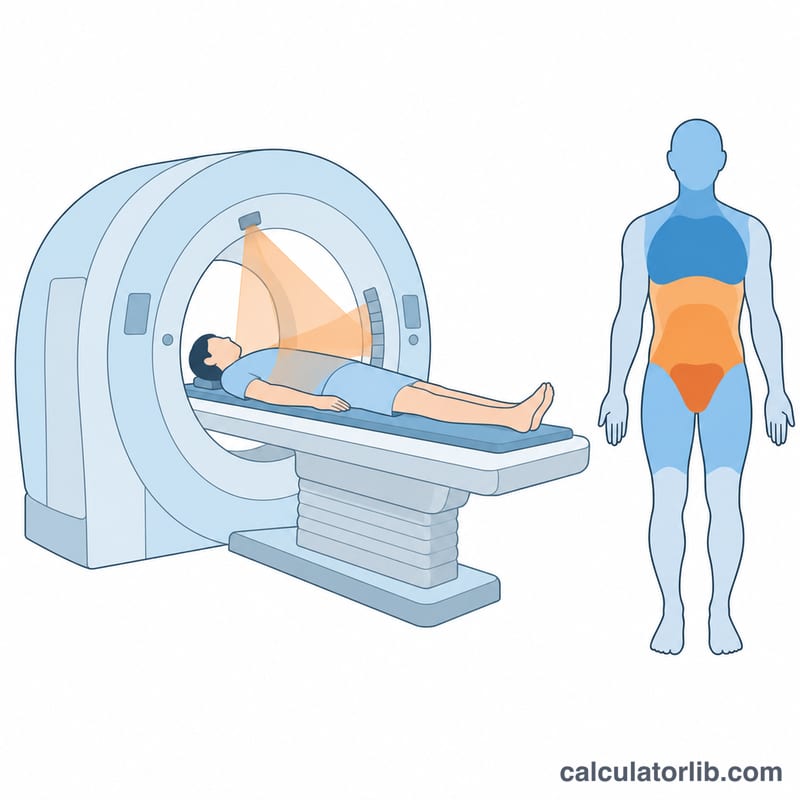
This tool estimates the effective dose, in millisieverts (mSv), delivered by a CT scan. It uses the dose-length product (DLP) printed on the scanner dose report and a conversion factor for the body region imaged. It then compares the result with natural background radiation and with chest X-rays so the number is easier to put in context.
How to use it
Enter the DLP in mGy·cm from the dose report, choose the body region, and enter your local annual background dose (about 3 mSv per year is a common figure for the US, and roughly 2.4 mSv is the world average). The calculator returns the effective dose, the number of days of background radiation it equals, and the number of chest X-rays (0.1 mSv each) that are equivalent.
The formula explained
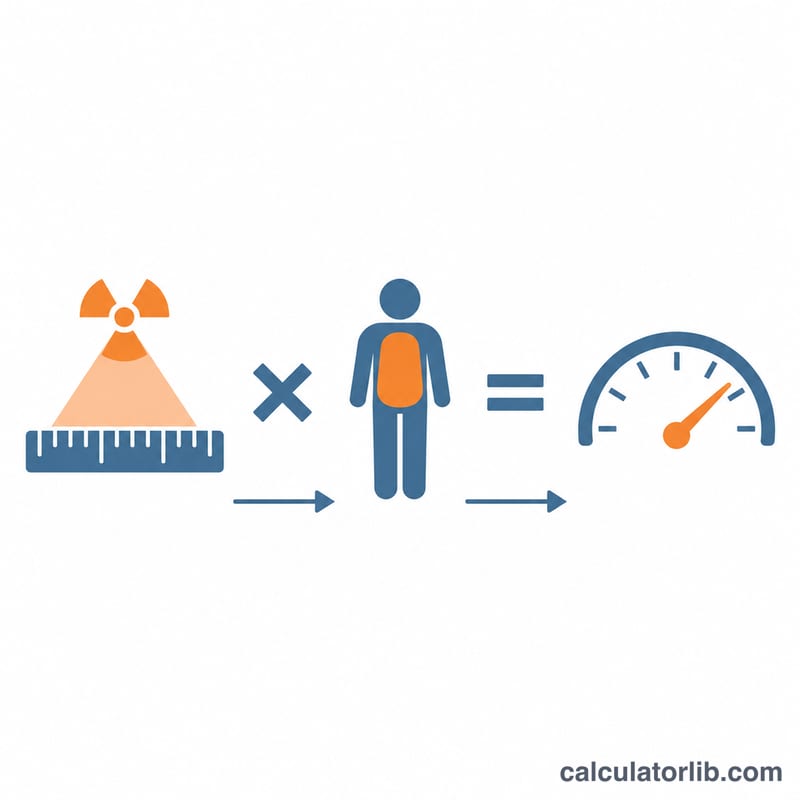
The effective dose is approximated as:
$$E = \text{DLP} \times k$$where \(E\) is the effective dose in mSv, \(\text{DLP}\) is the dose-length product in mGy·cm, and \(k\) is a region-specific factor for a standard adult (approximately 0.0021 for head, 0.0059 for neck, 0.014 for chest and 0.015 for abdomen, pelvis or the whole trunk). The background comparison is:
$$t = \frac{E}{B/365}$$with \(B\) the annual background dose in mSv.
Worked example
A chest CT reports a DLP of 400 mGy·cm. With \(k = 0.014\):
$$E = 400 \times 0.014 = 5.6\,\text{mSv}$$With 3 mSv per year of background radiation:
$$t = \frac{5.6}{3/365} \approx 681\,\text{days}$$That is about 1.9 years of natural background, or 56 chest X-rays.
Typical Effective Doses of Common Procedures and Sources
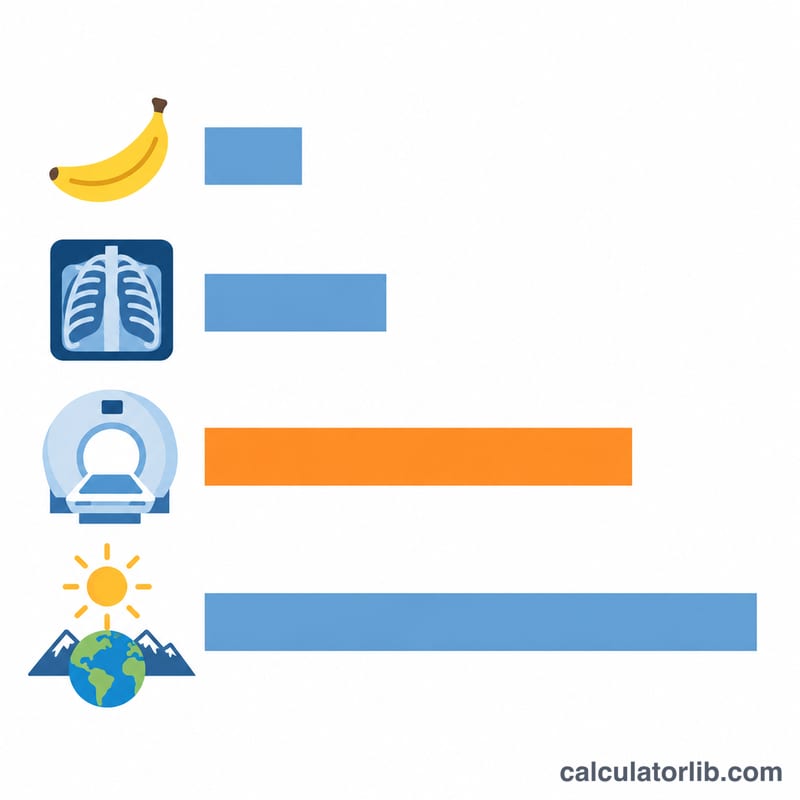
The values below are approximate typical effective doses compiled from published sources such as ICRP, UNSCEAR, ACR/RSNA and the Health Physics Society. They are rounded averages. Real doses vary with scanner, protocol, patient size and the number of scan phases.
| Procedure or source | Approximate effective dose (mSv) |
|---|---|
| Transatlantic flight (one way) | ~0.04-0.08 |
| Chest X-ray (PA view) | ~0.1 |
| Mammogram (screening) | ~0.4 |
| Head CT | ~2 |
| Chest CT | ~7 |
| Abdomen/pelvis CT | ~8-10 |
| Average annual natural background, worldwide (UNSCEAR) | ~2.4 per year |
| Average annual natural background, United States | ~3 per year |
Natural background differs a lot by location, altitude and local geology. You can enter your own local figure in the calculator's background field.
Interpreting Your Effective Dose
The calculator multiplies the scan's dose-length product (DLP, in mGy·cm) by a body-region factor k to estimate effective dose. For example, a chest CT with DLP 400 mGy·cm gives E = 400 × 0.014 = 5.6 mSv. That equals about 56 chest X-rays (5.6 / 0.1), or roughly 2.4 years of worldwide-average natural background.
- Under 1 mSv: comparable to a few months or less of natural background. It is also similar to the ICRP's recommended public dose limit of 1 mSv per year from planned non-medical sources.
- 1-10 mSv: comparable to roughly several months up to a few years of background. Most single diagnostic CT scans fall in this band.
- Over 10 mSv: a higher dose, typical of multi-phase or multi-region CT. For comparison, the ICRP occupational limit is 20 mSv per year averaged over five years. Dose limits do not apply to patient medical exposures, which are governed by justification and optimization.
The risk figure uses the ICRP nominal coefficient of about 5.5% per sievert (0.0055% per mSv). This is a population-level estimate based on the linear no-threshold (LNT) model. It is not a prediction for any one person. Uncertainty is large at low doses, and the effective dose itself is a protection quantity, not a measure of an individual's tissue dose. Age, sex and body size also change the real risk.
This is general information, not medical advice. If you have questions about a particular scan, ask your physician or radiologist. A medically justified scan generally has a benefit that outweighs its risk.
DLP-to-Effective-Dose Conversion Factors (k) by Body Region
The factors below are for a standard adult. They come from the European Guidelines on Quality Criteria for CT and from AAPM Report 96, and are expressed in mSv per mGy·cm. Effective dose is E = DLP × k.
| Body region | k (mSv per mGy·cm) |
|---|---|
| Head | 0.0021 |
| Neck | 0.0059 |
| Chest | 0.014 |
| Abdomen | 0.015 |
| Pelvis | 0.015 |
| Abdomen + pelvis | 0.015 |
| Whole body / trunk | 0.015 |
These factors apply to adults only. Pediatric k values are higher and depend on age, because smaller bodies absorb more dose per unit DLP. For infants, the head factor can be several times the adult value. Do not use the adult factors for children. Sources: European Commission, European Guidelines on Quality Criteria for CT (EUR 16262); AAPM Report 96 (2008), The Measurement, Reporting, and Management of Radiation Dose in CT.
FAQ
Is this value exact?
No. Conversion factors are population averages for a standard-sized adult, so individual doses can differ by a wide margin. Children and small patients usually need different factors.
Is a CT scan dangerous?
The doses are low and the diagnostic benefit usually outweighs the small theoretical risk, but unnecessary repeat scans should be avoided. Discuss concerns with your doctor or radiologist.
Where do I find the DLP?
It is usually listed on the dose summary page of your CT report. Ask the imaging facility if you cannot find it.