What Is the Top of Climb?
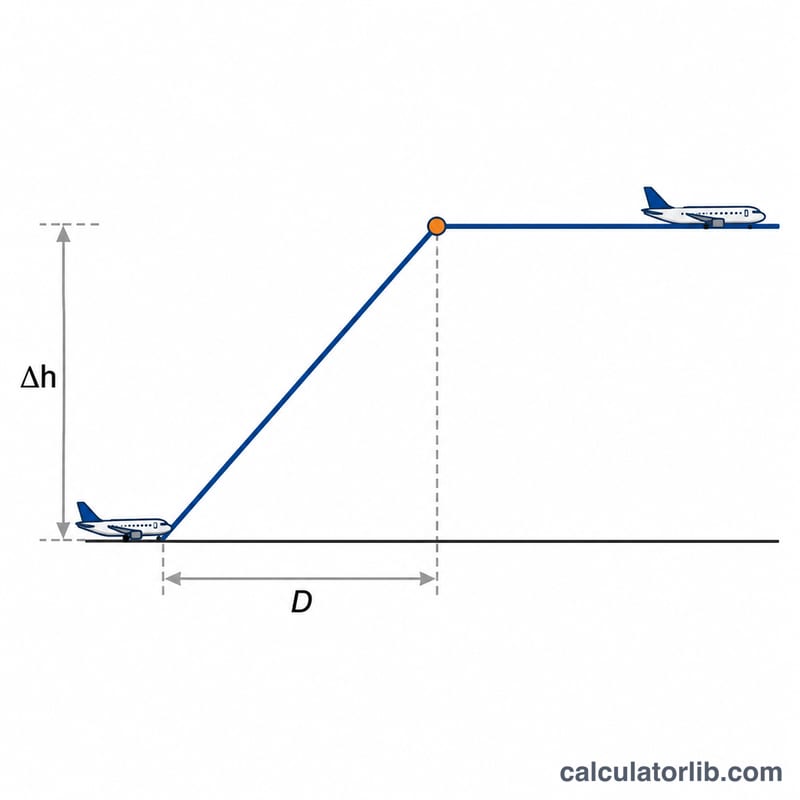
The top of climb (TOC) is the point on your route where the aircraft reaches its planned cruise altitude and levels off. Flight planners need to know how long the climb takes, how far along the route the TOC lies and how much fuel is burned getting there, because climb fuel flow is usually much higher than cruise fuel flow. This calculator works out all three from average climb performance.
How to Use the Calculator
Enter the departure field elevation and the cruise altitude in feet, the average rate of climb in feet per minute, the average groundspeed during the climb in knots (true airspeed corrected for the wind), and the climb fuel flow per hour. Fuel flow can be in any unit, such as US gallons, litres or pounds; the result is in the same unit. Take the climb figures from your aircraft performance charts where possible.
The Formulas
The climb time is the altitude to gain divided by the rate of climb:
$$t = \frac{h_{c} - h_{d}}{\text{ROC}}$$where \(h_{c}\) is cruise altitude, \(h_{d}\) is departure elevation and \(\text{ROC}\) is the rate of climb in ft/min. Distance and fuel then follow from the time in hours:
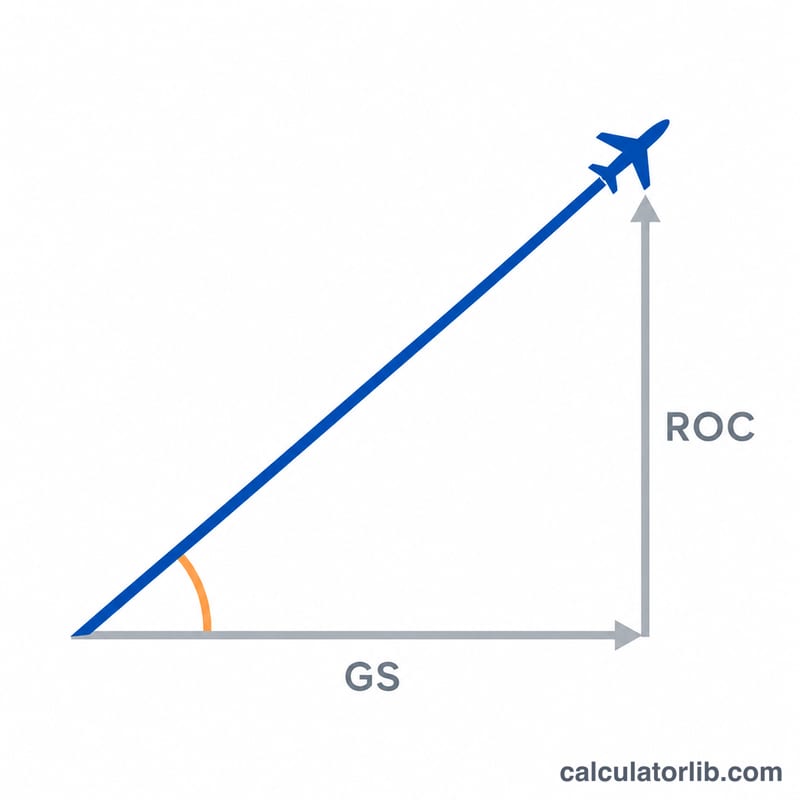
$$d = \text{GS} \times \frac{t}{60}, \qquad F = \text{FF} \times \frac{t}{60}$$The calculator also shows the climb gradient, \(\text{ROC} \times 60 / \text{GS}\), in feet per nautical mile. This is useful when checking against departure procedure climb requirements.
Worked Example
A light single departs a 500 ft airfield for 6,500 ft, climbing at 500 ft/min with a 90 kt groundspeed and burning 12 gal/h:
$$t = \frac{6500 - 500}{500} = 12\,\text{min}$$$$d = 90 \times \frac{12}{60} = 18\,\text{NM}, \qquad F = 12 \times \frac{12}{60} = 2.4\,\text{gal}$$So the top of climb is 18 NM along the route, reached after 12 minutes and 2.4 gallons of fuel.
More Worked Examples
Both examples use the same four relationships, with the altitude gain \(\Delta h = h_c - h_d\) (cruise altitude minus field elevation):
$$t = \frac{h_c - h_d}{\text{ROC}} \qquad d = \frac{\text{GS} \cdot t}{60} \qquad F = \frac{\text{FF} \cdot t}{60} \qquad G = \frac{60 \cdot \text{ROC}}{\text{GS}}$$Here \(t\) is in minutes, \(d\) in nautical miles, \(F\) is in whatever unit the fuel flow uses (gallons, litres, pounds or kilograms), and \(G\) is in feet per nautical mile. The ROC is an average rate for the whole climb. In practice the climb rate drops as the aircraft climbs, so take the average from the aircraft's performance charts.
Example 1: Turboprop climbing to FL180
A turboprop leaves a 1,200 ft field for FL180. That is 18,000 ft when the altimeter is set to standard pressure. The average climb is 1,200 ft/min at a climb groundspeed of 160 kt, and the average climb fuel flow is 500 lb/h. Because the fuel flow is in pounds per hour, the fuel answer is in pounds.
- Altitude gain: \(\Delta h = 18{,}000 - 1{,}200 = 16{,}800\) ft
- Time to climb: \(t = \dfrac{16{,}800}{1{,}200} = 14\) min, so the time is 14 minutes
- Distance to top of climb: \(d = \dfrac{160 \times 14}{60} = \dfrac{2{,}240}{60} = 37.33\) NM, about 37.3 NM
- Climb fuel: \(F = \dfrac{500 \times 14}{60} = \dfrac{7{,}000}{60} = 116.67\) lb, about 117 lb
- Climb gradient: \(G = \dfrac{60 \times 1{,}200}{160} = \dfrac{72{,}000}{160} = 450\) ft/NM
Result: top of climb comes about 37 NM from departure after 14 minutes, using about 117 lb of fuel. The climb gradient is 450 ft/NM.
Example 2: High-elevation departure into a headwind
A piston single departs a 5,000 ft field to cruise at 11,500 ft. Because the air is thin, the average climb rate is only 400 ft/min. The climb true airspeed is about 85 kt, but a 20 kt headwind brings the groundspeed down to 65 kt. Fuel flow is 10 gal/h.
- Altitude gain: \(\Delta h = 11{,}500 - 5{,}000 = 6{,}500\) ft
- Time to climb: \(t = \dfrac{6{,}500}{400} = 16.25\) min, about 16 min 15 s
- Distance to top of climb: \(d = \dfrac{65 \times 16.25}{60} = \dfrac{1{,}056.25}{60} = 17.60\) NM, about 17.6 NM
- Climb fuel: \(F = \dfrac{10 \times 16.25}{60} = \dfrac{162.5}{60} = 2.71\) gal, about 2.7 gal
- Climb gradient: \(G = \dfrac{60 \times 400}{65} = \dfrac{24{,}000}{65} = 369.23\) ft/NM, about 369 ft/NM
For comparison, with no wind (GS 85 kt) the same climb would cover \(\dfrac{85 \times 16.25}{60} = 23.02\) NM at a gradient of \(\dfrac{24{,}000}{85} = 282.35\) ft/NM. The headwind makes no difference to the climb time or fuel, because both depend only on altitude gain and ROC. It does shorten the ground distance to top of climb and steepens the gradient over the ground. That helps with obstacle clearance, but it also means the aircraft reaches cruise altitude closer to the airport.
Climb Scenarios Compared
Every row below uses the same 500 ft departure field. The base case is a climb to 6,500 ft at 500 ft/min, a 90 kt groundspeed and a 12 gal/h fuel flow. Each other row changes one input. All values come straight from \(t = \Delta h/\text{ROC}\), \(d = \text{GS} \cdot t/60\), \(F = \text{FF} \cdot t/60\) and \(G = 60 \cdot \text{ROC}/\text{GS}\), rounded to two decimals.
| Scenario | Altitude gain (ft) | ROC (ft/min) | GS (kt) | Time (min) | Distance (NM) | Fuel (gal) | Gradient (ft/NM) |
|---|---|---|---|---|---|---|---|
| Base case (to 6,500 ft) | 6,000 | 500 | 90 | 12 | 18 | 2.4 | 333.33 |
| 20 kt headwind | 6,000 | 500 | 70 | 12 | 14 | 2.4 | 428.57 |
| 20 kt tailwind | 6,000 | 500 | 110 | 12 | 22 | 2.4 | 272.73 |
| Higher cruise (8,500 ft) | 8,000 | 500 | 90 | 16 | 24 | 3.2 | 333.33 |
| Lower ROC (hot day or heavy) | 6,000 | 350 | 90 | 17.14 | 25.71 | 3.43 | 233.33 |
What the comparison shows:
- Wind changes only distance and gradient. Time and fuel stay at 12 min and 2.4 gal. A headwind brings top of climb closer and steepens the gradient. A tailwind pushes it farther out and flattens the gradient.
- A higher cruise altitude increases time, distance and fuel in proportion to the extra altitude gain. The gradient does not change, because ROC and GS are the same.
- A lower climb rate makes everything worse at once: the climb takes longer, burns more fuel, covers more ground and has the shallowest gradient. This is the case to check against obstacle and terrain clearance.
Note: these are illustrative inputs only, chosen to show how each variable affects the result. For real flight planning, take climb rate, climb speed and fuel flow from your aircraft's flight manual or performance charts, corrected for weight, temperature and pressure altitude. Use the forecast winds aloft for groundspeed.
FAQ
Why use average values?
Rate of climb drops as altitude increases, and true airspeed and wind change with height. Using mid-climb averages (or the time, fuel and distance-to-climb chart in your aircraft manual) gives a realistic estimate.
Does this include taxi and take-off fuel?
No. Add your start, taxi and run-up allowance separately in your fuel plan.
Can I use it for descent planning?
The same idea applies in reverse. Divide the altitude to lose by your descent rate to find the time, then multiply by groundspeed to find where to start down.