
What This Calculator Does
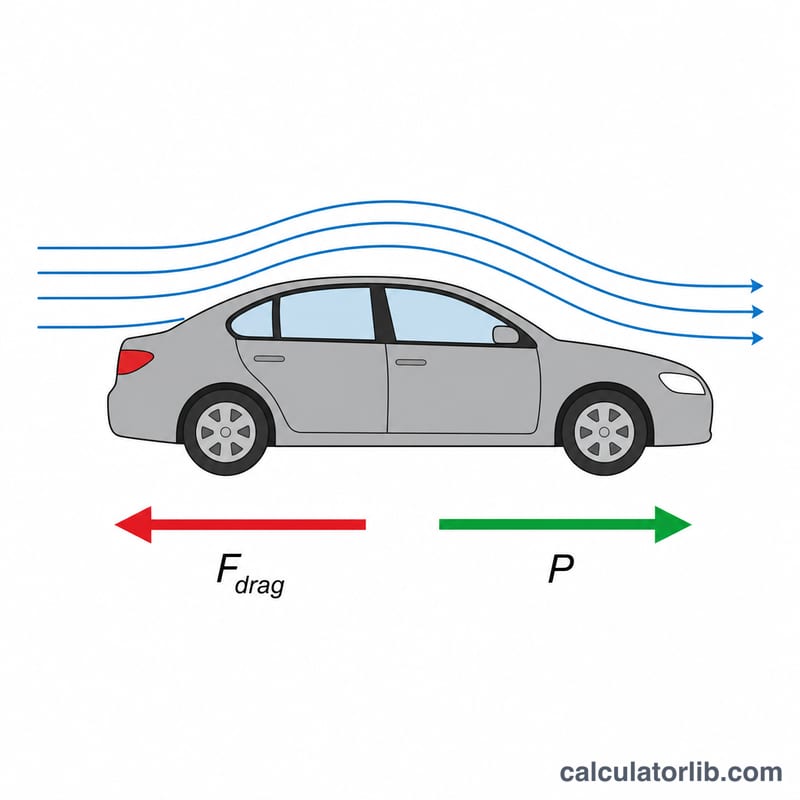
This tool estimates the drag-limited top speed of a vehicle from its power output and aerodynamic properties. At top speed, the vehicle can no longer accelerate because all available power is consumed overcoming aerodynamic drag. By balancing engine power against drag power, we can solve for the maximum theoretical velocity.
How to Use It
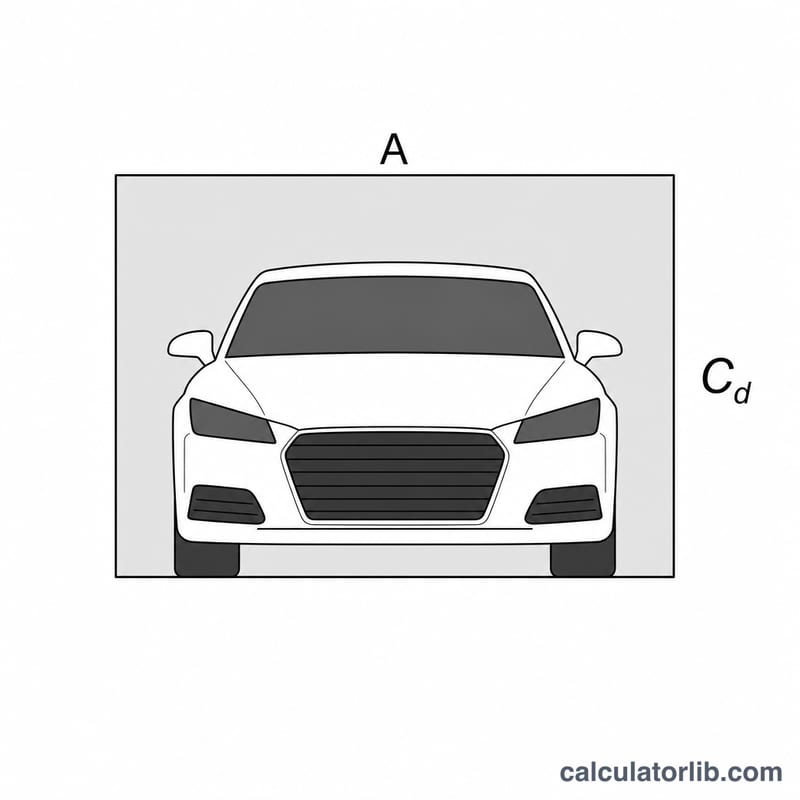
Enter the power delivered at the wheels in watts (1 hp ≈ 746 W, 1 kW = 1000 W), the air density (about 1.225 kg/m³ at sea level), the drag coefficient (Cd, typically 0.25–0.35 for cars), and the frontal area in square metres (roughly 2.0–2.5 m² for a car). The calculator returns the top speed in km/h, mph and m/s.
The Formula Explained
Aerodynamic drag force is \(F = \tfrac{1}{2}\cdot\rho\cdot C_d\cdot A\cdot v^2\). The power to overcome it is \(P = F\cdot v = \tfrac{1}{2}\cdot\rho\cdot C_d\cdot A\cdot v^3\). Setting this equal to available power and solving for v gives:
$$v = \sqrt[3]{\dfrac{P}{\tfrac{1}{2}\cdot\rho\cdot C_d\cdot A}}$$
The cube-root relationship explains why doubling top speed requires roughly eight times the power.
Worked Example
For a typical car: P = 150,000 W, ρ = 1.225 kg/m³, Cd = 0.30, A = 2.2 m². The denominator is \(0.5 \times 1.225 \times 0.30 \times 2.2 = 0.40425\). Then $$v = \sqrt[3]{\dfrac{150000}{0.40425}} = \sqrt[3]{371{,}057} \approx 71.86\ \text{m/s},$$ which is about 258.7 km/h (≈160.7 mph).
FAQ
Why is my real top speed lower? Real vehicles also lose power to rolling resistance, drivetrain losses and gearing limits, so actual top speed is usually below this aerodynamic ceiling.
What power should I enter? Use power at the wheels for the most realistic estimate; crank/engine power overstates the result because of drivetrain losses.
Does this work for any units? The physics is universal. Just keep inputs in SI units (watts, kg/m³, m²) and the outputs will be correct.