What the video watch time to revenue calculator does
This calculator estimates how much ad revenue your video watch time is worth. You enter your total public watch hours, your average view duration, and your RPM (revenue per 1,000 views). The tool converts watch hours into an estimated number of monetized views, then turns those views into an estimated dollar figure. It is built for YouTube-style creators who track watch time in their analytics and want a quick revenue estimate rather than a channel-eligibility check.
How to use it
Enter your total watch time in hours — the figure your analytics reports for a video or date range. Enter your average view duration in minutes, which the tool uses to work backward to a view count. Finally enter your RPM in US dollars: the revenue you actually keep per 1,000 views after the platform's share. The result shows your estimated revenue, the implied view count, and how many dollars each watch hour is worth.
The formula explained
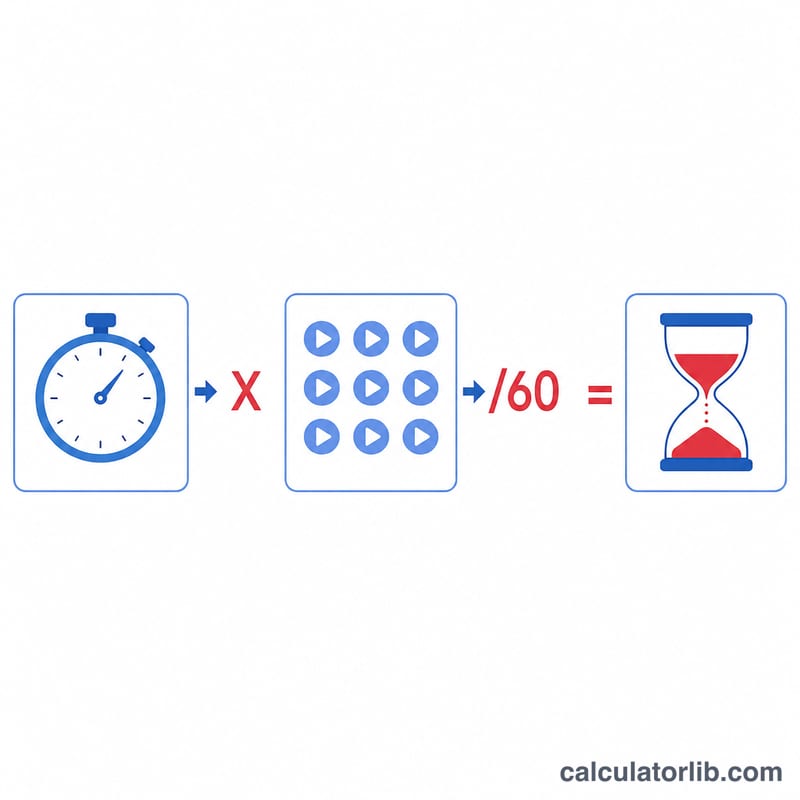
Watch time does not pay directly; views carry the ads. So the first step converts watch hours into views using your average view duration:
$$ \text{Views} = \frac{ \text{Watch hours} \times 60 }{ \text{Avg view duration (min)} } $$Multiplying watch hours by 60 turns them into watch minutes, and dividing by the average minutes per view returns the number of views. Revenue then follows from RPM, which is quoted per thousand views:
$$ \text{Revenue} = \frac{ \text{Views} }{1000} \times \text{RPM} $$Dividing the result by watch hours gives a handy per-hour yield:
$$ \text{Revenue per watch hour} = \frac{ \text{Revenue} }{ \text{Watch hours} } $$RPM (revenue per mille) is the standard creator metric and is already net of the platform revenue share, so no extra split adjustment is needed.
Worked example
Suppose a video logged 6,000 watch hours with an average view duration of 5 minutes and your channel earns an RPM of $6. Views equal 6,000 x 60 / 5 = 72,000. Revenue equals 72,000 / 1,000 x $6 = $432. That works out to $432 / 6,000 = $0.072 of revenue for every watch hour.
Revenue Across Different RPM and View Duration Scenarios
This table holds watch time constant at 4,000 hours (240,000 minutes) and varies average view duration (AVD) and RPM. Shorter average views mean many more views are needed to reach the same watch hours. The formulas used are:
$$\text{Views} = \frac{ \text{Watch Hours} \times 60}{\text{AVD (min)}}$$
$$\text{Revenue} = \frac{\text{Views}}{1000} \times \text{RPM}, \qquad \text{Revenue per Watch Hour} = \frac{\text{Revenue}}{\text{Watch Hours}}$$
| Watch Hours | AVD (min) | Implied Views | RPM | Estimated Revenue | Revenue per Watch Hour |
|---|---|---|---|---|---|
| 4,000 | 2 | 120,000 | $2 | $240 | $0.060 |
| 4,000 | 2 | 120,000 | $4 | $480 | $0.120 |
| 4,000 | 2 | 120,000 | $8 | $960 | $0.240 |
| 4,000 | 5 | 48,000 | $2 | $96 | $0.024 |
| 4,000 | 5 | 48,000 | $4 | $192 | $0.048 |
| 4,000 | 5 | 48,000 | $8 | $384 | $0.096 |
| 4,000 | 10 | 24,000 | $2 | $48 | $0.012 |
| 4,000 | 10 | 24,000 | $4 | $96 | $0.024 |
| 4,000 | 10 | 24,000 | $8 | $192 | $0.048 |
Example substitution (5-minute AVD, $4 RPM): views = \(\frac{4000 \times 60}{5} = 48{,}000\); revenue = \(\frac{48{,}000}{1000} \times 4 = 192\); per watch hour = \(\frac{192}{4000} = 0.048\).
Takeaway: with the same watch hours and RPM, a shorter AVD produces more views and therefore more RPM-based revenue in this model. In practice, RPM itself often differs between short and long videos, so treat these as illustrative, not predictive.
Key Terms: Watch Hours, AVD, RPM and CPM
- Watch hours: the total time viewers spent watching your videos, expressed in hours. In this calculator: \(\text{Watch Hours} = \frac{\text{AVD (min)} \times \text{Views}}{60}\).
- Average view duration (AVD): the average amount of time per view, here entered in minutes. It is total watch time divided by the number of views.
- Views: the count of times your videos were counted as watched. Each platform has its own rules for what counts as a view.
- RPM (revenue per mille): the estimated creator revenue per 1,000 views, after the platform has taken its share. It reflects all revenue sources included in your reporting, not just ads shown.
- CPM (cost per mille): what advertisers pay per 1,000 ad impressions, before the platform's share is deducted. CPM is usually higher than RPM for the same video.
- Monetized playbacks vs. total views: not every view shows an ad. Some viewers use ad blockers or ad-free subscriptions, some videos or regions have limited ad demand, and some content is not eligible for ads. RPM is calculated against total views, whereas playback-based CPM figures relate only to monetized playbacks or ad impressions, so the two are not directly interchangeable.
Interpreting Your Estimated Revenue
The result is an estimate based on the RPM you enter. It is not a payout, a forecast, or a guarantee. Actual earnings depend on factors such as:
- Niche: finance, software and business topics often attract higher advertiser demand than other categories.
- Audience geography: advertisers pay different rates depending on where viewers are located.
- Season: ad spending is commonly higher late in the year and lower early in the year.
- Ad formats and placement: the types, number and placement of ads, and whether a video is long-form or short-form, affect yield.
Revenue per watch hour is a yield metric: it shows how much revenue each hour of viewing generates under your assumptions. It is useful for comparing videos or scenarios with each other, but it will move as RPM and AVD change, so compare using consistent time periods.
Eligibility is separate from earnings. For YouTube's Partner Program, 4,000 public watch hours in the past 12 months is one of the eligibility requirements for the standard tier. Other requirements exist, such as a minimum subscriber count and compliance with channel policies, and YouTube may change the criteria or offer alternative tiers. Check YouTube's official help pages for the current rules in your region. Reaching the threshold does not by itself produce revenue; earnings begin only after approval and depend on ad delivery.
This is general information for planning purposes, not financial or professional advice.
Frequently asked questions
Is watch time paid directly? No. Platforms pay on ad impressions tied to views, not on raw watch hours. Watch time governs eligibility and how many ads a long video can show, so this tool converts hours into views first, then into revenue.
What RPM should I enter? Use the RPM from your own analytics if you have it; it varies widely by niche, audience country, and season, commonly ranging from about $1 to $20. RPM already reflects your take-home share after the platform cut, so enter the net figure.
Why does the tool ask for average view duration? Watch hours alone cannot be priced, but views can. Average view duration lets the calculator convert total hours back into an approximate view count, which is what RPM is quoted against.