
What is the Video Download Time Calculator?
This calculator estimates how long it will take to download a video, movie, game, or any file based on its size and your internet connection speed. Enter the file size and your download speed, choose the right units, and it returns the time in seconds plus a readable hours/minutes/seconds breakdown.
How to use it
Type the file size (for example 1.5 GB) and select its unit. Then enter your download speed — connection speeds are usually quoted in megabits per second (Mbps), while file managers often show MB/s (megabytes per second). Pick the matching unit and read off the estimated time. Remember that 1 byte = 8 bits, so a 50 Mbps connection delivers roughly 6.25 MB per second at best.
The formula explained
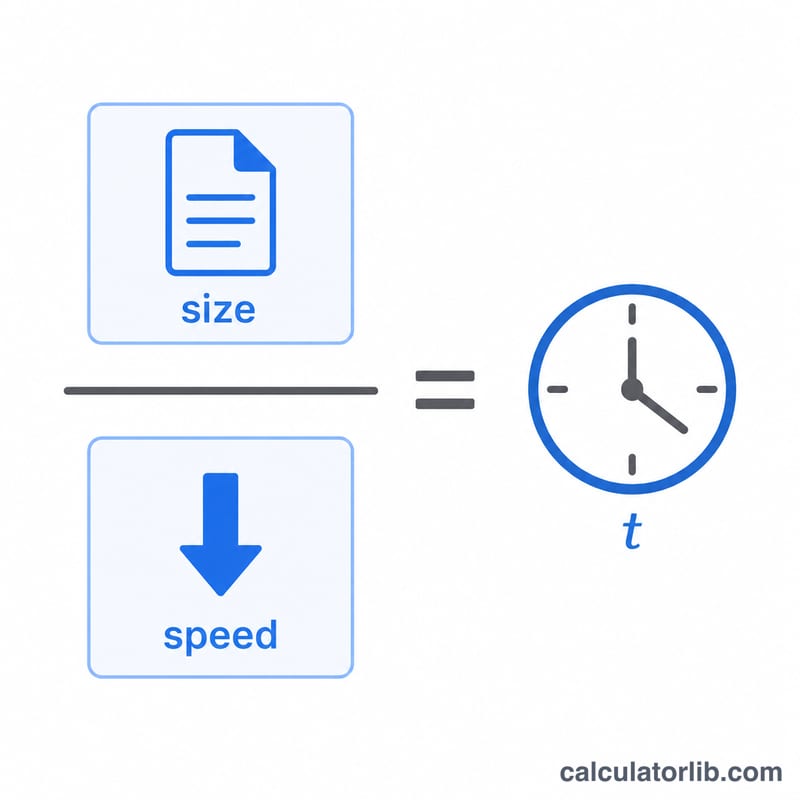
The core relationship is simply time = data ÷ rate. We convert the file size to bits and the speed to bits per second, then divide:
$$T = \frac{S_{\text{bits}}}{R_{\text{bps}}}$$
$$\text{where}\quad \left\{ \begin{aligned} S_{\text{bits}} &= \text{File Size} \times (1024)^{u} \times 8 \\ R_{\text{bps}} &= \text{Speed} \times (1000)^{v} \end{aligned} \right.$$
File sizes use binary prefixes (1 GB = 1024³ bytes), while network speeds use decimal prefixes (1 Mbps = 1,000,000 bits/s), matching how ISPs and storage are normally measured.
Worked example
Suppose you want to download a 1.5 GB video on a 50 Mbps connection. The file is \(1.5 \times 1024^3 \times 8 \approx 12{,}884{,}901{,}888\) bits. Your speed is 50,000,000 bits/s. Dividing gives about 257.7 seconds — roughly 4 minutes and 18 seconds in ideal conditions.
FAQ
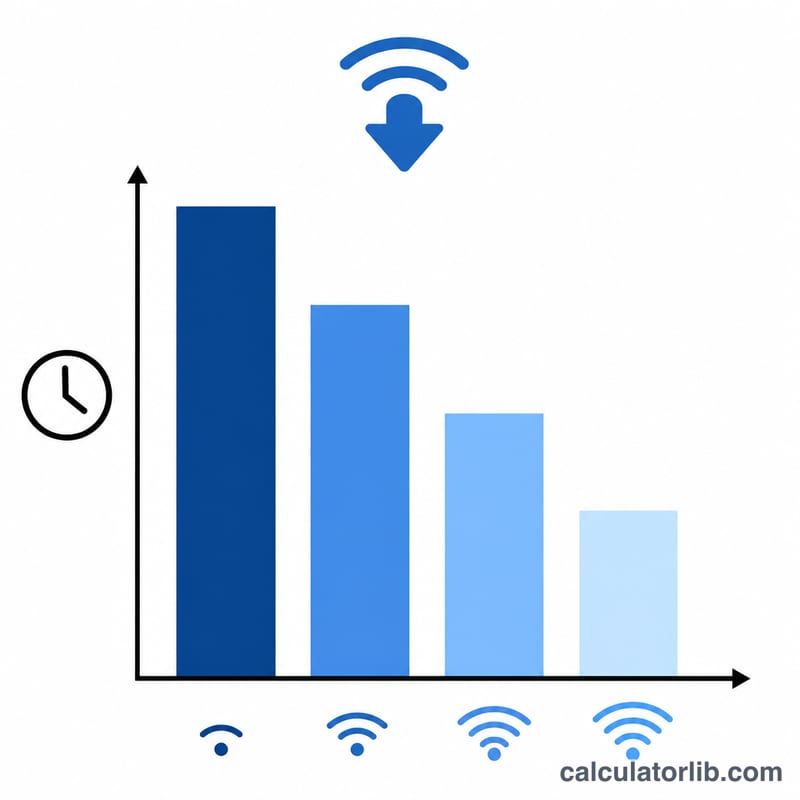
Why does my real download take longer? Network overhead, throttling, server limits, Wi-Fi interference, and shared bandwidth all reduce real-world throughput. This is a best-case estimate.
What's the difference between Mbps and MB/s? Mbps is megabits per second; MB/s is megabytes per second. Divide Mbps by 8 to get MB/s — so 50 Mbps ≈ 6.25 MB/s.
Does streaming use this? Streaming needs a sustained speed above the video's bitrate; this tool estimates full-file download time rather than streaming buffering.