
What Is Luminous Efficacy?
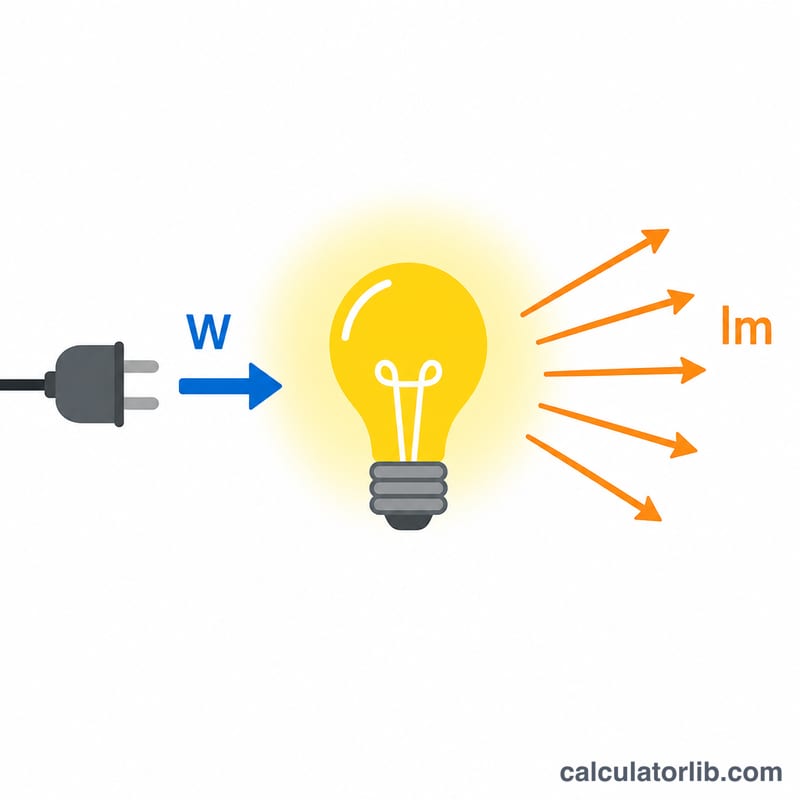
Luminous efficacy measures how efficiently a light source converts electrical power into visible light. It is expressed in lumens per watt (lm/W): the higher the number, the more light you get for each watt of power consumed. This is a universal photometric measure used worldwide to compare lamps, LEDs, and luminaires regardless of brand or technology.
How to Use This Calculator
Enter the total luminous flux of the light source in lumens (usually printed on the packaging) and the power it draws in watts. The calculator divides flux by power to give the luminous efficacy in lm/W. Use the rated wattage of the bulb for a fair comparison.
The Formula Explained
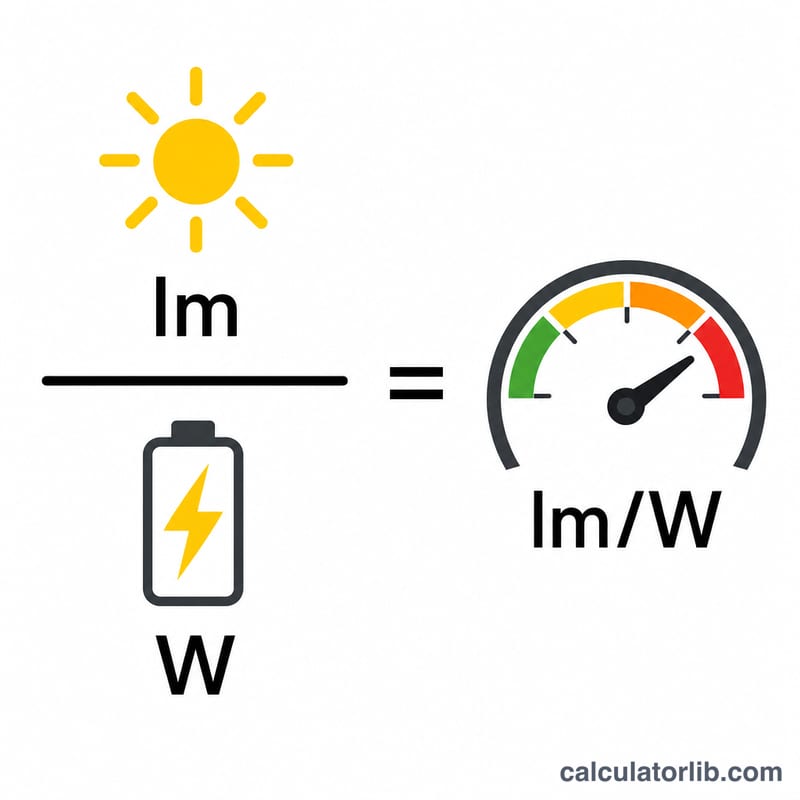
The relationship is simply:
$$\eta = \frac{\text{Luminous Flux (lm)}}{\text{Power (W)}}$$
Luminous flux (\(\Phi_v\)) is the total perceived light output, weighted by the human eye's sensitivity. Power (\(P\)) is the real electrical power drawn. Dividing them yields how many lumens each watt produces.
Worked Example
A modern LED bulb produces 800 lumens while drawing 9 watts. Its efficacy is $$800 \div 9 \approx 88.9 \text{ lm/W}.$$ Compare this with an old incandescent bulb that produced 800 lumens from 60 watts: $$800 \div 60 \approx 13.3 \text{ lm/W}.$$ The LED is roughly 6.7 times more efficient.
FAQ
What is a good lm/W value? Incandescent bulbs reach about 10–17 lm/W, halogens 16–24, fluorescents 50–100, and quality LEDs 80–150+ lm/W.
What is the theoretical maximum? The maximum possible luminous efficacy of radiation is about 683 lm/W for monochromatic 555 nm green light; white-light sources are inherently lower.
Does efficacy include the driver losses? If you use the total system wattage (including any driver or ballast), you get luminous efficacy of the whole source, which is the most realistic comparison.