
What This Calculator Does
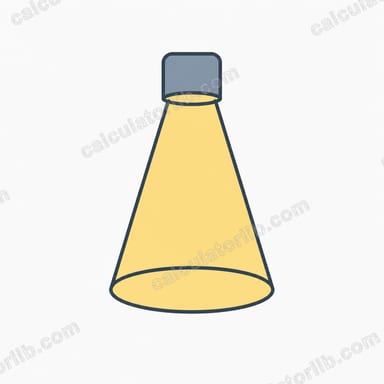
The Beam Angle to Spot Diameter Calculator converts a light fixture's beam angle and throw distance into the diameter of the illuminated circle (the "spot") that lands on a surface. It is widely used in stage lighting, photography, architectural lighting and LED downlight planning to predict how wide a beam will be before mounting anything.
How to Use It
Enter the beam angle in degrees (printed on most luminaire spec sheets — common values are 10°, 25°, 36°, 60°) and the distance from the fixture to the surface in meters. The calculator returns the spot diameter, its radius and the total illuminated area.
The Formula Explained
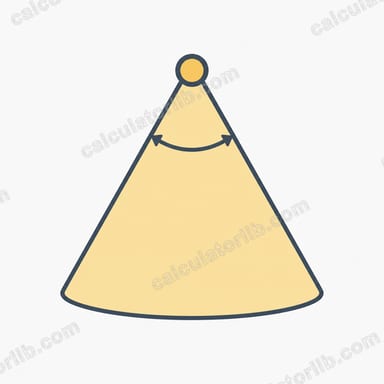
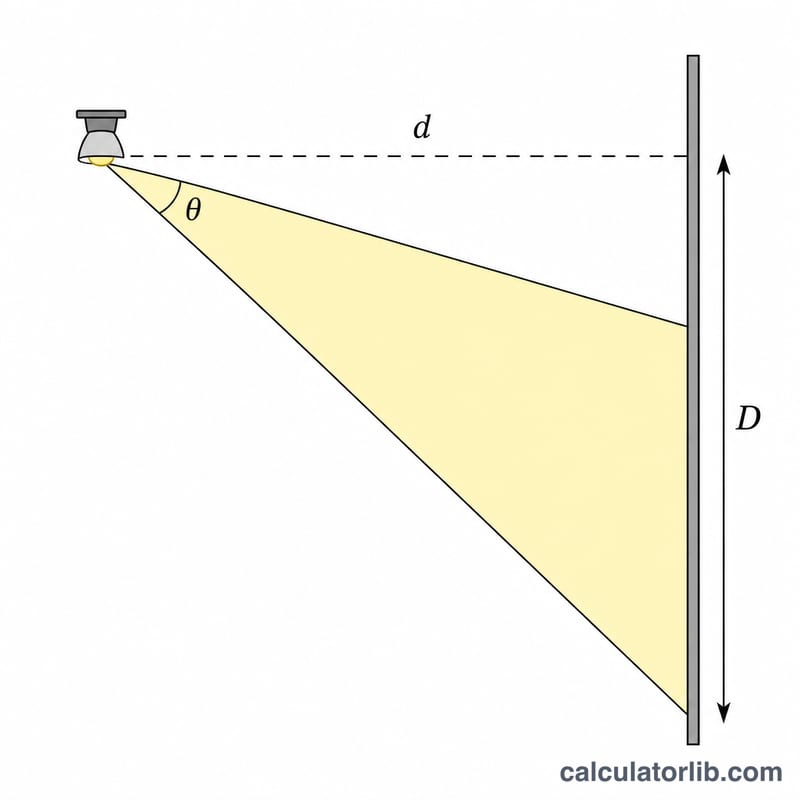
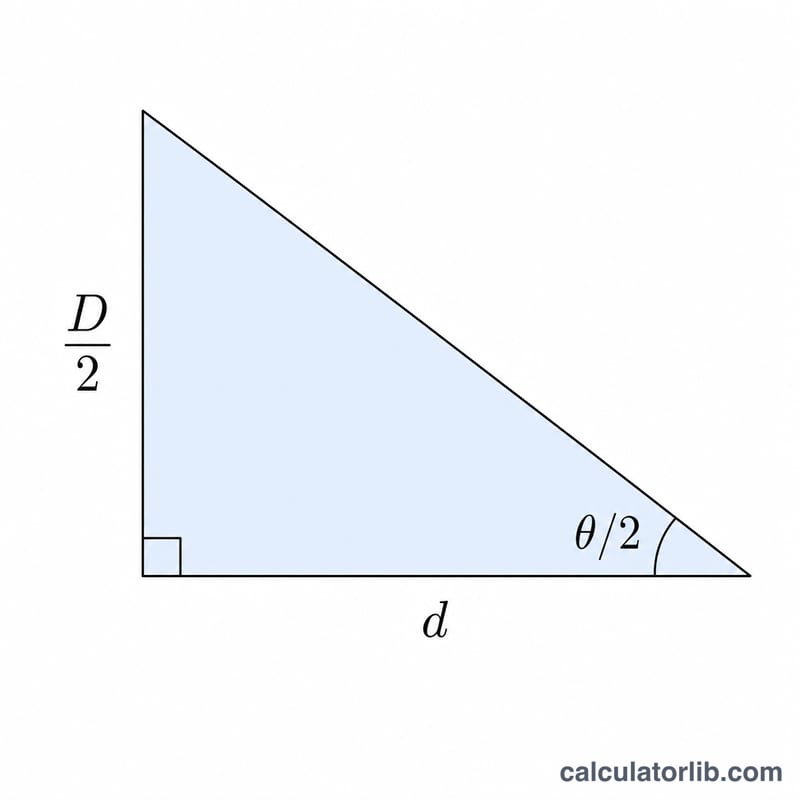
A cone of light spreads symmetrically around its center line. At distance d, the radius of the spot equals \(d \times \tan(\theta/2)\), where θ is the full beam angle. Doubling the radius gives the diameter:
$$D = 2 \times d \times \tan\!\left(\frac{\theta}{2}\right)$$
The angle is halved because the beam angle measures the full cone, while the tangent relationship uses the angle from the center line to the edge. The illuminated area then follows from the circle formula \(A = \pi \cdot (D/2)^2\).
Worked Example
A spotlight with a 36° beam angle is mounted 2 m from a wall. Half the angle is 18°, and \(\tan(18°) \approx 0.32492\). So $$D = 2 \times 2 \times 0.32492 \approx 1.30 \text{ m}$$ The illuminated area is \(\pi \times (0.65)^2 \approx 1.33 \text{ m}^2\).
Common Beam Angles and Their Spread
Lighting manufacturers group fixtures into broad beam-angle classes. A narrow beam concentrates light into a tight, bright pool, while a wide beam spreads the same lumens over a larger area at lower intensity. The categories below are widely used for spotlights, track lighting, downlights and architectural fixtures.
| Classification | Beam Angle | Typical Applications |
|---|---|---|
| Very Narrow Spot | \(\leq 10^\circ\) | Accenting small objects, highlighting sculptures, jewelry display, long-throw highlighting |
| Spot | \(10^\circ\!-\!18^\circ\) | Artwork, retail product features, focused task highlights |
| Narrow Flood | \(18^\circ\!-\!28^\circ\) | Accent lighting, wall washing of feature panels, display cases |
| Flood | \(28^\circ\!-\!40^\circ\) | General accent and task lighting, kitchen counters, work surfaces |
| Wide Flood | \(40^\circ\!-\!60^\circ\) | Ambient room lighting, even coverage, recessed ceiling downlights |
| Very Wide Flood | \(> 60^\circ\) | Broad ambient washes, low ceilings, wide uniform coverage |
Note that beam angle (the cone where intensity is at least 50% of peak) differs from the wider field angle (intensity at least 10% of peak). The spot-diameter formula on this page uses the published beam angle.
FAQ
What is beam angle? It is the angle between the two opposite points where light intensity falls to 50% of the maximum (center) intensity — the cone of "useful" light.
Does it work in feet? Yes — the spot diameter comes out in the same unit you enter for distance. Use feet in and you get feet out (area in square feet).
Beam angle vs. field angle? Field angle (50% to 10% intensity) is wider, producing a larger but dimmer outer ring. Use field angle if you want the full lit footprint instead of the bright core.