
What This Calculator Does
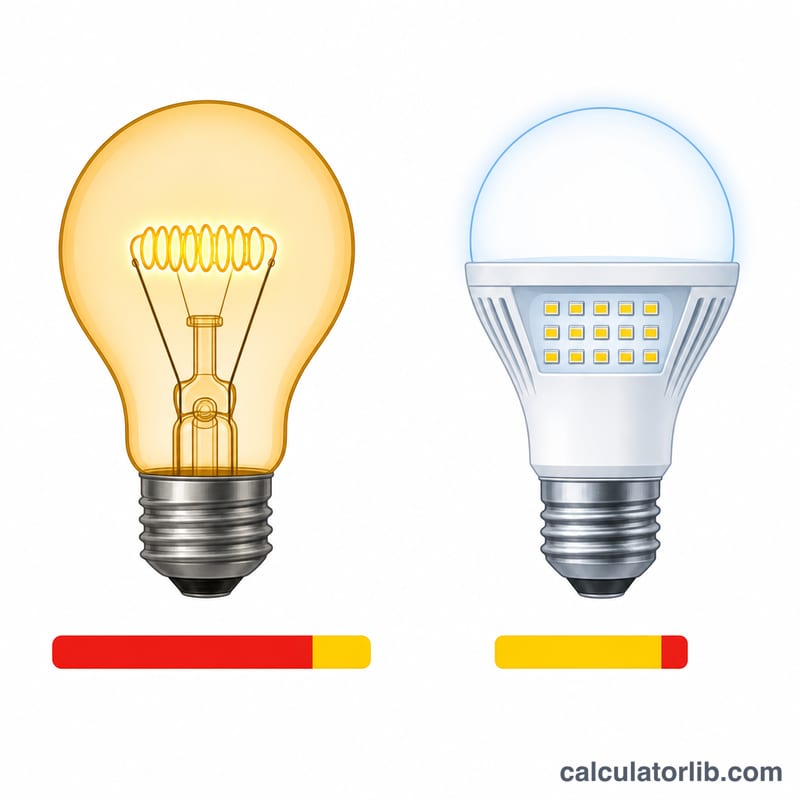
The LED Equivalent Wattage Calculator tells you which LED bulb will replace your old incandescent bulb while producing roughly the same amount of light. Instead of comparing watts (a measure of power), it compares lumens (a measure of brightness), then converts that light output into the much smaller wattage an LED needs to produce it.
How to Use It
Enter the wattage of your incandescent bulb (for example 60 W). The calculator estimates its light output using a typical incandescent efficacy of about 14 lumens per watt. It then divides those lumens by the efficacy of a modern LED (commonly 80–100 lm/W) to find the equivalent LED wattage. You can adjust both efficacy values if your bulbs differ.
The Formula Explained
First, lumens are estimated: $$\text{Lumens} = \text{Incandescent Watts} \times \text{Incandescent Efficacy}$$. Then the LED wattage needed for that brightness is: $$\text{LED Watts} = \text{Lumens} \div \text{LED Efficacy}$$. Because LEDs convert electricity to light far more efficiently, the resulting wattage is a fraction of the original.
Worked Example
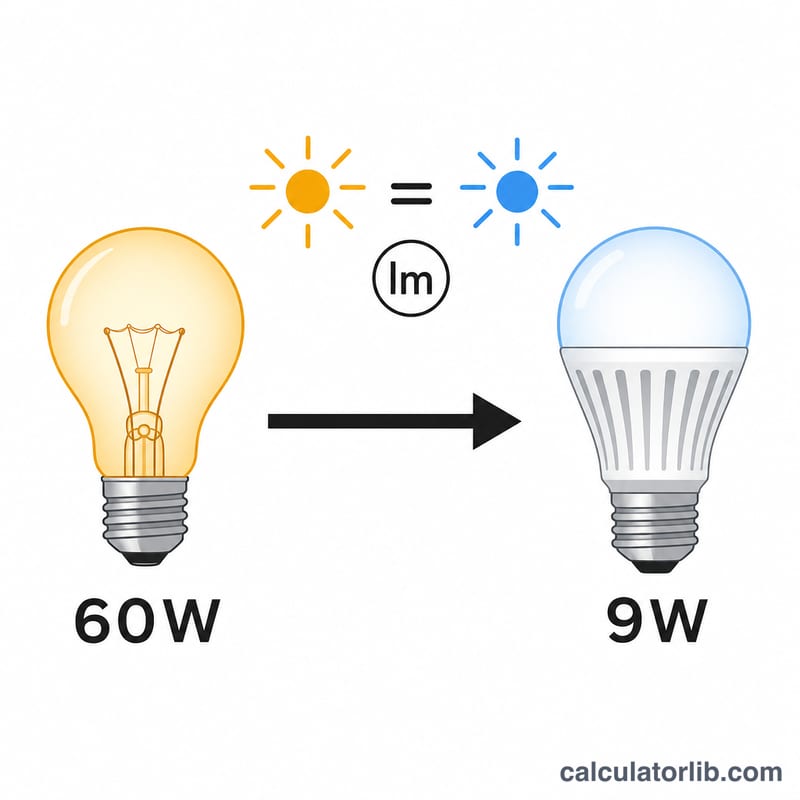
A 60 W incandescent bulb at 14 lm/W produces about $$60 \times 14 = 840 \text{ lumens}.$$ Dividing by an LED efficacy of 90 lm/W gives $$840 \div 90 \approx 9.3 \text{ W}.$$ So a ~9 W LED replaces a 60 W incandescent, cutting power use by roughly 84%.
FAQ
Why don't LEDs match incandescent watts directly? Watts measure energy use, not brightness. LEDs achieve the same brightness with far fewer watts, which is why a 9 W LED can equal a 60 W bulb.
What efficacy should I use? Incandescent bulbs average about 10–17 lm/W (14 is a good default). Quality LEDs range from 80 to over 120 lm/W; 90 is a sensible mid-range estimate.
Are these exact numbers? They are estimates. For precise matching, check the lumen rating printed on the bulb packaging rather than relying on wattage alone.